Low Skeletal Muscle Radiodensity Predicts Response to CDK4/6 Inhibitors Plus Aromatase Inhibitors in Advanced Breast Cancer

IF 9.1 1区 医学 Q1 GERIATRICS & GERONTOLOGY Journal of Cachexia Sarcopenia and Muscle Pub Date : 2024-12-17 DOI:10.1002/jcsm.13666
Hyunwook Kim, Seungjin Baek, Sookyeong Han, Gun Min Kim, Joohyuk Sohn, Yumie Rhee, Namki Hong, Min Hwan Kim
{"title":"Low Skeletal Muscle Radiodensity Predicts Response to CDK4/6 Inhibitors Plus Aromatase Inhibitors in Advanced Breast Cancer","authors":"Hyunwook Kim,&nbsp;Seungjin Baek,&nbsp;Sookyeong Han,&nbsp;Gun Min Kim,&nbsp;Joohyuk Sohn,&nbsp;Yumie Rhee,&nbsp;Namki Hong,&nbsp;Min Hwan Kim","doi":"10.1002/jcsm.13666","DOIUrl":null,"url":null,"abstract":"<div>\n \n \n <section>\n \n <h3> Background</h3>\n \n <p>Recent evidence indicates that a dysregulated host metabolism influences treatment outcomes in patients with breast cancer. We investigated the association of computed tomography (CT)-derived body composition indices with therapeutic responses in patients with hormone receptor-positive, HER2-negative advanced breast cancer (ABC) on endocrine plus CDK4/6 inhibitor (CDK4/6i) treatment.</p>\n </section>\n \n <section>\n \n <h3> Methods</h3>\n \n <p>The study involved a retrospective cohort of patients with ABC at the Yonsei Cancer Center who received CDK4/6i and aromatase inhibitors as first-line therapy between January 2017 and October 2020. Body composition parameters were estimated from the non-enhanced CT images of the third lumbar spine by commercialized deep learning software. Patients with low skeletal muscle radiodensity (SMD) were defined as patients with SMD of low tertile (≤ 28.7 Hounsfield Units). The primary outcome was progression-free survival (PFS).</p>\n </section>\n \n <section>\n \n <h3> Results</h3>\n \n <p>Among the 247 female participants (median age, 53 years; mean body mass index [BMI], 23.7 kg/m<sup>2</sup>), 45.7% had disease progression or death during a median follow-up of 36.4 months. After adjusting for age and visceral metastasis, SMD was the only independent predictor among body composition parameters for worse PFS (adjusted hazard ratio [HR] = 1.20 per standard deviation decrement, 95% CI: 1.01–1.42, <i>p</i> = 0.041), whereas BMI, muscle area, and fat area were not. Participants with low SMD had a higher risk of progression than those without (PFS, 27.2 vs. 51.1 months, <i>p</i> = 0.009; adjusted HR 1.84, 95% CI: 1.22–2.76, <i>p</i> = 0.003). Strong associations between low SMD and poor PFS were observed in groups with pre-menopause status (HR, 3.04 vs. 1.19 in post-menopause; 95% CI: 1.54–5.99, <i>p</i> for interaction &lt; 0.05) and without visceral metastases (HR, 2.95 vs. 1.19 in with visceral metastases; 95% CI: 1.59–5.49, <i>p</i> for interaction &lt; 0.05).</p>\n </section>\n \n <section>\n \n <h3> Conclusions</h3>\n \n <p>CT-defined low SMD predicts poor treatment outcomes in patients with ABC undergoing first-line treatment with aromatase inhibitors and CDK4/6i.</p>\n </section>\n </div>","PeriodicalId":48911,"journal":{"name":"Journal of Cachexia Sarcopenia and Muscle","volume":"16 1","pages":""},"PeriodicalIF":9.1000,"publicationDate":"2024-12-17","publicationTypes":"Journal Article","fieldsOfStudy":null,"isOpenAccess":false,"openAccessPdf":"https://onlinelibrary.wiley.com/doi/epdf/10.1002/jcsm.13666","citationCount":"0","resultStr":null,"platform":"Semanticscholar","paperid":null,"PeriodicalName":"Journal of Cachexia Sarcopenia and Muscle","FirstCategoryId":"3","ListUrlMain":"https://onlinelibrary.wiley.com/doi/10.1002/jcsm.13666","RegionNum":1,"RegionCategory":"医学","ArticlePicture":[],"TitleCN":null,"AbstractTextCN":null,"PMCID":null,"EPubDate":"","PubModel":"","JCR":"Q1","JCRName":"GERIATRICS & GERONTOLOGY","Score":null,"Total":0}
引用次数: 0

Abstract

Background

Recent evidence indicates that a dysregulated host metabolism influences treatment outcomes in patients with breast cancer. We investigated the association of computed tomography (CT)-derived body composition indices with therapeutic responses in patients with hormone receptor-positive, HER2-negative advanced breast cancer (ABC) on endocrine plus CDK4/6 inhibitor (CDK4/6i) treatment.

Methods

The study involved a retrospective cohort of patients with ABC at the Yonsei Cancer Center who received CDK4/6i and aromatase inhibitors as first-line therapy between January 2017 and October 2020. Body composition parameters were estimated from the non-enhanced CT images of the third lumbar spine by commercialized deep learning software. Patients with low skeletal muscle radiodensity (SMD) were defined as patients with SMD of low tertile (≤ 28.7 Hounsfield Units). The primary outcome was progression-free survival (PFS).

Results

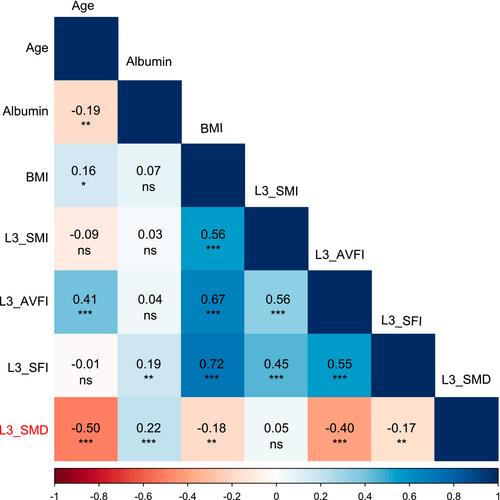
Among the 247 female participants (median age, 53 years; mean body mass index [BMI], 23.7 kg/m2), 45.7% had disease progression or death during a median follow-up of 36.4 months. After adjusting for age and visceral metastasis, SMD was the only independent predictor among body composition parameters for worse PFS (adjusted hazard ratio [HR] = 1.20 per standard deviation decrement, 95% CI: 1.01–1.42, p = 0.041), whereas BMI, muscle area, and fat area were not. Participants with low SMD had a higher risk of progression than those without (PFS, 27.2 vs. 51.1 months, p = 0.009; adjusted HR 1.84, 95% CI: 1.22–2.76, p = 0.003). Strong associations between low SMD and poor PFS were observed in groups with pre-menopause status (HR, 3.04 vs. 1.19 in post-menopause; 95% CI: 1.54–5.99, p for interaction < 0.05) and without visceral metastases (HR, 2.95 vs. 1.19 in with visceral metastases; 95% CI: 1.59–5.49, p for interaction < 0.05).

Conclusions

CT-defined low SMD predicts poor treatment outcomes in patients with ABC undergoing first-line treatment with aromatase inhibitors and CDK4/6i.
Abstract Image

查看原文
分享 分享
微信好友 朋友圈 QQ好友 复制链接
本刊更多论文
低骨骼肌放射密度预测CDK4/6抑制剂加芳香酶抑制剂对晚期乳腺癌的反应
最近的证据表明,宿主代谢失调会影响乳腺癌患者的治疗结果。我们研究了激素受体阳性、her2阴性的晚期乳腺癌(ABC)患者在接受内分泌加CDK4/6抑制剂(CDK4/6i)治疗后,计算机断层扫描(CT)衍生的身体成分指数与治疗反应的关系。
本文章由计算机程序翻译,如有差异,请以英文原文为准。
求助全文
约1分钟内获得全文 去求助
来源期刊
Journal of Cachexia Sarcopenia and Muscle
Journal of Cachexia Sarcopenia and Muscle MEDICINE, GENERAL & INTERNAL-
CiteScore
13.30
自引率
12.40%
发文量
234
审稿时长
16 weeks
期刊介绍: The Journal of Cachexia, Sarcopenia and Muscle is a peer-reviewed international journal dedicated to publishing materials related to cachexia and sarcopenia, as well as body composition and its physiological and pathophysiological changes across the lifespan and in response to various illnesses from all fields of life sciences. The journal aims to provide a reliable resource for professionals interested in related research or involved in the clinical care of affected patients, such as those suffering from AIDS, cancer, chronic heart failure, chronic lung disease, liver cirrhosis, chronic kidney failure, rheumatoid arthritis, or sepsis.
期刊最新文献
Correction to ‘Determination of Ultrasound Reference Values for Diagnosing Low Muscle Mass in Older Chinese Adults’ Cancer Cachexia Prevalence Is Underestimated in Medical Records of Patients in a Regional Tertiary Hospital Comment on ‘Muscle-Specific Strength Better Predicts Physical Performance Decline Than Conventional Metrics: The I-Lan Longitudinal Aging Study’ by Chien et al.—The Authors Reply Physical Fitness and Physical Function in Patients With Fabry Disease: A Cross-Sectional Multicentre Study Menopause, Female Sex Hormones, Skeletal Muscle Mass and Muscle Protein Turnover in Humans
×
引用
GB/T 7714-2015
复制
MLA
复制
APA
复制
导出至
BibTeX EndNote RefMan NoteFirst NoteExpress
×
×
提示
您的信息不完整,为了账户安全,请先补充。
现在去补充
×
提示
您因"违规操作"
具体请查看互助需知
我知道了
×
提示
现在去查看 取消
×
提示
确定
0
微信
客服QQ
Book学术公众号 扫码关注我们
反馈
×
意见反馈
请填写您的意见或建议
请填写您的手机或邮箱
已复制链接
已复制链接
快去分享给好友吧!
我知道了
×
扫码分享
扫码分享
Book学术官方微信
Book学术文献互助
Book学术文献互助群
群 号:604180095
Book学术
文献互助 智能选刊 最新文献 互助须知 联系我们:info@booksci.cn
Book学术提供免费学术资源搜索服务,方便国内外学者检索中英文文献。致力于提供最便捷和优质的服务体验。
Copyright © 2023 Book学术 All rights reserved.
ghs 京公网安备 11010802042870号 京ICP备2023020795号-1





