{"title":"Efficient Cellobiose Hydrolysis over a Sulfonated Carbon Catalyst in a Spatially Separated Microwave Electric- and Magnetic-Field Flow Reactor","authors":"Shuntaro Tsubaki, Kazuaki Senda, Ayumu Onda, Satoshi Fujii","doi":"10.1021/acssuschemeng.4c07690","DOIUrl":null,"url":null,"abstract":"Enhanced polysaccharide hydrolysis is essential for converting polysaccharides into mono- and oligosaccharide sugars for use in food, pharmaceutical, and biobased chemical applications. In this study, we developed an efficient continuous-flow hydrolysis process by applying microwaves and sulfonated carbon catalyst (AC-SO<sub>3</sub>H) using cellobiose as a model sugar substrate. We built a microwave flow reactor equipped with a rectangular waveguide and a solid-state microwave generator capable of applying microwaves to a fixed catalyst bed with spatially separated electric (<i>E</i>-) and magnetic (<i>H</i>-) fields and showed that the microwave flow reaction under the <i>E</i>-field improves the glucose formation rate up to 21.7 mmol/g per hour, which is 35.3 times higher than that achieved in the batch microwave reactor. AC-SO<sub>3</sub>H showed 16–30 times higher activity than Amberlyst 70 because of the higher dielectric loss tangent (tan δ) value of AC-SO<sub>3</sub>H (0.187) than Amberlyst 70 (0.040). <i>H</i>-field heating of AC-SO<sub>3</sub>H also improved the glucose formation rate by 1.2–1.6 times. Notably, the <i>H</i>-field reduced the microwave power to 45% of that of the <i>E</i>-field. Therefore, a microwave <i>H</i>-field flow reactor equipped with an AC-SO<sub>3</sub>H catalyst greatly improves both the glucose production rate and energy efficiency of cellobiose hydrolysis.","PeriodicalId":25,"journal":{"name":"ACS Sustainable Chemistry & Engineering","volume":"22 1","pages":""},"PeriodicalIF":7.3000,"publicationDate":"2024-12-16","publicationTypes":"Journal Article","fieldsOfStudy":null,"isOpenAccess":false,"openAccessPdf":"","citationCount":"0","resultStr":null,"platform":"Semanticscholar","paperid":null,"PeriodicalName":"ACS Sustainable Chemistry & Engineering","FirstCategoryId":"92","ListUrlMain":"https://doi.org/10.1021/acssuschemeng.4c07690","RegionNum":1,"RegionCategory":"化学","ArticlePicture":[],"TitleCN":null,"AbstractTextCN":null,"PMCID":null,"EPubDate":"","PubModel":"","JCR":"Q1","JCRName":"CHEMISTRY, MULTIDISCIPLINARY","Score":null,"Total":0}
引用次数: 0
Abstract
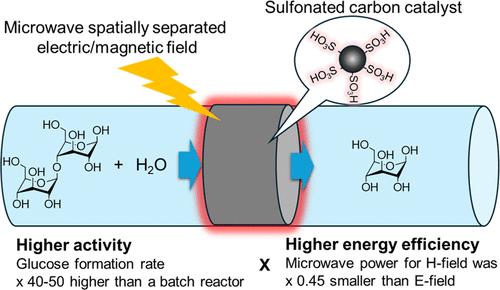
Enhanced polysaccharide hydrolysis is essential for converting polysaccharides into mono- and oligosaccharide sugars for use in food, pharmaceutical, and biobased chemical applications. In this study, we developed an efficient continuous-flow hydrolysis process by applying microwaves and sulfonated carbon catalyst (AC-SO3H) using cellobiose as a model sugar substrate. We built a microwave flow reactor equipped with a rectangular waveguide and a solid-state microwave generator capable of applying microwaves to a fixed catalyst bed with spatially separated electric (E-) and magnetic (H-) fields and showed that the microwave flow reaction under the E-field improves the glucose formation rate up to 21.7 mmol/g per hour, which is 35.3 times higher than that achieved in the batch microwave reactor. AC-SO3H showed 16–30 times higher activity than Amberlyst 70 because of the higher dielectric loss tangent (tan δ) value of AC-SO3H (0.187) than Amberlyst 70 (0.040). H-field heating of AC-SO3H also improved the glucose formation rate by 1.2–1.6 times. Notably, the H-field reduced the microwave power to 45% of that of the E-field. Therefore, a microwave H-field flow reactor equipped with an AC-SO3H catalyst greatly improves both the glucose production rate and energy efficiency of cellobiose hydrolysis.
期刊介绍:
ACS Sustainable Chemistry & Engineering is a prestigious weekly peer-reviewed scientific journal published by the American Chemical Society. Dedicated to advancing the principles of green chemistry and green engineering, it covers a wide array of research topics including green chemistry, green engineering, biomass, alternative energy, and life cycle assessment.
The journal welcomes submissions in various formats, including Letters, Articles, Features, and Perspectives (Reviews), that address the challenges of sustainability in the chemical enterprise and contribute to the advancement of sustainable practices. Join us in shaping the future of sustainable chemistry and engineering.




 京公网安备 11010802042870号
京ICP备2023020795号-1
京公网安备 11010802042870号
京ICP备2023020795号-1

 分享
分享
 求助内容:
求助内容: 应助结果提醒方式:
 扫码关注我们
