{"title":"Inhibitory Effects of Gliadin Hydrolysates on BACE1 Expression and APP Processing to Prevent Aβ Aggregation.","authors":"Chin-Yu Lin, Cheng-Hong Hsieh, Pei-Yu Lai, Ching-Wei Huang, Yung-Hui Chung, Shang-Ming Huang, Kuo-Chiang Hsu","doi":"10.3390/ijms252313212","DOIUrl":null,"url":null,"abstract":"<p><p>Alzheimer's disease (AD), a leading neurodegenerative disorder, is closely associated with the accumulation of amyloid-beta (Aβ) peptides in the brain. The enzyme β-secretase (BACE1), pivotal in Aβ production, represents a promising therapeutic target for AD. While bioactive peptides derived from food protein hydrolysates have neuroprotective properties, their inhibitory effects on BACE1 remain largely unexplored. In this study, we evaluated the inhibitory potential of protein hydrolysates from gliadin, whey, and casein proteins prepared using bromelain, papain, and thermolysin. Through in vitro and cellular assays, bromelain-hydrolyzed gliadin (G-Bro) emerged as the most potent BACE1 inhibitor, with an IC<sub>50</sub> of 0.408 mg/mL. G-Bro significantly reduced BACE1 expression and amyloid precursor protein (APP) processing in N2a/PS/APP cell cultures, suggesting its potential to attenuate Aβ aggregation. The unique peptide profile of G-Bro likely contributes to its inhibitory effect, with proline residues disrupting β-sheets, lysine residues introducing positive charges that hinder aggregation, hydrophobic residues stabilizing binding interactions, and glutamine residues enhancing solubility and stability. These findings highlight gliadin hydrolysates, particularly G-Bro, as potential natural BACE1 inhibitors with applications in dietary interventions for AD prevention. However, further studies are warranted to elucidate specific peptide interactions and their bioactivity in neural pathways to better understand their therapeutic potential.</p>","PeriodicalId":14156,"journal":{"name":"International Journal of Molecular Sciences","volume":"25 23","pages":""},"PeriodicalIF":4.9000,"publicationDate":"2024-12-09","publicationTypes":"Journal Article","fieldsOfStudy":null,"isOpenAccess":false,"openAccessPdf":"https://www.ncbi.nlm.nih.gov/pmc/articles/PMC11642305/pdf/","citationCount":"0","resultStr":null,"platform":"Semanticscholar","paperid":null,"PeriodicalName":"International Journal of Molecular Sciences","FirstCategoryId":"99","ListUrlMain":"https://doi.org/10.3390/ijms252313212","RegionNum":2,"RegionCategory":"生物学","ArticlePicture":[],"TitleCN":null,"AbstractTextCN":null,"PMCID":null,"EPubDate":"","PubModel":"","JCR":"","JCRName":"","Score":null,"Total":0}
引用次数: 0
Abstract
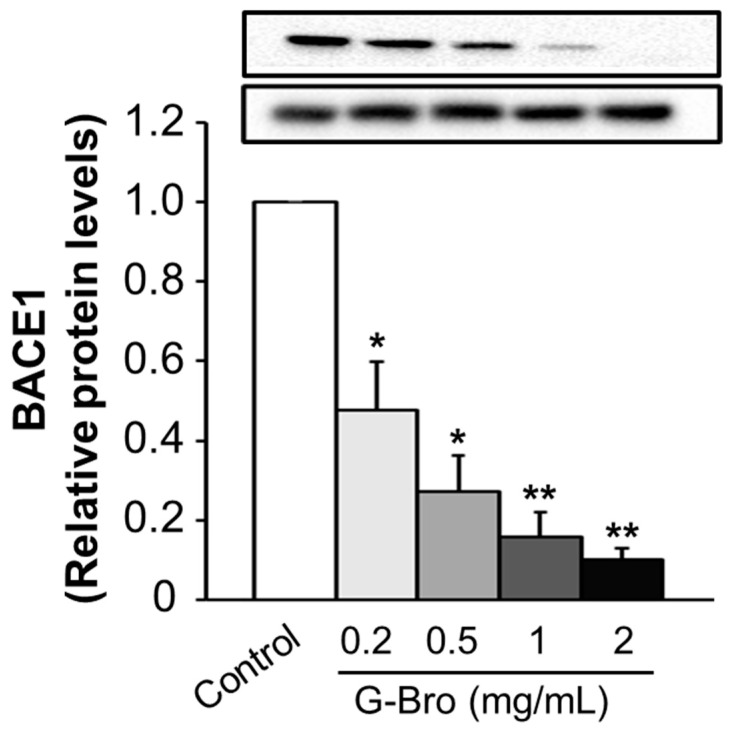
Alzheimer's disease (AD), a leading neurodegenerative disorder, is closely associated with the accumulation of amyloid-beta (Aβ) peptides in the brain. The enzyme β-secretase (BACE1), pivotal in Aβ production, represents a promising therapeutic target for AD. While bioactive peptides derived from food protein hydrolysates have neuroprotective properties, their inhibitory effects on BACE1 remain largely unexplored. In this study, we evaluated the inhibitory potential of protein hydrolysates from gliadin, whey, and casein proteins prepared using bromelain, papain, and thermolysin. Through in vitro and cellular assays, bromelain-hydrolyzed gliadin (G-Bro) emerged as the most potent BACE1 inhibitor, with an IC50 of 0.408 mg/mL. G-Bro significantly reduced BACE1 expression and amyloid precursor protein (APP) processing in N2a/PS/APP cell cultures, suggesting its potential to attenuate Aβ aggregation. The unique peptide profile of G-Bro likely contributes to its inhibitory effect, with proline residues disrupting β-sheets, lysine residues introducing positive charges that hinder aggregation, hydrophobic residues stabilizing binding interactions, and glutamine residues enhancing solubility and stability. These findings highlight gliadin hydrolysates, particularly G-Bro, as potential natural BACE1 inhibitors with applications in dietary interventions for AD prevention. However, further studies are warranted to elucidate specific peptide interactions and their bioactivity in neural pathways to better understand their therapeutic potential.
期刊介绍:
The International Journal of Molecular Sciences (ISSN 1422-0067) provides an advanced forum for chemistry, molecular physics (chemical physics and physical chemistry) and molecular biology. It publishes research articles, reviews, communications and short notes. Our aim is to encourage scientists to publish their theoretical and experimental results in as much detail as possible. Therefore, there is no restriction on the length of the papers or the number of electronics supplementary files. For articles with computational results, the full experimental details must be provided so that the results can be reproduced. Electronic files regarding the full details of the calculation and experimental procedure, if unable to be published in a normal way, can be deposited as supplementary material (including animated pictures, videos, interactive Excel sheets, software executables and others).





 京公网安备 11010802042870号
京ICP备2023020795号-1
京公网安备 11010802042870号
京ICP备2023020795号-1

 分享
分享
 求助内容:
求助内容: 应助结果提醒方式:
 扫码关注我们
