Sara Araújo, Ana Paula Neto, Maria João Pinho, Sofia Dória, Alberto Barros, Filipa Carvalho
{"title":"Genetic study on candidates for oocyte donation.","authors":"Sara Araújo, Ana Paula Neto, Maria João Pinho, Sofia Dória, Alberto Barros, Filipa Carvalho","doi":"10.5935/1518-0557.20240087","DOIUrl":null,"url":null,"abstract":"<p><strong>Objective: </strong>There is a rising demand for assisted reproductive medicine, including sperm, oocyte and embryo donation. Besides medical and legal considerations, genetic testing, including carrier screening for multiple autosomal and X-linked recessive disorders plays an essential role in evaluating hereditary risk among donors and therefore exclude them from the donation process.</p><p><strong>Methods: </strong>A retrospective study was conducted on oocyte donors from a private clinic of assisted reproduction who underwent genetic testing between June 2014 and September 2023. Pre and post-test procedures were performed at the private clinic while karyotyping and carrier screening for Cystic Fibrosis, Fragile X syndrome and Spinal Muscular Atrophy were performed at the Genetic Unit of Faculty of Medicine, University of Porto.</p><p><strong>Results: </strong>Among 581 donors, 81 women were excluded from the donation process since 5/563 had an alteration in karyotype, 57/581 were carriers of a Cystic Fibrosis Transmembrane conductance Regulator pathogenic variant or had a 5T allele, 11/394 had Survival of Motor Neuron 1 deletion and 8/426 had an intermediate or premutation allele in Fragile X Messenger Ribonucleoprotein gene. While recommendations from fertility societies advocate for comprehensive screening, opinions differ on the mandatory implementation of expanded carrier screening.</p><p><strong>Conclusions: </strong>In conclusion, the genetic tests and the pre and post-test counseling is imperative to optimize reproductive outcomes in the oocyte donation process.</p>","PeriodicalId":46364,"journal":{"name":"Jornal Brasileiro de Reproducao Assistida","volume":" ","pages":"61-66"},"PeriodicalIF":1.7000,"publicationDate":"2025-03-12","publicationTypes":"Journal Article","fieldsOfStudy":null,"isOpenAccess":false,"openAccessPdf":"https://www.ncbi.nlm.nih.gov/pmc/articles/PMC11867239/pdf/","citationCount":"0","resultStr":null,"platform":"Semanticscholar","paperid":null,"PeriodicalName":"Jornal Brasileiro de Reproducao Assistida","FirstCategoryId":"1085","ListUrlMain":"https://doi.org/10.5935/1518-0557.20240087","RegionNum":0,"RegionCategory":null,"ArticlePicture":[],"TitleCN":null,"AbstractTextCN":null,"PMCID":null,"EPubDate":"","PubModel":"","JCR":"Q3","JCRName":"OBSTETRICS & GYNECOLOGY","Score":null,"Total":0}
引用次数: 0
Abstract
Objective: There is a rising demand for assisted reproductive medicine, including sperm, oocyte and embryo donation. Besides medical and legal considerations, genetic testing, including carrier screening for multiple autosomal and X-linked recessive disorders plays an essential role in evaluating hereditary risk among donors and therefore exclude them from the donation process.
Methods: A retrospective study was conducted on oocyte donors from a private clinic of assisted reproduction who underwent genetic testing between June 2014 and September 2023. Pre and post-test procedures were performed at the private clinic while karyotyping and carrier screening for Cystic Fibrosis, Fragile X syndrome and Spinal Muscular Atrophy were performed at the Genetic Unit of Faculty of Medicine, University of Porto.
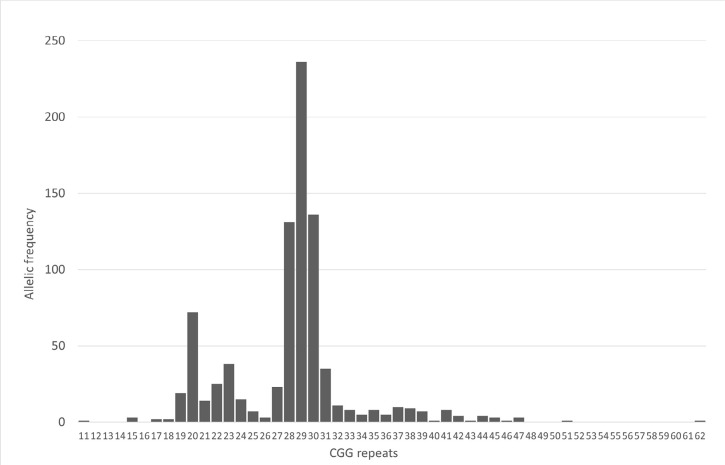
Results: Among 581 donors, 81 women were excluded from the donation process since 5/563 had an alteration in karyotype, 57/581 were carriers of a Cystic Fibrosis Transmembrane conductance Regulator pathogenic variant or had a 5T allele, 11/394 had Survival of Motor Neuron 1 deletion and 8/426 had an intermediate or premutation allele in Fragile X Messenger Ribonucleoprotein gene. While recommendations from fertility societies advocate for comprehensive screening, opinions differ on the mandatory implementation of expanded carrier screening.
Conclusions: In conclusion, the genetic tests and the pre and post-test counseling is imperative to optimize reproductive outcomes in the oocyte donation process.





 京公网安备 11010802042870号
京ICP备2023020795号-1
京公网安备 11010802042870号
京ICP备2023020795号-1

 分享
分享
 求助内容:
求助内容: 应助结果提醒方式:
 扫码关注我们
