Dan Denis, Carissa DiPietro, R Nathan Spreng, Daniel L Schacter, Robert Stickgold, Jessica D Payne
{"title":"Sleep and retrieval practice both strengthen and distort story recollection.","authors":"Dan Denis, Carissa DiPietro, R Nathan Spreng, Daniel L Schacter, Robert Stickgold, Jessica D Payne","doi":"10.1093/sleepadvances/zpae083","DOIUrl":null,"url":null,"abstract":"<p><p>Over time, memories lose episodic detail and become distorted, a process with serious ramifications for eyewitness identification. What are the processes contributing to such transformations over time? We investigated the roles of post-learning sleep and retrieval practice in memory accuracy and distortion, using a naturalistic story recollection task. Undergraduate students listened to a recording of the \"War of the Ghosts,\" a Native American folktale, and were assigned to either a sleep or wake delay group, and either a retrieval practice or listen-only study condition. We found higher accuracy after sleep compared to wake in the listen-only condition, but not in the retrieval practice condition. This effect was driven by participants in the wake, retrieval practice condition showing superior memory compared to the wake, listen-only condition. A similar pattern was found for memory distortion, with both sleep and retrieval practice being associated with more inferences of nonpresented, but story-related information, compared to the wake, listen-only condition. These findings suggest both sleep and retrieval practice contribute to narrative memory stabilization and distortion.</p>","PeriodicalId":74808,"journal":{"name":"Sleep advances : a journal of the Sleep Research Society","volume":"5 1","pages":"zpae083"},"PeriodicalIF":0.0000,"publicationDate":"2024-11-16","publicationTypes":"Journal Article","fieldsOfStudy":null,"isOpenAccess":false,"openAccessPdf":"https://www.ncbi.nlm.nih.gov/pmc/articles/PMC11648565/pdf/","citationCount":"0","resultStr":null,"platform":"Semanticscholar","paperid":null,"PeriodicalName":"Sleep advances : a journal of the Sleep Research Society","FirstCategoryId":"1085","ListUrlMain":"https://doi.org/10.1093/sleepadvances/zpae083","RegionNum":0,"RegionCategory":null,"ArticlePicture":[],"TitleCN":null,"AbstractTextCN":null,"PMCID":null,"EPubDate":"2024/1/1 0:00:00","PubModel":"eCollection","JCR":"","JCRName":"","Score":null,"Total":0}
引用次数: 0
Abstract
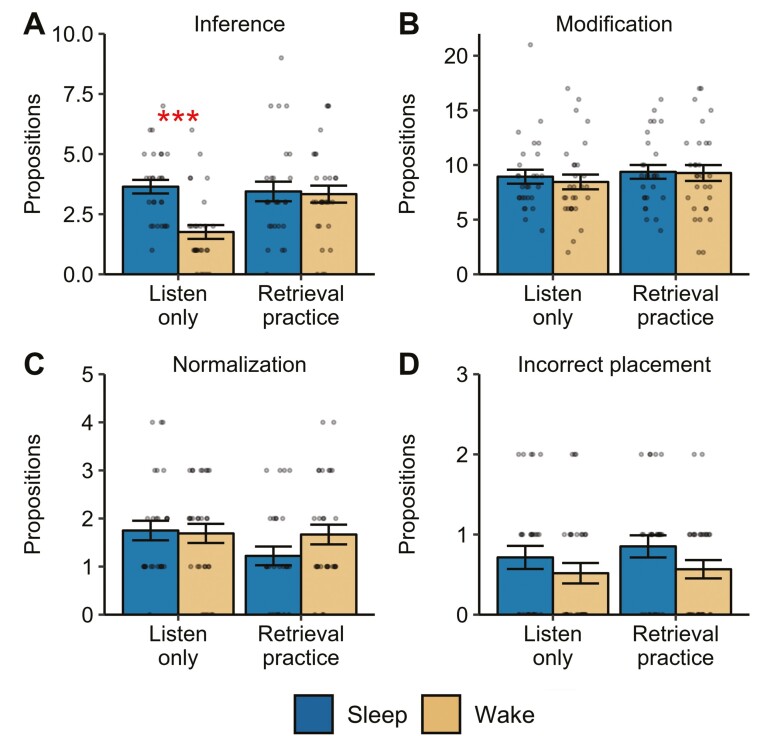
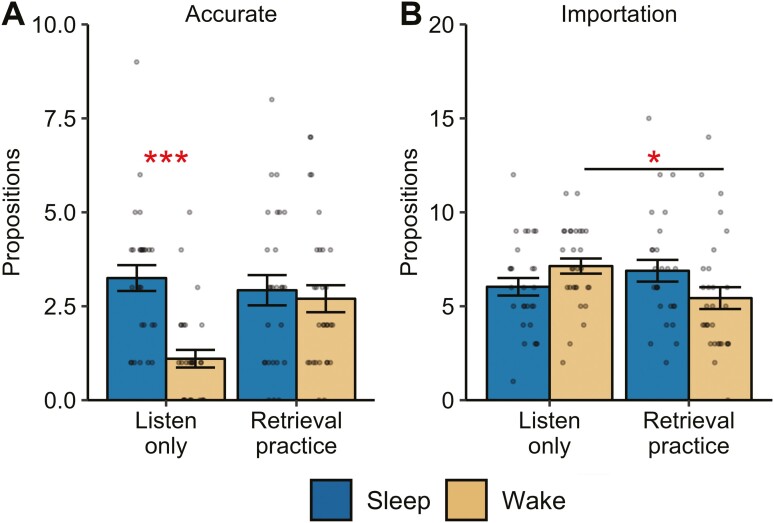
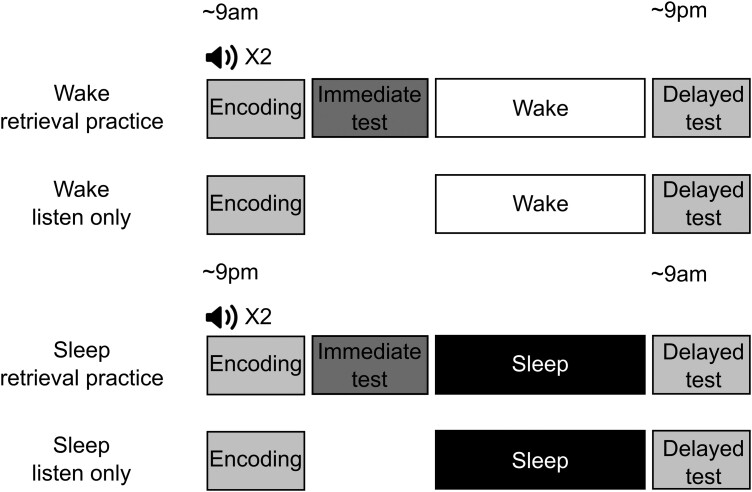
Over time, memories lose episodic detail and become distorted, a process with serious ramifications for eyewitness identification. What are the processes contributing to such transformations over time? We investigated the roles of post-learning sleep and retrieval practice in memory accuracy and distortion, using a naturalistic story recollection task. Undergraduate students listened to a recording of the "War of the Ghosts," a Native American folktale, and were assigned to either a sleep or wake delay group, and either a retrieval practice or listen-only study condition. We found higher accuracy after sleep compared to wake in the listen-only condition, but not in the retrieval practice condition. This effect was driven by participants in the wake, retrieval practice condition showing superior memory compared to the wake, listen-only condition. A similar pattern was found for memory distortion, with both sleep and retrieval practice being associated with more inferences of nonpresented, but story-related information, compared to the wake, listen-only condition. These findings suggest both sleep and retrieval practice contribute to narrative memory stabilization and distortion.



 京公网安备 11010802042870号
京ICP备2023020795号-1
京公网安备 11010802042870号
京ICP备2023020795号-1

 分享
分享

 求助内容:
求助内容: 应助结果提醒方式:
 扫码关注我们
