Vijayakumar G Gayathri, Bartholomew Richard, Jithin Thomas Chacko, Jagadeesh Bayry and P Abdul Rasheed
{"title":"Non-Ti MXenes: new biocompatible and biodegradable candidates for biomedical applications","authors":"Vijayakumar G Gayathri, Bartholomew Richard, Jithin Thomas Chacko, Jagadeesh Bayry and P Abdul Rasheed","doi":"10.1039/D4TB01904K","DOIUrl":null,"url":null,"abstract":"<p >MXenes are a class of two-dimensional nanomaterials with the general formula M<small><sub><em>n</em>+1</sub></small>X<small><sub><em>n</em></sub></small>T<small><sub><em>x</em></sub></small>, where M denotes a transition metal, X denotes either carbon or nitrogen and T<small><sub><em>x</em></sub></small> refers to surface terminations, such as –OH, –O, –F or –Cl. The unique properties of MXenes, including their tunable surface chemistry and high surface area-to-volume ratio, make them promising candidates for various biomedical applications, such as targeted drug delivery, photothermal therapy and so on. Among the family of MXenes, titanium (Ti)-based MXenes, especially Ti<small><sub>3</sub></small>C<small><sub>2</sub></small>T<small><sub><em>x</em></sub></small>, have been extensively explored for biomedical applications. However, despite their potential, Ti-based MXenes have shown some limitations, such as low biocompatibility. Recent studies have also indicated that Ti MXenes may disrupt spermatogenesis and accumulate in the uterus. Non-Ti MXenes are emerging as promising alternatives to Ti-based MXenes due to their superior biodegradability and enhanced biocompatibility. Recently, non-Ti MXenes have been explored for a range of biomedical applications, including drug delivery, photothermal therapy, chemodynamic therapy and sonodynamic therapy. In addition, some non-Ti MXenes exhibit enzyme-mimicking activity, such as superoxide dismutase and peroxidase-like functions, which play a major role in scavenging reactive oxygen species (ROS). This review discusses the properties of non-Ti MXenes, such as biocompatibility, biodegradability, antibacterial activity, and neuroprotective effects, highlighting their potential in various biomedical applications. These properties can be leveraged to mitigate oxidative stress and develop safe and innovative strategies for managing chronic diseases. This review provides a comprehensive analysis of the various biomedical applications of non-Ti MXenes, including their use in drug delivery and combinatorial therapies and as nanozymes for sensing and therapeutic purposes. The theranostic applications of non-Ti MXenes are also discussed. Finally, the antibacterial properties of non-Ti MXenes and the proposed mechanisms are discussed. The review concludes with a summary of the key findings and future perspectives. In short, this review provides a thorough analysis of the biomedical applications of non-Ti MXenes, emphasizing their unique properties, potential opportunities and challenges in the field.</p>","PeriodicalId":83,"journal":{"name":"Journal of Materials Chemistry B","volume":" 4","pages":" 1212-1228"},"PeriodicalIF":6.1000,"publicationDate":"2024-12-03","publicationTypes":"Journal Article","fieldsOfStudy":null,"isOpenAccess":false,"openAccessPdf":"https://pubs.rsc.org/en/content/articlepdf/2025/tb/d4tb01904k?page=search","citationCount":"0","resultStr":null,"platform":"Semanticscholar","paperid":null,"PeriodicalName":"Journal of Materials Chemistry B","FirstCategoryId":"1","ListUrlMain":"https://pubs.rsc.org/en/content/articlelanding/2025/tb/d4tb01904k","RegionNum":3,"RegionCategory":"医学","ArticlePicture":[],"TitleCN":null,"AbstractTextCN":null,"PMCID":null,"EPubDate":"","PubModel":"","JCR":"Q1","JCRName":"MATERIALS SCIENCE, BIOMATERIALS","Score":null,"Total":0}
引用次数: 0
Abstract
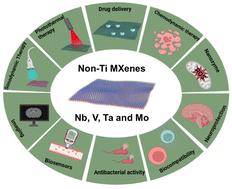
MXenes are a class of two-dimensional nanomaterials with the general formula Mn+1XnTx, where M denotes a transition metal, X denotes either carbon or nitrogen and Tx refers to surface terminations, such as –OH, –O, –F or –Cl. The unique properties of MXenes, including their tunable surface chemistry and high surface area-to-volume ratio, make them promising candidates for various biomedical applications, such as targeted drug delivery, photothermal therapy and so on. Among the family of MXenes, titanium (Ti)-based MXenes, especially Ti3C2Tx, have been extensively explored for biomedical applications. However, despite their potential, Ti-based MXenes have shown some limitations, such as low biocompatibility. Recent studies have also indicated that Ti MXenes may disrupt spermatogenesis and accumulate in the uterus. Non-Ti MXenes are emerging as promising alternatives to Ti-based MXenes due to their superior biodegradability and enhanced biocompatibility. Recently, non-Ti MXenes have been explored for a range of biomedical applications, including drug delivery, photothermal therapy, chemodynamic therapy and sonodynamic therapy. In addition, some non-Ti MXenes exhibit enzyme-mimicking activity, such as superoxide dismutase and peroxidase-like functions, which play a major role in scavenging reactive oxygen species (ROS). This review discusses the properties of non-Ti MXenes, such as biocompatibility, biodegradability, antibacterial activity, and neuroprotective effects, highlighting their potential in various biomedical applications. These properties can be leveraged to mitigate oxidative stress and develop safe and innovative strategies for managing chronic diseases. This review provides a comprehensive analysis of the various biomedical applications of non-Ti MXenes, including their use in drug delivery and combinatorial therapies and as nanozymes for sensing and therapeutic purposes. The theranostic applications of non-Ti MXenes are also discussed. Finally, the antibacterial properties of non-Ti MXenes and the proposed mechanisms are discussed. The review concludes with a summary of the key findings and future perspectives. In short, this review provides a thorough analysis of the biomedical applications of non-Ti MXenes, emphasizing their unique properties, potential opportunities and challenges in the field.
期刊介绍:
Journal of Materials Chemistry A, B & C cover high quality studies across all fields of materials chemistry. The journals focus on those theoretical or experimental studies that report new understanding, applications, properties and synthesis of materials. Journal of Materials Chemistry A, B & C are separated by the intended application of the material studied. Broadly, applications in energy and sustainability are of interest to Journal of Materials Chemistry A, applications in biology and medicine are of interest to Journal of Materials Chemistry B, and applications in optical, magnetic and electronic devices are of interest to Journal of Materials Chemistry C.Journal of Materials Chemistry B is a Transformative Journal and Plan S compliant. Example topic areas within the scope of Journal of Materials Chemistry B are listed below. This list is neither exhaustive nor exclusive:
Antifouling coatings
Biocompatible materials
Bioelectronics
Bioimaging
Biomimetics
Biomineralisation
Bionics
Biosensors
Diagnostics
Drug delivery
Gene delivery
Immunobiology
Nanomedicine
Regenerative medicine & Tissue engineering
Scaffolds
Soft robotics
Stem cells
Therapeutic devices



 京公网安备 11010802042870号
京ICP备2023020795号-1
京公网安备 11010802042870号
京ICP备2023020795号-1

 分享
分享
 求助内容:
求助内容: 应助结果提醒方式:
 扫码关注我们
