Justina F. Avila-Rieger, Paris B. Adkins-Jackson, Tanisha G. Hill-Jarrett, Whitney R. Robinson, Katherine M. Keyes, Nicole Schupf, Adam M. Brickman, Richard P. Mayeux, Jennifer J. Manly
{"title":"Early life exposure to structural sexism and late-life memory trajectories among black and white women and men in the United States","authors":"Justina F. Avila-Rieger, Paris B. Adkins-Jackson, Tanisha G. Hill-Jarrett, Whitney R. Robinson, Katherine M. Keyes, Nicole Schupf, Adam M. Brickman, Richard P. Mayeux, Jennifer J. Manly","doi":"10.1002/alz.14410","DOIUrl":null,"url":null,"abstract":"<div>\n \n \n <section>\n \n <h3> INTRODUCTION</h3>\n \n <p>We investigated whether early life exposure to state-level structural sexism influenced late-life memory trajectories among United Staes (U.S.) -born women and men and determined whether associations differed between racialized groups.</p>\n </section>\n \n <section>\n \n <h3> METHODS</h3>\n \n <p>Participants were from the Washington Heights-Inwood Columbia Aging Project (WHICAP; <i>N </i>= 2314) and Health and Retirement Study (HRS; <i>N </i>= 18,631). State-level structural sexism was measured via U.S. census and administrative data and linked to participants in each study by birth year and state.</p>\n </section>\n \n <section>\n \n <h3> RESULTS</h3>\n \n <p>Exposure to greater structural sexism was associated with lower baseline memory performance among WHICAP women and HRS men and faster memory decline among women in both studies. Women born in the state with the highest structural sexism showed memory decline like that of those who were 9 years older. Structural sexism-baseline memory associations were stronger among Black women than White women.</p>\n </section>\n \n <section>\n \n <h3> DISCUSSION</h3>\n \n <p>Early life exposure to structural sexism negatively impacts late-life memory trajectories among women.</p>\n </section>\n \n <section>\n \n <h3> Highlights</h3>\n \n <div>\n <ul>\n \n <li>A longitudinal measure captured state-level structural sexism from 1900 to 1960.</li>\n \n <li>Exposure to structural sexism was associated with worse late-life memory outcomes.</li>\n \n <li>Associations were strongest among women for memory decline.</li>\n \n <li>The negative impact on memory performance was stronger among Black women.</li>\n \n <li>Lowering structural sexism may, in turn, reduce memory decline among women.</li>\n </ul>\n </div>\n </section>\n </div>","PeriodicalId":7471,"journal":{"name":"Alzheimer's & Dementia","volume":"21 2","pages":""},"PeriodicalIF":11.1000,"publicationDate":"2024-12-18","publicationTypes":"Journal Article","fieldsOfStudy":null,"isOpenAccess":false,"openAccessPdf":"https://onlinelibrary.wiley.com/doi/epdf/10.1002/alz.14410","citationCount":"0","resultStr":null,"platform":"Semanticscholar","paperid":null,"PeriodicalName":"Alzheimer's & Dementia","FirstCategoryId":"3","ListUrlMain":"https://alz-journals.onlinelibrary.wiley.com/doi/10.1002/alz.14410","RegionNum":1,"RegionCategory":"医学","ArticlePicture":[],"TitleCN":null,"AbstractTextCN":null,"PMCID":null,"EPubDate":"","PubModel":"","JCR":"Q1","JCRName":"CLINICAL NEUROLOGY","Score":null,"Total":0}
引用次数: 0
Abstract
INTRODUCTION
We investigated whether early life exposure to state-level structural sexism influenced late-life memory trajectories among United Staes (U.S.) -born women and men and determined whether associations differed between racialized groups.
METHODS
Participants were from the Washington Heights-Inwood Columbia Aging Project (WHICAP; N = 2314) and Health and Retirement Study (HRS; N = 18,631). State-level structural sexism was measured via U.S. census and administrative data and linked to participants in each study by birth year and state.
RESULTS
Exposure to greater structural sexism was associated with lower baseline memory performance among WHICAP women and HRS men and faster memory decline among women in both studies. Women born in the state with the highest structural sexism showed memory decline like that of those who were 9 years older. Structural sexism-baseline memory associations were stronger among Black women than White women.
DISCUSSION
Early life exposure to structural sexism negatively impacts late-life memory trajectories among women.
Highlights
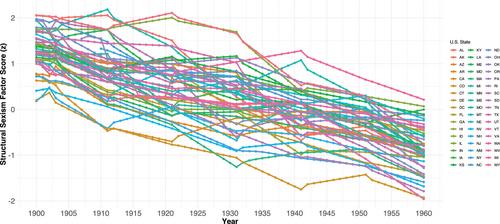
A longitudinal measure captured state-level structural sexism from 1900 to 1960.
Exposure to structural sexism was associated with worse late-life memory outcomes.
Associations were strongest among women for memory decline.
The negative impact on memory performance was stronger among Black women.
Lowering structural sexism may, in turn, reduce memory decline among women.
期刊介绍:
Alzheimer's & Dementia is a peer-reviewed journal that aims to bridge knowledge gaps in dementia research by covering the entire spectrum, from basic science to clinical trials to social and behavioral investigations. It provides a platform for rapid communication of new findings and ideas, optimal translation of research into practical applications, increasing knowledge across diverse disciplines for early detection, diagnosis, and intervention, and identifying promising new research directions. In July 2008, Alzheimer's & Dementia was accepted for indexing by MEDLINE, recognizing its scientific merit and contribution to Alzheimer's research.






 京公网安备 11010802042870号
京ICP备2023020795号-1
京公网安备 11010802042870号
京ICP备2023020795号-1

 分享
分享
 求助内容:
求助内容: 应助结果提醒方式:
 扫码关注我们
