Individual and joint associations between sleep duration and physical activity with cognitive function: A longitudinal analysis among middle-aged and older adults in China
Hongwei Liu, Yan Shi, Min Yu, Xiaolei Guo, Ye Ruan, Fei Qin, Rongfei Zhou, Jingyuan Feng, Zihan Hu, Fei Wu, Qingqing Jia, Yanlu Yin, Yanfei Guo, Fan Wu
{"title":"Individual and joint associations between sleep duration and physical activity with cognitive function: A longitudinal analysis among middle-aged and older adults in China","authors":"Hongwei Liu, Yan Shi, Min Yu, Xiaolei Guo, Ye Ruan, Fei Qin, Rongfei Zhou, Jingyuan Feng, Zihan Hu, Fei Wu, Qingqing Jia, Yanlu Yin, Yanfei Guo, Fan Wu","doi":"10.1002/alz.14212","DOIUrl":null,"url":null,"abstract":"<div>\n \n \n <section>\n \n <h3> INTRODUCTION</h3>\n \n <p>Studies using cross-sectional data or with a short follow-up period fail to distinguish whether the associations between sleep duration and physical activity with cognitive function result from reverse causation.</p>\n </section>\n \n <section>\n \n <h3> METHODS</h3>\n \n <p>The longitudinal study examined the individual and joint associations, with specific temporality, between sleep duration and physical activity with cognitive function, using time-lagged linear mixed models and generalized additive mixed models.</p>\n </section>\n \n <section>\n \n <h3> RESULTS</h3>\n \n <p>A total of 14,694 participants aged ≥ 50 years were included, with an average lagged time of 4.5 (standard deviation 1.3) years. Long sleep duration was independently associated with cognitive decline, while short sleep duration and physical activity were not. The analysis of joint effects showed that increased physical activity slowed the rate of cognitive decline among participants reporting long sleep duration, consistent with the results of the stratified analyses.</p>\n </section>\n \n <section>\n \n <h3> DISCUSSION</h3>\n \n <p>Interventions on improving sleep should consider concurrent physical activity to maximize benefits for slowing cognitive decline.</p>\n </section>\n \n <section>\n \n <h3> Highlights</h3>\n \n <div>\n <ul>\n \n <li>Long sleep duration was independently associated with worse cognitive function, while short sleep duration was not.</li>\n \n <li>Elevated levels of physical activity were not independently associated with better cognitive function.</li>\n \n <li>Increased physical activity appeared to mitigate the negative impact of long sleep duration on cognitive function.</li>\n </ul>\n </div>\n </section>\n </div>","PeriodicalId":7471,"journal":{"name":"Alzheimer's & Dementia","volume":"21 1","pages":""},"PeriodicalIF":11.1000,"publicationDate":"2024-12-18","publicationTypes":"Journal Article","fieldsOfStudy":null,"isOpenAccess":false,"openAccessPdf":"https://onlinelibrary.wiley.com/doi/epdf/10.1002/alz.14212","citationCount":"0","resultStr":null,"platform":"Semanticscholar","paperid":null,"PeriodicalName":"Alzheimer's & Dementia","FirstCategoryId":"3","ListUrlMain":"https://alz-journals.onlinelibrary.wiley.com/doi/10.1002/alz.14212","RegionNum":1,"RegionCategory":"医学","ArticlePicture":[],"TitleCN":null,"AbstractTextCN":null,"PMCID":null,"EPubDate":"","PubModel":"","JCR":"Q1","JCRName":"CLINICAL NEUROLOGY","Score":null,"Total":0}
引用次数: 0
Abstract
INTRODUCTION
Studies using cross-sectional data or with a short follow-up period fail to distinguish whether the associations between sleep duration and physical activity with cognitive function result from reverse causation.
METHODS
The longitudinal study examined the individual and joint associations, with specific temporality, between sleep duration and physical activity with cognitive function, using time-lagged linear mixed models and generalized additive mixed models.
RESULTS
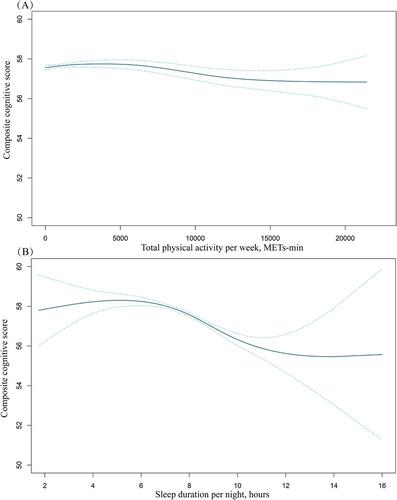
A total of 14,694 participants aged ≥ 50 years were included, with an average lagged time of 4.5 (standard deviation 1.3) years. Long sleep duration was independently associated with cognitive decline, while short sleep duration and physical activity were not. The analysis of joint effects showed that increased physical activity slowed the rate of cognitive decline among participants reporting long sleep duration, consistent with the results of the stratified analyses.
DISCUSSION
Interventions on improving sleep should consider concurrent physical activity to maximize benefits for slowing cognitive decline.
Highlights
Long sleep duration was independently associated with worse cognitive function, while short sleep duration was not.
Elevated levels of physical activity were not independently associated with better cognitive function.
Increased physical activity appeared to mitigate the negative impact of long sleep duration on cognitive function.
期刊介绍:
Alzheimer's & Dementia is a peer-reviewed journal that aims to bridge knowledge gaps in dementia research by covering the entire spectrum, from basic science to clinical trials to social and behavioral investigations. It provides a platform for rapid communication of new findings and ideas, optimal translation of research into practical applications, increasing knowledge across diverse disciplines for early detection, diagnosis, and intervention, and identifying promising new research directions. In July 2008, Alzheimer's & Dementia was accepted for indexing by MEDLINE, recognizing its scientific merit and contribution to Alzheimer's research.






 京公网安备 11010802042870号
京ICP备2023020795号-1
京公网安备 11010802042870号
京ICP备2023020795号-1

 分享
分享
 求助内容:
求助内容: 应助结果提醒方式:
 扫码关注我们
