The rice stem borer, Chilo suppressalis Walker (Lepidoptera: Crambidae), is a damaging pest of rice worldwide. Following the evolution of C. suppressalis resistance to diamide and abamectin insecticides, emamectin benzoate (EB) became a key insecticide for the control of this species in China. With the widespread use of EB, resistance has developed rapidly in some field populations of C. suppressalis. However, the molecular mechanisms underlying resistance remain unresolved.
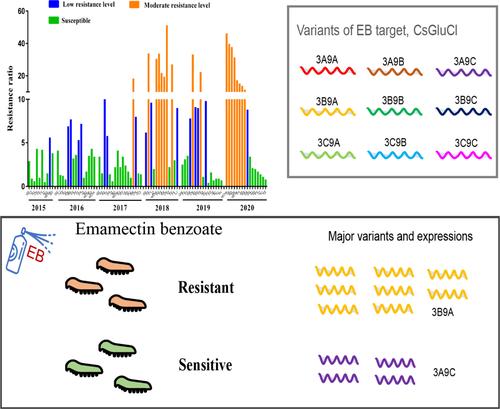
Here we monitored the sensitivity of 87 field populations of C. suppressalis in China to EB over a 6 year period and investigated the role of target-site modifications in resistance. Field populations of C. suppressalis from Hunan, Zhejiang and Jiangxi provinces exhibited a trend of expanding and increasing resistance over time, reaching resistance ratios of 50-fold. Nine spliceosomes of the gene encoding the EB target, the glutamate-gated chloride channel (GluCl), were identified with different combinations of exon 3 and exon 9. The frequency of exon 3A and exon 9C inclusion was negatively correlated with EB resistance, while exon 3B and exon 9A inclusion was positively correlated with resistance. Furthermore, the CsGluCl was found to be two-fold overexpressed in the field-resistant populations of C. suppressalis compared to a susceptible reference strain.
Study results suggest that overexpression and variable splicing of CsGluCl may play a role in C. suppressalis resistance to EB. This study provides a contemporary update on the sensitivity of C. suppressalis to insecticides and contributes to a better understanding of the function of the GluCl in insects. © 2024 Society of Chemical Industry.







 京公网安备 11010802042870号
京ICP备2023020795号-1
京公网安备 11010802042870号
京ICP备2023020795号-1

 分享
分享
 求助内容:
求助内容: 应助结果提醒方式:
 扫码关注我们
