{"title":"Real-Time Structural Dynamics at the 3D/2D Perovskite Interface in CsPbBr3/PEA2PbBr4 Nano-heterostructures","authors":"Xiayan Wu, Nithin Pathoor, Xin Xu, Shun Omagari, Toranosuke Takagi, Martin Vacha","doi":"10.1021/acs.nanolett.4c05021","DOIUrl":null,"url":null,"abstract":"Three-dimensional (3D) and two-dimensional (2D) perovskite hybrid systems, known for their exceptional optoelectronic properties and stability, are revolutionizing optoelectronic materials research. However, fundamental physics of the 3D/2D interfaces and their dynamics remain poorly understood. We use fluorescence microspectroscopy to study the photoluminescence (PL) properties of 3D/2D nano-heterostructures of CsPbBr<sub>3</sub>/PEA<sub>2</sub>PbBr<sub>4</sub> formed by postgrowth self-assembly. The in situ PL spectra uncover the presence of new structural phases, quasi-2D PEA<sub>2</sub>Cs<sub><i>n</i>–1</sub>Pb<sub>n</sub>Br<sub>3<i>n</i>+1</sub> layers of varying <i>n</i>, at the 3D/2D interface and demonstrate their reversible restructuring under light excitation at room temperature. The restructuring is a result of layer-by-layer cation diffusion at the epitaxial interfaces, manifested as reversible spectral shifts occurring on a time scale of seconds. Such dynamics ultimately leads to optimized distribution of the quasi-2D phases in the system for efficient energy transfer from the 2D to the 3D phases. Our findings provide new insights into controlling energy flow in 3D/2D perovskites for next-generation optoelectronic devices.","PeriodicalId":53,"journal":{"name":"Nano Letters","volume":"256 1","pages":""},"PeriodicalIF":9.1000,"publicationDate":"2024-12-18","publicationTypes":"Journal Article","fieldsOfStudy":null,"isOpenAccess":false,"openAccessPdf":"","citationCount":"0","resultStr":null,"platform":"Semanticscholar","paperid":null,"PeriodicalName":"Nano Letters","FirstCategoryId":"88","ListUrlMain":"https://doi.org/10.1021/acs.nanolett.4c05021","RegionNum":1,"RegionCategory":"材料科学","ArticlePicture":[],"TitleCN":null,"AbstractTextCN":null,"PMCID":null,"EPubDate":"","PubModel":"","JCR":"Q1","JCRName":"CHEMISTRY, MULTIDISCIPLINARY","Score":null,"Total":0}
引用次数: 0
Abstract
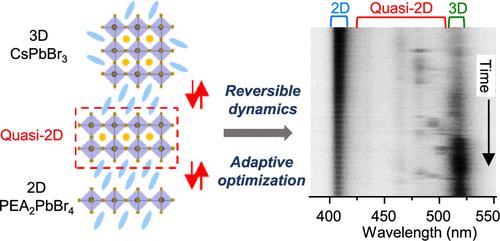
Three-dimensional (3D) and two-dimensional (2D) perovskite hybrid systems, known for their exceptional optoelectronic properties and stability, are revolutionizing optoelectronic materials research. However, fundamental physics of the 3D/2D interfaces and their dynamics remain poorly understood. We use fluorescence microspectroscopy to study the photoluminescence (PL) properties of 3D/2D nano-heterostructures of CsPbBr3/PEA2PbBr4 formed by postgrowth self-assembly. The in situ PL spectra uncover the presence of new structural phases, quasi-2D PEA2Csn–1PbnBr3n+1 layers of varying n, at the 3D/2D interface and demonstrate their reversible restructuring under light excitation at room temperature. The restructuring is a result of layer-by-layer cation diffusion at the epitaxial interfaces, manifested as reversible spectral shifts occurring on a time scale of seconds. Such dynamics ultimately leads to optimized distribution of the quasi-2D phases in the system for efficient energy transfer from the 2D to the 3D phases. Our findings provide new insights into controlling energy flow in 3D/2D perovskites for next-generation optoelectronic devices.
三维(3D)和二维(2D)包晶石杂化系统以其卓越的光电特性和稳定性而著称,正在为光电材料研究带来革命性的变化。然而,人们对三维/二维界面的基本物理学及其动力学仍然知之甚少。我们利用荧光微光谱技术研究了由生长后自组装形成的铯铋硼3/PEA2PbBr4三维/二维纳米异质结构的光致发光(PL)特性。原位聚光光谱揭示了在三维/二维界面上存在新的结构相,即不同 n 的准二维 PEA2Csn-1PbnBr3n+1 层,并证明了它们在室温光激发下的可逆重组。这种重组是阳离子在外延界面逐层扩散的结果,表现为以秒为单位的可逆光谱移动。这种动态变化最终导致系统中准二维相的优化分布,从而实现从二维相到三维相的高效能量转移。我们的发现为控制三维/二维包晶中的能量流以实现下一代光电器件提供了新的见解。
期刊介绍:
Nano Letters serves as a dynamic platform for promptly disseminating original results in fundamental, applied, and emerging research across all facets of nanoscience and nanotechnology. A pivotal criterion for inclusion within Nano Letters is the convergence of at least two different areas or disciplines, ensuring a rich interdisciplinary scope. The journal is dedicated to fostering exploration in diverse areas, including:
- Experimental and theoretical findings on physical, chemical, and biological phenomena at the nanoscale
- Synthesis, characterization, and processing of organic, inorganic, polymer, and hybrid nanomaterials through physical, chemical, and biological methodologies
- Modeling and simulation of synthetic, assembly, and interaction processes
- Realization of integrated nanostructures and nano-engineered devices exhibiting advanced performance
- Applications of nanoscale materials in living and environmental systems
Nano Letters is committed to advancing and showcasing groundbreaking research that intersects various domains, fostering innovation and collaboration in the ever-evolving field of nanoscience and nanotechnology.



 京公网安备 11010802042870号
京ICP备2023020795号-1
京公网安备 11010802042870号
京ICP备2023020795号-1

 分享
分享
 求助内容:
求助内容: 应助结果提醒方式:
 扫码关注我们
