Oculomotor nerve palsy recovery following microsurgery vs. endovascular treatment of posterior communicating artery aneurysms: a comparative meta-analysis of short- and long-term outcomes.
Rahim Abo Kasem, Conor Cunningham, Sameh Samir Elawady, Mohammad Mahdi Sowlat, Sofia Babool, Saad Hulou, Zachary Hubbard, Atakan Orscelik, Basel Musmar, Alejandro M Spiotta
{"title":"Oculomotor nerve palsy recovery following microsurgery vs. endovascular treatment of posterior communicating artery aneurysms: a comparative meta-analysis of short- and long-term outcomes.","authors":"Rahim Abo Kasem, Conor Cunningham, Sameh Samir Elawady, Mohammad Mahdi Sowlat, Sofia Babool, Saad Hulou, Zachary Hubbard, Atakan Orscelik, Basel Musmar, Alejandro M Spiotta","doi":"10.1007/s10143-024-03149-7","DOIUrl":null,"url":null,"abstract":"<p><p>Recent advancements in endovascular treatment (EVT) and different views on optimal management for posterior communicating artery (PComA) aneurysms with oculomotor nerve palsy (ONP) highlight a need to compare recovery timelines between microsurgery and EVT; heterogeneous outcomes and influencing factors may also affect results. A comprehensive systematic review and meta-analysis were conducted by searching PubMed, Embase, Scopus, and Web of Science databases. The extracted data encompassed patient demographics, details on treatment modalities and timing, and characteristics of PComA aneurysms ONP caused by either unruptured or ruptured aneurysms. The primary outcome was ONP favorable recovery, defined as the resolution of admission symptoms, except for subtle ptosis and mild pupillary asymmetry. We used random effect models to calculate odds ratios (OR) and pool prevalence with their corresponding 95% confidence intervals (CI). A total of 40 studies met the inclusion criteria. Overall, microsurgical clipping of PComA aneurysms demonstrated a significantly higher likelihood of ONP recovery compared to EVT at 1,3,6, and 12 months follow-up. However, recovery rates were comparable in long-term follow-up [18 months: (0.87 vs. 0.64, P-value = 0.36); ≥24 months: (0.86 vs. 0.72 P-Value = 0.26)]. The recovery outcomes for early treatment were similar when assessed during the 6-month follow-up (0.75 vs. 0.56, P-value = 0.07). Our findings suggest microsurgery leads to prompt ONP recovery from PComA aneurysms, while EVT shows potential for delayed favorable recovery; both treatments yield short-term recovery when administered early. A case-by-case approach is recommended, emphasizing a comprehensive understanding of patient factors in relation to the immediate and sustained effects of each treatment.</p>","PeriodicalId":19184,"journal":{"name":"Neurosurgical Review","volume":"47 1","pages":"904"},"PeriodicalIF":2.5000,"publicationDate":"2024-12-18","publicationTypes":"Journal Article","fieldsOfStudy":null,"isOpenAccess":false,"openAccessPdf":"https://www.ncbi.nlm.nih.gov/pmc/articles/PMC11655586/pdf/","citationCount":"0","resultStr":null,"platform":"Semanticscholar","paperid":null,"PeriodicalName":"Neurosurgical Review","FirstCategoryId":"3","ListUrlMain":"https://doi.org/10.1007/s10143-024-03149-7","RegionNum":3,"RegionCategory":"医学","ArticlePicture":[],"TitleCN":null,"AbstractTextCN":null,"PMCID":null,"EPubDate":"","PubModel":"","JCR":"Q2","JCRName":"CLINICAL NEUROLOGY","Score":null,"Total":0}
引用次数: 0
Abstract
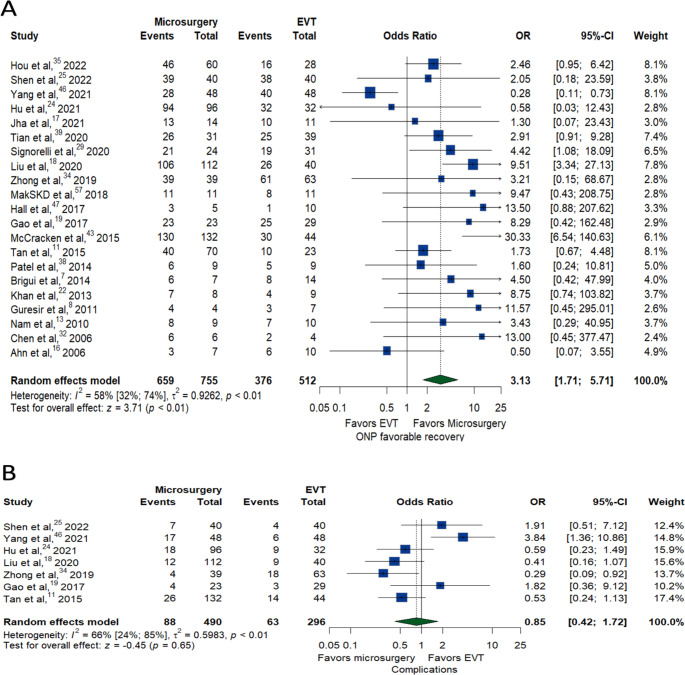
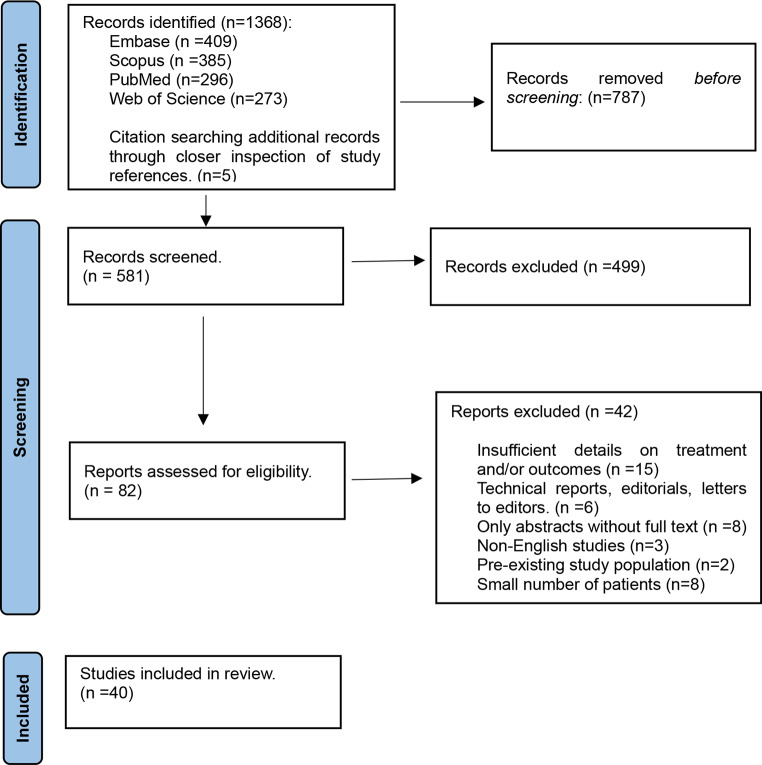
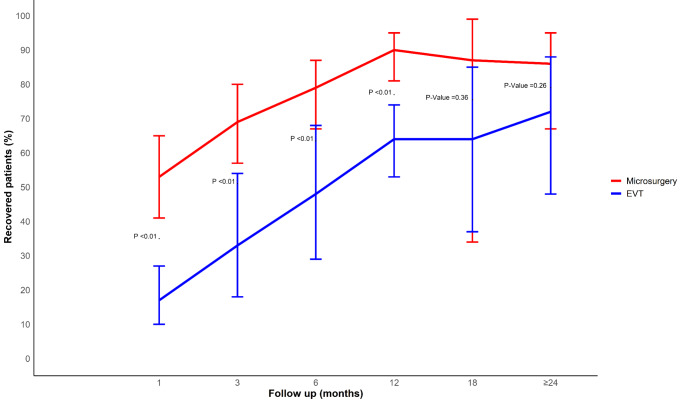
Recent advancements in endovascular treatment (EVT) and different views on optimal management for posterior communicating artery (PComA) aneurysms with oculomotor nerve palsy (ONP) highlight a need to compare recovery timelines between microsurgery and EVT; heterogeneous outcomes and influencing factors may also affect results. A comprehensive systematic review and meta-analysis were conducted by searching PubMed, Embase, Scopus, and Web of Science databases. The extracted data encompassed patient demographics, details on treatment modalities and timing, and characteristics of PComA aneurysms ONP caused by either unruptured or ruptured aneurysms. The primary outcome was ONP favorable recovery, defined as the resolution of admission symptoms, except for subtle ptosis and mild pupillary asymmetry. We used random effect models to calculate odds ratios (OR) and pool prevalence with their corresponding 95% confidence intervals (CI). A total of 40 studies met the inclusion criteria. Overall, microsurgical clipping of PComA aneurysms demonstrated a significantly higher likelihood of ONP recovery compared to EVT at 1,3,6, and 12 months follow-up. However, recovery rates were comparable in long-term follow-up [18 months: (0.87 vs. 0.64, P-value = 0.36); ≥24 months: (0.86 vs. 0.72 P-Value = 0.26)]. The recovery outcomes for early treatment were similar when assessed during the 6-month follow-up (0.75 vs. 0.56, P-value = 0.07). Our findings suggest microsurgery leads to prompt ONP recovery from PComA aneurysms, while EVT shows potential for delayed favorable recovery; both treatments yield short-term recovery when administered early. A case-by-case approach is recommended, emphasizing a comprehensive understanding of patient factors in relation to the immediate and sustained effects of each treatment.
血管内治疗(EVT)的最新进展和对后交通动脉(PComA)动脉瘤伴动眼神经麻痹(ONP)的最佳治疗方法的不同看法突出了比较显微手术和EVT的恢复时间的必要性;异质性结果和影响因素也可能影响结果。通过检索PubMed、Embase、Scopus和Web of Science数据库进行了全面的系统评价和荟萃分析。提取的数据包括患者人口统计、治疗方式和时间的细节,以及由未破裂或破裂的动脉瘤引起的PComA动脉瘤的特征。主要结果是ONP的良好恢复,定义为入院症状的解决,除了轻微的上睑下垂和轻微的瞳孔不对称。我们使用随机效应模型计算比值比(OR)和池患病率及其相应的95%置信区间(CI)。共有40项研究符合纳入标准。总的来说,在随访1、3、6和12个月时,显微手术夹持PComA动脉瘤与EVT相比,ONP恢复的可能性明显更高。然而,长期随访[18个月]的恢复率具有可比性:(0.87 vs. 0.64, p值= 0.36);≥24个月:(0.86 vs. 0.72 p值= 0.26)]。在6个月的随访中,早期治疗的恢复结果相似(0.75 vs. 0.56, p值= 0.07)。我们的研究结果表明显微手术可以促进PComA动脉瘤的ONP恢复,而EVT有可能延迟良好的恢复;这两种治疗在早期都能产生短期的恢复。建议采用具体情况具体分析的方法,强调全面了解与每种治疗的直接和持续效果有关的患者因素。
期刊介绍:
The goal of Neurosurgical Review is to provide a forum for comprehensive reviews on current issues in neurosurgery. Each issue contains up to three reviews, reflecting all important aspects of one topic (a disease or a surgical approach). Comments by a panel of experts within the same issue complete the topic. By providing comprehensive coverage of one topic per issue, Neurosurgical Review combines the topicality of professional journals with the indepth treatment of a monograph. Original papers of high quality are also welcome.



 京公网安备 11010802042870号
京ICP备2023020795号-1
京公网安备 11010802042870号
京ICP备2023020795号-1

 分享
分享
 求助内容:
求助内容: 应助结果提醒方式:
 扫码关注我们
