Charlotte Kröger, Sophie Müller, Jacqueline Leidner, Theresa Kröber, Stefanie Warnat-Herresthal, Jannis Bastian Spintge, Timo Zajac, Anna Neubauer, Aleksej Frolov, Caterina Carraro, Frank Jessen, Simone Puccio, Anna C. Aschenbrenner, Joachim L. Schultze, Tal Pecht, Marc D. Beyer, Lorenzo Bonaguro
{"title":"Unveiling the power of high-dimensional cytometry data with cyCONDOR","authors":"Charlotte Kröger, Sophie Müller, Jacqueline Leidner, Theresa Kröber, Stefanie Warnat-Herresthal, Jannis Bastian Spintge, Timo Zajac, Anna Neubauer, Aleksej Frolov, Caterina Carraro, Frank Jessen, Simone Puccio, Anna C. Aschenbrenner, Joachim L. Schultze, Tal Pecht, Marc D. Beyer, Lorenzo Bonaguro","doi":"10.1038/s41467-024-55179-w","DOIUrl":null,"url":null,"abstract":"<p>High-dimensional cytometry (HDC) is a powerful technology for studying single-cell phenotypes in complex biological systems. Although technological developments and affordability have made HDC broadly available in recent years, technological advances were not coupled with an adequate development of analytical methods that can take full advantage of the complex data generated. While several analytical platforms and bioinformatics tools have become available for the analysis of HDC data, these are either web-hosted with limited scalability or designed for expert computational biologists, making their use unapproachable for wet lab scientists. Additionally, end-to-end HDC data analysis is further hampered due to missing unified analytical ecosystems, requiring researchers to navigate multiple platforms and software packages to complete the analysis. To bridge this data analysis gap in HDC we develop <i>cyCONDOR</i>, an easy-to-use computational framework covering not only all essential steps of cytometry data analysis but also including an array of downstream functions and tools to expand the biological interpretation of the data. The comprehensive suite of features of <i>cyCONDOR</i>, including guided pre-processing, clustering, dimensionality reduction, and machine learning algorithms, facilitates the seamless integration of <i>cyCONDOR</i> into clinically relevant settings, where scalability and disease classification are paramount for the widespread adoption of HDC in clinical practice. Additionally, the advanced analytical features of <i>cyCONDOR</i>, such as pseudotime analysis and batch integration, provide researchers with the tools to extract deeper insights from their data. We use <i>cyCONDOR</i> on a variety of data from different tissues and technologies demonstrating its versatility to assist the analysis of high-dimensional data from preprocessing to biological interpretation.</p>","PeriodicalId":19066,"journal":{"name":"Nature Communications","volume":"31 1","pages":""},"PeriodicalIF":15.7000,"publicationDate":"2024-12-19","publicationTypes":"Journal Article","fieldsOfStudy":null,"isOpenAccess":false,"openAccessPdf":"","citationCount":"0","resultStr":null,"platform":"Semanticscholar","paperid":null,"PeriodicalName":"Nature Communications","FirstCategoryId":"103","ListUrlMain":"https://doi.org/10.1038/s41467-024-55179-w","RegionNum":1,"RegionCategory":"综合性期刊","ArticlePicture":[],"TitleCN":null,"AbstractTextCN":null,"PMCID":null,"EPubDate":"","PubModel":"","JCR":"Q1","JCRName":"MULTIDISCIPLINARY SCIENCES","Score":null,"Total":0}
引用次数: 0
Abstract
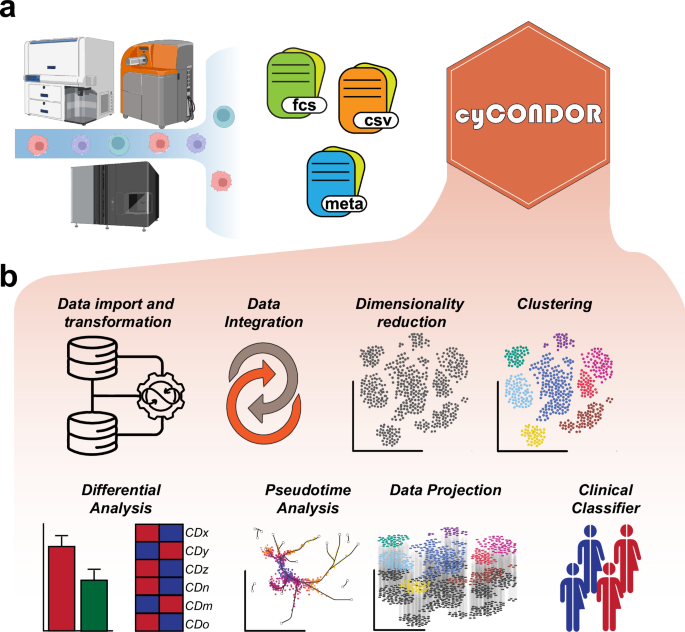
High-dimensional cytometry (HDC) is a powerful technology for studying single-cell phenotypes in complex biological systems. Although technological developments and affordability have made HDC broadly available in recent years, technological advances were not coupled with an adequate development of analytical methods that can take full advantage of the complex data generated. While several analytical platforms and bioinformatics tools have become available for the analysis of HDC data, these are either web-hosted with limited scalability or designed for expert computational biologists, making their use unapproachable for wet lab scientists. Additionally, end-to-end HDC data analysis is further hampered due to missing unified analytical ecosystems, requiring researchers to navigate multiple platforms and software packages to complete the analysis. To bridge this data analysis gap in HDC we develop cyCONDOR, an easy-to-use computational framework covering not only all essential steps of cytometry data analysis but also including an array of downstream functions and tools to expand the biological interpretation of the data. The comprehensive suite of features of cyCONDOR, including guided pre-processing, clustering, dimensionality reduction, and machine learning algorithms, facilitates the seamless integration of cyCONDOR into clinically relevant settings, where scalability and disease classification are paramount for the widespread adoption of HDC in clinical practice. Additionally, the advanced analytical features of cyCONDOR, such as pseudotime analysis and batch integration, provide researchers with the tools to extract deeper insights from their data. We use cyCONDOR on a variety of data from different tissues and technologies demonstrating its versatility to assist the analysis of high-dimensional data from preprocessing to biological interpretation.
期刊介绍:
Nature Communications, an open-access journal, publishes high-quality research spanning all areas of the natural sciences. Papers featured in the journal showcase significant advances relevant to specialists in each respective field. With a 2-year impact factor of 16.6 (2022) and a median time of 8 days from submission to the first editorial decision, Nature Communications is committed to rapid dissemination of research findings. As a multidisciplinary journal, it welcomes contributions from biological, health, physical, chemical, Earth, social, mathematical, applied, and engineering sciences, aiming to highlight important breakthroughs within each domain.




 京公网安备 11010802042870号
京ICP备2023020795号-1
京公网安备 11010802042870号
京ICP备2023020795号-1

 分享
分享
 求助内容:
求助内容: 应助结果提醒方式:
 扫码关注我们
