{"title":"Highly Stable Lanthanide-Organic Frameworks Based on {Ln6O8} Clusters with Photocatalytic Reduction of CO2 to CO","authors":"Kang-Le Xie, Li-Ping Wu, Ya-Qing Liao, Jun-Jie Hu, Kang-Qiang Lu, He-Rui Wen, Jin-Rong Huo","doi":"10.1021/acs.inorgchem.4c03799","DOIUrl":null,"url":null,"abstract":"Metal–organic frameworks (MOFs) with adjustable structures, diverse chemical functionalities, and excellent CO<sub>2</sub> capture ability have shown important potential application in the photocatalytic reduction of CO<sub>2</sub> to valuable fuel to curb the energy crisis. In this work, a series of new isostructural lanthanide-organic frameworks based on hexanuclear {Ln<sub>6</sub>O<sub>8</sub>} clusters, {(DMA)<sub>2</sub> [Ln<sub>6</sub>(μ<sub>3</sub>–OH)<sub>8</sub>(H<sub>2</sub>O)<sub>6</sub>(SBTC)<sub>3</sub>]}<sub>n</sub> (Ln-MOFs, Ln = Eu, Dy, Gd, Tb, Yb; H<sub>4</sub>SBTC = 5,5′-(ethene-1,2-diyl) di-isophthalic acid; DMA = dimethylamine cation) were synthesized by the solvothermal method. Ln-MOFs were metal–organic frameworks formed by {Ln<sub>6</sub>(μ<sub>3</sub>–OH)<sub>8</sub>} clusters and poly(carboxylic acid) ligands H<sub>4</sub>SBTC, which exhibited excellent photocatalytic properties for the reduction of CO<sub>2</sub> to CO. Among these Ln-MOFs, the production rate of photocatalytic reduction of CO<sub>2</sub> to CO by <b>Eu-MOF</b> was 663.00 μmol·h<sup>–1</sup>·g<sup>–1</sup> and the selectivity reached 94.2%, utilizing [Ru(bpy)<sub>3</sub>]Cl<sub>2</sub>·6H<sub>2</sub>O as photosensitizers. Experimental characterizations and density functional theory (DFT) calculations unveiled that the effective charge separation, strong CO<sub>2</sub> binding affinity, weak H<sub>2</sub>O adsorption energy, as well as low reaction energy barriers for the *COOH intermediates over <b>Eu-MOF</b> play an important role in possessing superior photoactivity. This study provides insights into the field of Ln-MOF materials for efficient photocatalytic CO<sub>2</sub> reduction and conversion applications.","PeriodicalId":40,"journal":{"name":"Inorganic Chemistry","volume":"23 1","pages":""},"PeriodicalIF":4.7000,"publicationDate":"2024-12-19","publicationTypes":"Journal Article","fieldsOfStudy":null,"isOpenAccess":false,"openAccessPdf":"","citationCount":"0","resultStr":null,"platform":"Semanticscholar","paperid":null,"PeriodicalName":"Inorganic Chemistry","FirstCategoryId":"92","ListUrlMain":"https://doi.org/10.1021/acs.inorgchem.4c03799","RegionNum":2,"RegionCategory":"化学","ArticlePicture":[],"TitleCN":null,"AbstractTextCN":null,"PMCID":null,"EPubDate":"","PubModel":"","JCR":"Q1","JCRName":"CHEMISTRY, INORGANIC & NUCLEAR","Score":null,"Total":0}
引用次数: 0
Abstract
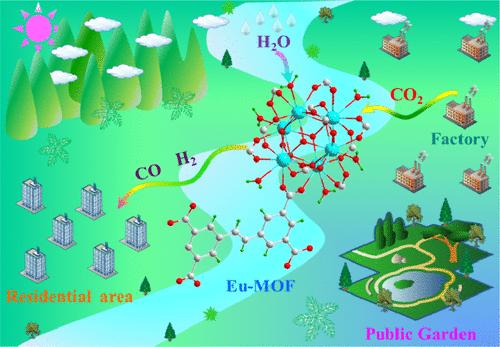
Metal–organic frameworks (MOFs) with adjustable structures, diverse chemical functionalities, and excellent CO2 capture ability have shown important potential application in the photocatalytic reduction of CO2 to valuable fuel to curb the energy crisis. In this work, a series of new isostructural lanthanide-organic frameworks based on hexanuclear {Ln6O8} clusters, {(DMA)2 [Ln6(μ3–OH)8(H2O)6(SBTC)3]}n (Ln-MOFs, Ln = Eu, Dy, Gd, Tb, Yb; H4SBTC = 5,5′-(ethene-1,2-diyl) di-isophthalic acid; DMA = dimethylamine cation) were synthesized by the solvothermal method. Ln-MOFs were metal–organic frameworks formed by {Ln6(μ3–OH)8} clusters and poly(carboxylic acid) ligands H4SBTC, which exhibited excellent photocatalytic properties for the reduction of CO2 to CO. Among these Ln-MOFs, the production rate of photocatalytic reduction of CO2 to CO by Eu-MOF was 663.00 μmol·h–1·g–1 and the selectivity reached 94.2%, utilizing [Ru(bpy)3]Cl2·6H2O as photosensitizers. Experimental characterizations and density functional theory (DFT) calculations unveiled that the effective charge separation, strong CO2 binding affinity, weak H2O adsorption energy, as well as low reaction energy barriers for the *COOH intermediates over Eu-MOF play an important role in possessing superior photoactivity. This study provides insights into the field of Ln-MOF materials for efficient photocatalytic CO2 reduction and conversion applications.
期刊介绍:
Inorganic Chemistry publishes fundamental studies in all phases of inorganic chemistry. Coverage includes experimental and theoretical reports on quantitative studies of structure and thermodynamics, kinetics, mechanisms of inorganic reactions, bioinorganic chemistry, and relevant aspects of organometallic chemistry, solid-state phenomena, and chemical bonding theory. Emphasis is placed on the synthesis, structure, thermodynamics, reactivity, spectroscopy, and bonding properties of significant new and known compounds.



 京公网安备 11010802042870号
京ICP备2023020795号-1
京公网安备 11010802042870号
京ICP备2023020795号-1

 分享
分享
 求助内容:
求助内容: 应助结果提醒方式:
 扫码关注我们
