Alzheimer's disease-associated CD83(+) microglia are linked with increased immunoglobulin G4 and human cytomegalovirus in the gut, vagal nerve, and brain
Benjamin P. Readhead, Diego F. Mastroeni, Qi Wang, Maria A. Sierra, Camila de Ávila, Tajudeen O. Jimoh, Jean-Vianney Haure-Mirande, Kristina E. Atanasoff, Jennifer Nolz, Crystal Suazo, Nathaniel J. Barton, Adrian R. Orszulak, Samantha M. Chigas, Khanh Tran, Anne Mirza, Krista Ryon, Jacqueline Proszynski, Deena Najjar, Joel T. Dudley, Sean T. H. Liu, Sam Gandy, Michelle E. Ehrlich, Eric Alsop, Jerry Antone, Rebecca Reiman, Cory Funk, Rebecca L. Best, Michael Jhatro, Kathy Kamath, John Shon, Timothy F. Kowalik, David A. Bennett, Winnie S. Liang, Geidy E. Serrano, Thomas G. Beach, Kendall Van Keuren-Jensen, Christopher E. Mason, Yingleong Chan, Elaine T. Lim, Domenico Tortorella, Eric M. Reiman
{"title":"Alzheimer's disease-associated CD83(+) microglia are linked with increased immunoglobulin G4 and human cytomegalovirus in the gut, vagal nerve, and brain","authors":"Benjamin P. Readhead, Diego F. Mastroeni, Qi Wang, Maria A. Sierra, Camila de Ávila, Tajudeen O. Jimoh, Jean-Vianney Haure-Mirande, Kristina E. Atanasoff, Jennifer Nolz, Crystal Suazo, Nathaniel J. Barton, Adrian R. Orszulak, Samantha M. Chigas, Khanh Tran, Anne Mirza, Krista Ryon, Jacqueline Proszynski, Deena Najjar, Joel T. Dudley, Sean T. H. Liu, Sam Gandy, Michelle E. Ehrlich, Eric Alsop, Jerry Antone, Rebecca Reiman, Cory Funk, Rebecca L. Best, Michael Jhatro, Kathy Kamath, John Shon, Timothy F. Kowalik, David A. Bennett, Winnie S. Liang, Geidy E. Serrano, Thomas G. Beach, Kendall Van Keuren-Jensen, Christopher E. Mason, Yingleong Chan, Elaine T. Lim, Domenico Tortorella, Eric M. Reiman","doi":"10.1002/alz.14401","DOIUrl":null,"url":null,"abstract":"<div>\n \n \n <section>\n \n <h3> INTRODUCTION</h3>\n \n <p>While there may be microbial contributions to Alzheimer's disease (AD), findings have been inconclusive. We recently reported an AD-associated CD83(+) microglia subtype associated with increased immunoglobulin G4 (IgG4) in the transverse colon (TC).</p>\n </section>\n \n <section>\n \n <h3> METHODS</h3>\n \n <p>We used immunohistochemistry (IHC), IgG4 repertoire profiling, and brain organoid experiments to explore this association.</p>\n </section>\n \n <section>\n \n <h3> RESULTS</h3>\n \n <p>CD83(+) microglia in the superior frontal gyrus (SFG) are associated with elevated IgG4 and human cytomegalovirus (HCMV) in the TC, anti-HCMV IgG4 in cerebrospinal fluid, and both HCMV and IgG4 in the SFG and vagal nerve. This association was replicated in an independent AD cohort. HCMV-infected cerebral organoids showed accelerated AD pathophysiological features (Aβ42 and pTau-212) and neuronal death.</p>\n </section>\n \n <section>\n \n <h3> DISCUSSION</h3>\n \n <p>Findings indicate complex, cross-tissue interactions between HCMV and the adaptive immune response associated with CD83(+) microglia in persons with AD. This may indicate an opportunity for antiviral therapy in persons with AD and biomarker evidence of HCMV, IgG4, or CD83(+) microglia.</p>\n </section>\n \n <section>\n \n <h3> Highlights</h3>\n \n <div>\n <ul>\n \n <li>Cross-tissue interaction between HCMV and the adaptive immune response in a subset of persons with AD.</li>\n \n <li>Presence of CD83(+) microglial associated with IgG4 and HCMV in the gut.</li>\n \n <li>CD83(+) microglia are also associated presence of HCMV and IgG4 in the cortex and vagal nerve.</li>\n \n <li>Replication of key association in an independent cohort of AD subjects.</li>\n \n <li>HCMV infection of cerebral organoids accelerates the production of AD neuropathological features.</li>\n </ul>\n </div>\n </section>\n </div>","PeriodicalId":7471,"journal":{"name":"Alzheimer's & Dementia","volume":"21 1","pages":""},"PeriodicalIF":11.1000,"publicationDate":"2024-12-19","publicationTypes":"Journal Article","fieldsOfStudy":null,"isOpenAccess":false,"openAccessPdf":"https://onlinelibrary.wiley.com/doi/epdf/10.1002/alz.14401","citationCount":"0","resultStr":null,"platform":"Semanticscholar","paperid":null,"PeriodicalName":"Alzheimer's & Dementia","FirstCategoryId":"3","ListUrlMain":"https://alz-journals.onlinelibrary.wiley.com/doi/10.1002/alz.14401","RegionNum":1,"RegionCategory":"医学","ArticlePicture":[],"TitleCN":null,"AbstractTextCN":null,"PMCID":null,"EPubDate":"","PubModel":"","JCR":"Q1","JCRName":"CLINICAL NEUROLOGY","Score":null,"Total":0}
引用次数: 0
Abstract
INTRODUCTION
While there may be microbial contributions to Alzheimer's disease (AD), findings have been inconclusive. We recently reported an AD-associated CD83(+) microglia subtype associated with increased immunoglobulin G4 (IgG4) in the transverse colon (TC).
METHODS
We used immunohistochemistry (IHC), IgG4 repertoire profiling, and brain organoid experiments to explore this association.
RESULTS
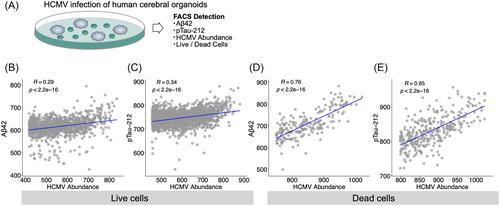
CD83(+) microglia in the superior frontal gyrus (SFG) are associated with elevated IgG4 and human cytomegalovirus (HCMV) in the TC, anti-HCMV IgG4 in cerebrospinal fluid, and both HCMV and IgG4 in the SFG and vagal nerve. This association was replicated in an independent AD cohort. HCMV-infected cerebral organoids showed accelerated AD pathophysiological features (Aβ42 and pTau-212) and neuronal death.
DISCUSSION
Findings indicate complex, cross-tissue interactions between HCMV and the adaptive immune response associated with CD83(+) microglia in persons with AD. This may indicate an opportunity for antiviral therapy in persons with AD and biomarker evidence of HCMV, IgG4, or CD83(+) microglia.
Highlights
Cross-tissue interaction between HCMV and the adaptive immune response in a subset of persons with AD.
Presence of CD83(+) microglial associated with IgG4 and HCMV in the gut.
CD83(+) microglia are also associated presence of HCMV and IgG4 in the cortex and vagal nerve.
Replication of key association in an independent cohort of AD subjects.
HCMV infection of cerebral organoids accelerates the production of AD neuropathological features.
期刊介绍:
Alzheimer's & Dementia is a peer-reviewed journal that aims to bridge knowledge gaps in dementia research by covering the entire spectrum, from basic science to clinical trials to social and behavioral investigations. It provides a platform for rapid communication of new findings and ideas, optimal translation of research into practical applications, increasing knowledge across diverse disciplines for early detection, diagnosis, and intervention, and identifying promising new research directions. In July 2008, Alzheimer's & Dementia was accepted for indexing by MEDLINE, recognizing its scientific merit and contribution to Alzheimer's research.






 京公网安备 11010802042870号
京ICP备2023020795号-1
京公网安备 11010802042870号
京ICP备2023020795号-1

 分享
分享
 求助内容:
求助内容: 应助结果提醒方式:
 扫码关注我们
