Ruochen Guo;Jianning Dong;Rob E. Wolleswinkel;Reynard de Vries;Mohamad Ghaffarian Niasar
{"title":"Electrical Architecture of 90-Seater Electric Aircraft: A Cable Perspective","authors":"Ruochen Guo;Jianning Dong;Rob E. Wolleswinkel;Reynard de Vries;Mohamad Ghaffarian Niasar","doi":"10.1109/TTE.2024.3517838","DOIUrl":null,"url":null,"abstract":"Optimized power system architectures and lighter weight are enabling considerations for the successful development of all-electric aircraft (AEA). In this article, a cross-redundant connection architecture and weight reduction solutions are investigated for a 90-seater full battery-electric aircraft from the perspective of high-power aviation cable. Design criteria of the power system architecture are introduced. Material selection, sizing, and weight estimation methods of cable for AEA are discussed by combining ground cable standards with aviation requirements. The influence of the conductor materials, voltage level, current, battery pack quantity, and operating temperature on cable evaluation is thoroughly discussed and analyzed. Weight comparison under two controversial voltage level options (800 V and 3 kV) is conducted. Comparison results show that the use of an aluminum conductor, polytetrafluoroethylene (PTFE) insulator, and a voltage level of 3 kV proves to be a preferable selection for current AEA medium and high voltage cables. Increasing the rating operation temperature to <inline-formula> <tex-math>$120~^{\\circ }$ </tex-math></inline-formula>C is a conservative and secure option. The layout of battery packs consistent with the quantity of distributed electric motors is preferable to achieve the lightest cabling system. This study provides a guideline for the cable sizing methods of high-power aviation cables and an optimized design solution for the power system architecture of AEA from the perspective of cable layout and weight assessment.","PeriodicalId":56269,"journal":{"name":"IEEE Transactions on Transportation Electrification","volume":"11 2","pages":"6854-6865"},"PeriodicalIF":8.3000,"publicationDate":"2024-12-18","publicationTypes":"Journal Article","fieldsOfStudy":null,"isOpenAccess":false,"openAccessPdf":"","citationCount":"0","resultStr":null,"platform":"Semanticscholar","paperid":null,"PeriodicalName":"IEEE Transactions on Transportation Electrification","FirstCategoryId":"5","ListUrlMain":"https://ieeexplore.ieee.org/document/10806784/","RegionNum":1,"RegionCategory":"工程技术","ArticlePicture":[],"TitleCN":null,"AbstractTextCN":null,"PMCID":null,"EPubDate":"","PubModel":"","JCR":"Q1","JCRName":"ENGINEERING, ELECTRICAL & ELECTRONIC","Score":null,"Total":0}
引用次数: 0
Abstract
Optimized power system architectures and lighter weight are enabling considerations for the successful development of all-electric aircraft (AEA). In this article, a cross-redundant connection architecture and weight reduction solutions are investigated for a 90-seater full battery-electric aircraft from the perspective of high-power aviation cable. Design criteria of the power system architecture are introduced. Material selection, sizing, and weight estimation methods of cable for AEA are discussed by combining ground cable standards with aviation requirements. The influence of the conductor materials, voltage level, current, battery pack quantity, and operating temperature on cable evaluation is thoroughly discussed and analyzed. Weight comparison under two controversial voltage level options (800 V and 3 kV) is conducted. Comparison results show that the use of an aluminum conductor, polytetrafluoroethylene (PTFE) insulator, and a voltage level of 3 kV proves to be a preferable selection for current AEA medium and high voltage cables. Increasing the rating operation temperature to $120~^{\circ }$ C is a conservative and secure option. The layout of battery packs consistent with the quantity of distributed electric motors is preferable to achieve the lightest cabling system. This study provides a guideline for the cable sizing methods of high-power aviation cables and an optimized design solution for the power system architecture of AEA from the perspective of cable layout and weight assessment.
期刊介绍:
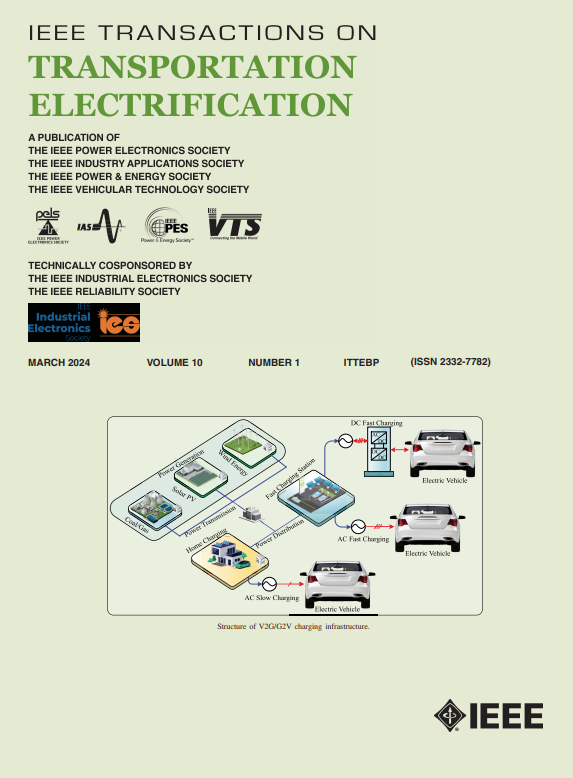
IEEE Transactions on Transportation Electrification is focused on components, sub-systems, systems, standards, and grid interface technologies related to power and energy conversion, propulsion, and actuation for all types of electrified vehicles including on-road, off-road, off-highway, and rail vehicles, airplanes, and ships.



 京公网安备 11010802042870号
京ICP备2023020795号-1
京公网安备 11010802042870号
京ICP备2023020795号-1

 分享
分享
 求助内容:
求助内容: 应助结果提醒方式:
 扫码关注我们
