Cole J.T. Lewis, Li H. Xie, Shivani Milind Bhandarkar, Danni Jin, Kyrillos Abdallah, Austin S. Draycott, Yixuan Chen, Carson C. Thoreen, Wendy V. Gilbert
{"title":"Quantitative profiling of human translation initiation reveals elements that potently regulate endogenous and therapeutically modified mRNAs","authors":"Cole J.T. Lewis, Li H. Xie, Shivani Milind Bhandarkar, Danni Jin, Kyrillos Abdallah, Austin S. Draycott, Yixuan Chen, Carson C. Thoreen, Wendy V. Gilbert","doi":"10.1016/j.molcel.2024.11.030","DOIUrl":null,"url":null,"abstract":"mRNA therapeutics offer a potentially universal strategy for the efficient development and delivery of therapeutic proteins. Current mRNA vaccines include chemically modified nucleotides to reduce cellular immunogenicity. Here, we develop an efficient, high-throughput method to measure human translation initiation on therapeutically modified as well as endogenous RNAs. Using systems-level biochemistry, we quantify ribosome recruitment to tens of thousands of human 5′ untranslated regions (UTRs) including alternative isoforms and identify sequences that mediate 200-fold effects. We observe widespread effects of coding sequences on translation initiation and identify small regulatory elements of 3–6 nucleotides that are sufficient to potently affect translational output. Incorporation of N1-methylpseudouridine (m1Ψ) selectively enhances translation by specific 5′ UTRs that we demonstrate surpass those of current mRNA vaccines. Our approach is broadly applicable to dissecting mechanisms of human translation initiation and engineering more potent therapeutic mRNAs.","PeriodicalId":18950,"journal":{"name":"Molecular Cell","volume":"32 1","pages":""},"PeriodicalIF":16.6000,"publicationDate":"2024-12-19","publicationTypes":"Journal Article","fieldsOfStudy":null,"isOpenAccess":false,"openAccessPdf":"","citationCount":"0","resultStr":null,"platform":"Semanticscholar","paperid":null,"PeriodicalName":"Molecular Cell","FirstCategoryId":"99","ListUrlMain":"https://doi.org/10.1016/j.molcel.2024.11.030","RegionNum":1,"RegionCategory":"生物学","ArticlePicture":[],"TitleCN":null,"AbstractTextCN":null,"PMCID":null,"EPubDate":"","PubModel":"","JCR":"Q1","JCRName":"BIOCHEMISTRY & MOLECULAR BIOLOGY","Score":null,"Total":0}
引用次数: 0
Abstract
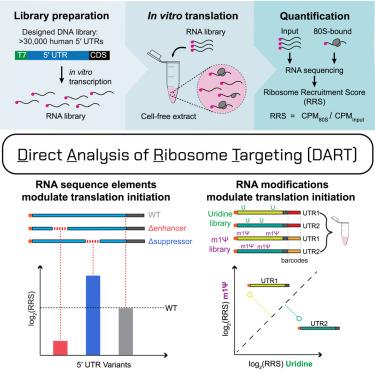
mRNA therapeutics offer a potentially universal strategy for the efficient development and delivery of therapeutic proteins. Current mRNA vaccines include chemically modified nucleotides to reduce cellular immunogenicity. Here, we develop an efficient, high-throughput method to measure human translation initiation on therapeutically modified as well as endogenous RNAs. Using systems-level biochemistry, we quantify ribosome recruitment to tens of thousands of human 5′ untranslated regions (UTRs) including alternative isoforms and identify sequences that mediate 200-fold effects. We observe widespread effects of coding sequences on translation initiation and identify small regulatory elements of 3–6 nucleotides that are sufficient to potently affect translational output. Incorporation of N1-methylpseudouridine (m1Ψ) selectively enhances translation by specific 5′ UTRs that we demonstrate surpass those of current mRNA vaccines. Our approach is broadly applicable to dissecting mechanisms of human translation initiation and engineering more potent therapeutic mRNAs.
期刊介绍:
Molecular Cell is a companion to Cell, the leading journal of biology and the highest-impact journal in the world. Launched in December 1997 and published monthly. Molecular Cell is dedicated to publishing cutting-edge research in molecular biology, focusing on fundamental cellular processes. The journal encompasses a wide range of topics, including DNA replication, recombination, and repair; Chromatin biology and genome organization; Transcription; RNA processing and decay; Non-coding RNA function; Translation; Protein folding, modification, and quality control; Signal transduction pathways; Cell cycle and checkpoints; Cell death; Autophagy; Metabolism.



 京公网安备 11010802042870号
京ICP备2023020795号-1
京公网安备 11010802042870号
京ICP备2023020795号-1

 分享
分享
 求助内容:
求助内容: 应助结果提醒方式:
 扫码关注我们
