Balázs L. Tóth , Stephanie G. E. Amos , Arjan W. Kleij
{"title":"From conventional to dual Co/photoredox mediated reductive coupling of alkynes and alkenes","authors":"Balázs L. Tóth , Stephanie G. E. Amos , Arjan W. Kleij","doi":"10.1039/d4qo02143f","DOIUrl":null,"url":null,"abstract":"<div><div>Metal-catalyzed reductive coupling reactions between alkenes and alkynes are a long-standing tradition as a way to create complex unsaturated building blocks of value in organic synthesis ventures. Here, we review the general synthetic approaches realized under Co-catalysis utilizing chemical reductants, albeit with some limitations in scope and user-friendliness. A more recent advancement shows that these reductive ene–yne coupling reactions can also be accommodated by photoredox catalysis marking a stepping stone in the area, and creating new incentives for this kind of carbon–carbon bond formation and beyond.</div></div>","PeriodicalId":94379,"journal":{"name":"Organic chemistry frontiers : an international journal of organic chemistry","volume":"12 4","pages":"Pages 1326-1339"},"PeriodicalIF":0.0000,"publicationDate":"2024-12-10","publicationTypes":"Journal Article","fieldsOfStudy":null,"isOpenAccess":false,"openAccessPdf":"","citationCount":"0","resultStr":null,"platform":"Semanticscholar","paperid":null,"PeriodicalName":"Organic chemistry frontiers : an international journal of organic chemistry","FirstCategoryId":"1085","ListUrlMain":"https://www.sciencedirect.com/org/science/article/pii/S2052412924008763","RegionNum":0,"RegionCategory":null,"ArticlePicture":[],"TitleCN":null,"AbstractTextCN":null,"PMCID":null,"EPubDate":"2024/12/19 0:00:00","PubModel":"Epub","JCR":"","JCRName":"","Score":null,"Total":0}
引用次数: 0
Abstract
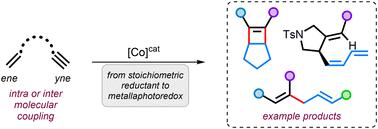
Metal-catalyzed reductive coupling reactions between alkenes and alkynes are a long-standing tradition as a way to create complex unsaturated building blocks of value in organic synthesis ventures. Here, we review the general synthetic approaches realized under Co-catalysis utilizing chemical reductants, albeit with some limitations in scope and user-friendliness. A more recent advancement shows that these reductive ene–yne coupling reactions can also be accommodated by photoredox catalysis marking a stepping stone in the area, and creating new incentives for this kind of carbon–carbon bond formation and beyond.




 京公网安备 11010802042870号
京ICP备2023020795号-1
京公网安备 11010802042870号
京ICP备2023020795号-1

 分享
分享

 求助内容:
求助内容: 应助结果提醒方式:
 扫码关注我们
