Dr. Xiaoyi Li, Nimit L. Patel, Dr. Joseph Kalen, Dr. Martin J. Schnermann
{"title":"Benzyl Ammonium Carbamates Undergo Two-Step Linker Cleavage and Improve the Properties of Antibody Conjugates","authors":"Dr. Xiaoyi Li, Nimit L. Patel, Dr. Joseph Kalen, Dr. Martin J. Schnermann","doi":"10.1002/anie.202417651","DOIUrl":null,"url":null,"abstract":"<p>Targeted payload delivery strategies, such as antibody-drug conjugates (ADCs), have emerged as important therapeutics. Although considerable efforts have been made in the areas of antibody engineering and labeling methodology, improving the overall physicochemical properties of the linker/payload combination remains an important challenge. Here we report an approach to create an intrinsically hydrophilic linker domain. We find that benzyl α-ammonium carbamates (BACs) undergo tandem 1,6–1,2-elimination to release secondary amines. Using a fluorogenic hemicyanine as a model payload component, we show that a zwitterionic BAC linker improves labeling efficiency and reduces antibody aggregation when compared to a commonly used <i>para</i>-amino benzyl (PAB) linker as well as a cationic BAC. Cellular and <i>in vivo</i> fluorescence imaging studies demonstrate that the model payload is specifically released in antigen-expressing cells and tumors. The therapeutic potential of the BAC linker strategy was assessed using an MMAE payload, a potent microtubule-disrupting agent frequently used for ADC applications. The BAC-MMAE combination enhances labeling efficiency and cellular toxicity when compared to the routinely used PAB-Val-Cit ADC analogue. Broadly, this strategy provides a general approach to mask payload hydrophobicity and improve the properties of targeted agents.</p>","PeriodicalId":125,"journal":{"name":"Angewandte Chemie International Edition","volume":"64 6","pages":""},"PeriodicalIF":16.9000,"publicationDate":"2024-12-18","publicationTypes":"Journal Article","fieldsOfStudy":null,"isOpenAccess":false,"openAccessPdf":"https://onlinelibrary.wiley.com/doi/epdf/10.1002/anie.202417651","citationCount":"0","resultStr":null,"platform":"Semanticscholar","paperid":null,"PeriodicalName":"Angewandte Chemie International Edition","FirstCategoryId":"92","ListUrlMain":"https://onlinelibrary.wiley.com/doi/10.1002/anie.202417651","RegionNum":1,"RegionCategory":"化学","ArticlePicture":[],"TitleCN":null,"AbstractTextCN":null,"PMCID":null,"EPubDate":"","PubModel":"","JCR":"Q1","JCRName":"CHEMISTRY, MULTIDISCIPLINARY","Score":null,"Total":0}
引用次数: 0
Abstract
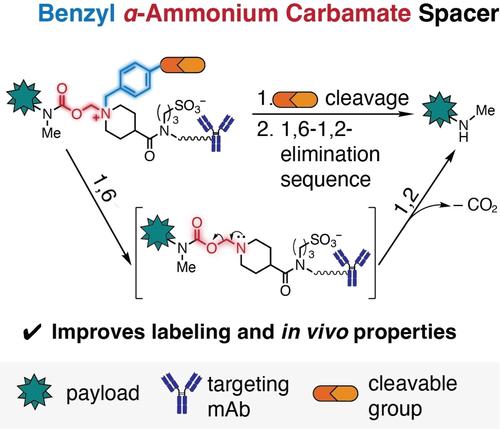
Targeted payload delivery strategies, such as antibody-drug conjugates (ADCs), have emerged as important therapeutics. Although considerable efforts have been made in the areas of antibody engineering and labeling methodology, improving the overall physicochemical properties of the linker/payload combination remains an important challenge. Here we report an approach to create an intrinsically hydrophilic linker domain. We find that benzyl α-ammonium carbamates (BACs) undergo tandem 1,6–1,2-elimination to release secondary amines. Using a fluorogenic hemicyanine as a model payload component, we show that a zwitterionic BAC linker improves labeling efficiency and reduces antibody aggregation when compared to a commonly used para-amino benzyl (PAB) linker as well as a cationic BAC. Cellular and in vivo fluorescence imaging studies demonstrate that the model payload is specifically released in antigen-expressing cells and tumors. The therapeutic potential of the BAC linker strategy was assessed using an MMAE payload, a potent microtubule-disrupting agent frequently used for ADC applications. The BAC-MMAE combination enhances labeling efficiency and cellular toxicity when compared to the routinely used PAB-Val-Cit ADC analogue. Broadly, this strategy provides a general approach to mask payload hydrophobicity and improve the properties of targeted agents.
期刊介绍:
Angewandte Chemie, a journal of the German Chemical Society (GDCh), maintains a leading position among scholarly journals in general chemistry with an impressive Impact Factor of 16.6 (2022 Journal Citation Reports, Clarivate, 2023). Published weekly in a reader-friendly format, it features new articles almost every day. Established in 1887, Angewandte Chemie is a prominent chemistry journal, offering a dynamic blend of Review-type articles, Highlights, Communications, and Research Articles on a weekly basis, making it unique in the field.





 京公网安备 11010802042870号
京ICP备2023020795号-1
京公网安备 11010802042870号
京ICP备2023020795号-1

 分享
分享
 求助内容:
求助内容: 应助结果提醒方式:
 扫码关注我们
