Evaluating causal associations of chronotype with pregnancy and perinatal outcomes and its interactions with insomnia and sleep duration: a mendelian randomization study.
Qian Yang, Maria C Magnus, Fanny Kilpi, Gillian Santorelli, Ana Goncalves Soares, Jane West, Per Magnus, Siri E Håberg, Kate Tilling, Deborah A Lawlor, M Carolina Borges, Eleanor Sanderson
{"title":"Evaluating causal associations of chronotype with pregnancy and perinatal outcomes and its interactions with insomnia and sleep duration: a mendelian randomization study.","authors":"Qian Yang, Maria C Magnus, Fanny Kilpi, Gillian Santorelli, Ana Goncalves Soares, Jane West, Per Magnus, Siri E Håberg, Kate Tilling, Deborah A Lawlor, M Carolina Borges, Eleanor Sanderson","doi":"10.1186/s12884-024-07023-8","DOIUrl":null,"url":null,"abstract":"<p><strong>Background: </strong>Observational studies suggested chronotype was associated with pregnancy and perinatal outcomes. Whether these associations are causal is unclear. Our aims are to use Mendelian randomization (MR) to explore (1) associations of evening preference with stillbirth, miscarriage, gestational diabetes, hypertensive disorders of pregnancy, perinatal depression, preterm birth and offspring birthweight; and (2) differences in associations of insomnia and sleep duration with those outcomes between chronotype preferences.</p><p><strong>Methods: </strong>We conducted two-sample MR using 105 genetic variants reported in a genome-wide association study (N = 248,100) to instrument for lifelong predisposition to evening- versus morning-preference. We generated variant-outcome associations in European ancestry women from UK Biobank (UKB, N = 176,897), Avon Longitudinal Study of Parents and Children (ALSPAC, N = 6826), Born in Bradford (BiB, N = 2940) and the Norwegian Mother, Father and Child Cohort Study (MoBa, N = 57,430), and extracted equivalent associations from FinnGen (N = 190,879). We used inverse variance weighted (IVW) as main analysis, with weighted median and MR-Egger as sensitivity analyses. Relying on the individual participant data from UKB, ALSPAC, BiB and MoBa, we also conducted IVW analyses of insomnia and sleep duration on the pregnancy and perinatal outcomes, stratified by genetically predicted chronotypes.</p><p><strong>Results: </strong>In IVW and sensitivity analyses, we did not find robust evidence of associations of chronotype with the outcomes. Insomnia was associated with a higher risk of preterm birth among evening preference women (odds ratio 1.61, 95% confidence interval: 1.17, 2.21), but not among morning preference women (odds ratio 0.87, 95% confidence interval: 0.64, 1.18), with an interaction P-value = 0.01. There was no evidence of interactions between insomnia and chronotype on other outcomes, or between sleep duration and chronotype on any outcomes.</p><p><strong>Conclusions: </strong>This study raises the possibility of a higher risk of preterm birth among women with insomnia who also have an evening preference. Our findings warrant replications due to imprecise estimates.</p>","PeriodicalId":9033,"journal":{"name":"BMC Pregnancy and Childbirth","volume":"24 1","pages":"816"},"PeriodicalIF":2.7000,"publicationDate":"2024-12-18","publicationTypes":"Journal Article","fieldsOfStudy":null,"isOpenAccess":false,"openAccessPdf":"https://www.ncbi.nlm.nih.gov/pmc/articles/PMC11654309/pdf/","citationCount":"0","resultStr":null,"platform":"Semanticscholar","paperid":null,"PeriodicalName":"BMC Pregnancy and Childbirth","FirstCategoryId":"3","ListUrlMain":"https://doi.org/10.1186/s12884-024-07023-8","RegionNum":2,"RegionCategory":"医学","ArticlePicture":[],"TitleCN":null,"AbstractTextCN":null,"PMCID":null,"EPubDate":"","PubModel":"","JCR":"Q1","JCRName":"OBSTETRICS & GYNECOLOGY","Score":null,"Total":0}
引用次数: 0
Abstract
Background: Observational studies suggested chronotype was associated with pregnancy and perinatal outcomes. Whether these associations are causal is unclear. Our aims are to use Mendelian randomization (MR) to explore (1) associations of evening preference with stillbirth, miscarriage, gestational diabetes, hypertensive disorders of pregnancy, perinatal depression, preterm birth and offspring birthweight; and (2) differences in associations of insomnia and sleep duration with those outcomes between chronotype preferences.
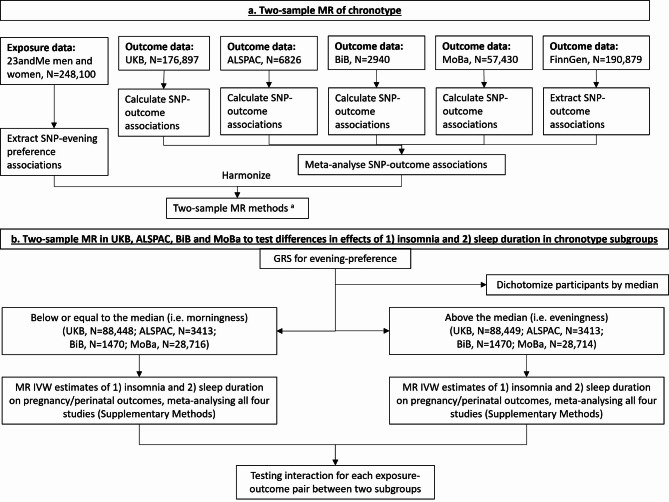
Methods: We conducted two-sample MR using 105 genetic variants reported in a genome-wide association study (N = 248,100) to instrument for lifelong predisposition to evening- versus morning-preference. We generated variant-outcome associations in European ancestry women from UK Biobank (UKB, N = 176,897), Avon Longitudinal Study of Parents and Children (ALSPAC, N = 6826), Born in Bradford (BiB, N = 2940) and the Norwegian Mother, Father and Child Cohort Study (MoBa, N = 57,430), and extracted equivalent associations from FinnGen (N = 190,879). We used inverse variance weighted (IVW) as main analysis, with weighted median and MR-Egger as sensitivity analyses. Relying on the individual participant data from UKB, ALSPAC, BiB and MoBa, we also conducted IVW analyses of insomnia and sleep duration on the pregnancy and perinatal outcomes, stratified by genetically predicted chronotypes.
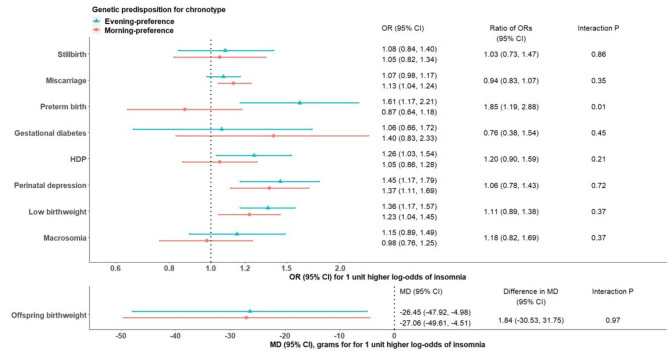
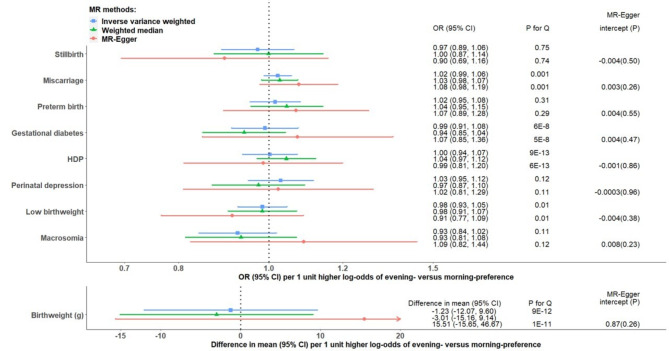
Results: In IVW and sensitivity analyses, we did not find robust evidence of associations of chronotype with the outcomes. Insomnia was associated with a higher risk of preterm birth among evening preference women (odds ratio 1.61, 95% confidence interval: 1.17, 2.21), but not among morning preference women (odds ratio 0.87, 95% confidence interval: 0.64, 1.18), with an interaction P-value = 0.01. There was no evidence of interactions between insomnia and chronotype on other outcomes, or between sleep duration and chronotype on any outcomes.
Conclusions: This study raises the possibility of a higher risk of preterm birth among women with insomnia who also have an evening preference. Our findings warrant replications due to imprecise estimates.
背景:观察性研究表明,睡眠类型与妊娠和围产期结局有关。这些联系是否有因果关系尚不清楚。我们的目的是使用孟德尔随机化(MR)来探索(1)夜间偏好与死产、流产、妊娠糖尿病、妊娠高血压疾病、围产期抑郁症、早产和后代出生体重的关系;(2)不同睡眠类型偏好对失眠和睡眠持续时间影响的差异。方法:我们使用全基因组关联研究中报告的105个遗传变异(N = 248,100)进行了两样本MR,以测量晚睡偏好和早睡偏好的终生倾向。我们从英国生物银行(UKB, N = 176,897)、雅芳父母和孩子纵向研究(ALSPAC, N = 6826)、出生在布拉德福德(BiB, N = 2940)和挪威母亲、父亲和孩子队列研究(MoBa, N = 57,430)中提取了欧洲血统女性的可变结局关联,并从FinnGen (N = 190,879)中提取了等效关联。我们使用逆方差加权(IVW)作为主要分析,加权中位数和MR-Egger作为敏感性分析。根据UKB、ALSPAC、BiB和MoBa的个体参与者数据,我们还对失眠和睡眠时间对妊娠和围产期结局的影响进行了IVW分析,并按基因预测的时型进行了分层。结果:在IVW和敏感性分析中,我们没有发现睡眠类型与结果相关的有力证据。偏好晚睡的女性失眠与早产风险较高相关(优势比1.61,95%可信区间:1.17,2.21),但偏好早睡的女性失眠与早产风险较高相关(优势比0.87,95%可信区间:0.64,1.18),交互作用p值= 0.01。没有证据表明失眠和生物钟对其他结果有相互作用,也没有证据表明睡眠时间和生物钟对任何结果有相互作用。结论:这项研究增加了失眠女性早产的可能性,这些女性也有晚上偏好。由于估计不精确,我们的研究结果值得重复。
期刊介绍:
BMC Pregnancy & Childbirth is an open access, peer-reviewed journal that considers articles on all aspects of pregnancy and childbirth. The journal welcomes submissions on the biomedical aspects of pregnancy, breastfeeding, labor, maternal health, maternity care, trends and sociological aspects of pregnancy and childbirth.



 京公网安备 11010802042870号
京ICP备2023020795号-1
京公网安备 11010802042870号
京ICP备2023020795号-1

 分享
分享
 求助内容:
求助内容: 应助结果提醒方式:
 扫码关注我们
