Prophylactic clip closure in preventing delayed bleeding after colorectal endoscopic submucosal dissection in patients on anticoagulants: a multicenter retrospective cohort study in Japan.
{"title":"Prophylactic clip closure in preventing delayed bleeding after colorectal endoscopic submucosal dissection in patients on anticoagulants: a multicenter retrospective cohort study in Japan.","authors":"Kazunori Takada, Naohisa Yoshida, Yoshikazu Hayashi, Daichi Togo, Shiro Oka, Shusei Fukunaga, Yoshinori Morita, Takemasa Hayashi, Kazuhiro Kozuka, Yosuke Tsuji, Takashi Murakami, Takeshi Yamamura, Yoriaki Komeda, Yoji Takeuchi, Kensuke Shinmura, Hiroko Fukuda, Shinji Yoshii, Shoko Ono, Shinichi Katsuki, Kazumasa Kawashima, Daiki Nemoto, Hiroyuki Yamamoto, Yutaka Saito, Naoto Tamai, Aya Tamura","doi":"10.1055/a-2505-7315","DOIUrl":null,"url":null,"abstract":"<p><strong>Background: </strong> The effectiveness of prophylactic clip closure in reducing the risk of delayed bleeding after colorectal endoscopic submucosal dissection (ESD) is uncertain among patients on anticoagulants. We therefore aimed to assess this effectiveness using data from a large multicenter study.</p><p><strong>Methods: </strong> We used the ABCD-J study database to analyze delayed bleeding among 34 455 colorectal ESD cases from 47 Japanese institutions. Delayed bleeding rates among the no/partial and complete closure groups were compared in patients on direct oral anticoagulants (DOACs) or warfarin. Propensity score matching was used for baseline characteristics to reduce the effects of selection bias.</p><p><strong>Results: </strong> Overall, data from 1478 patients on anticoagulants who underwent colorectal ESD were examined. After propensity score matching, the complete and no/partial closure groups were compared in 212 patients on DOACs and 82 on warfarin. The complete closure group showed a significantly lower delayed bleeding rate in patients receiving DOACs (10.8 % vs. 5.2 %, absolute risk reduction [ARR] 5.7 %, <i>P</i> = 0.048) and warfarin (17.1 % vs. 6.1 %, ARR 11.0 %, <i>P</i> = 0.049). Additionally, complete closure significantly reduced the risk of delayed bleeding among patients taking DOACs for right-sided lesions (ARR 6.7 %, <i>P</i> = 0.04), whereas no risk reduction was observed for left-sided (<i>P</i> > 0.99) or rectal (<i>P</i> = 0.50) lesions. A similar trend was observed among patients on warfarin.</p><p><strong>Conclusions: </strong> Prophylactic complete clip closure after colorectal ESD significantly reduced the delayed bleeding rate in patients receiving DOACs or warfarin. It should be performed after ESD, particularly for right-sided lesions.</p>","PeriodicalId":11516,"journal":{"name":"Endoscopy","volume":" ","pages":"631-642"},"PeriodicalIF":12.8000,"publicationDate":"2025-06-01","publicationTypes":"Journal Article","fieldsOfStudy":null,"isOpenAccess":false,"openAccessPdf":"","citationCount":"0","resultStr":null,"platform":"Semanticscholar","paperid":null,"PeriodicalName":"Endoscopy","FirstCategoryId":"3","ListUrlMain":"https://doi.org/10.1055/a-2505-7315","RegionNum":1,"RegionCategory":"医学","ArticlePicture":[],"TitleCN":null,"AbstractTextCN":null,"PMCID":null,"EPubDate":"2024/12/18 0:00:00","PubModel":"Epub","JCR":"Q1","JCRName":"GASTROENTEROLOGY & HEPATOLOGY","Score":null,"Total":0}
引用次数: 0
Abstract
Background: The effectiveness of prophylactic clip closure in reducing the risk of delayed bleeding after colorectal endoscopic submucosal dissection (ESD) is uncertain among patients on anticoagulants. We therefore aimed to assess this effectiveness using data from a large multicenter study.
Methods: We used the ABCD-J study database to analyze delayed bleeding among 34 455 colorectal ESD cases from 47 Japanese institutions. Delayed bleeding rates among the no/partial and complete closure groups were compared in patients on direct oral anticoagulants (DOACs) or warfarin. Propensity score matching was used for baseline characteristics to reduce the effects of selection bias.
Results: Overall, data from 1478 patients on anticoagulants who underwent colorectal ESD were examined. After propensity score matching, the complete and no/partial closure groups were compared in 212 patients on DOACs and 82 on warfarin. The complete closure group showed a significantly lower delayed bleeding rate in patients receiving DOACs (10.8 % vs. 5.2 %, absolute risk reduction [ARR] 5.7 %, P = 0.048) and warfarin (17.1 % vs. 6.1 %, ARR 11.0 %, P = 0.049). Additionally, complete closure significantly reduced the risk of delayed bleeding among patients taking DOACs for right-sided lesions (ARR 6.7 %, P = 0.04), whereas no risk reduction was observed for left-sided (P > 0.99) or rectal (P = 0.50) lesions. A similar trend was observed among patients on warfarin.
Conclusions: Prophylactic complete clip closure after colorectal ESD significantly reduced the delayed bleeding rate in patients receiving DOACs or warfarin. It should be performed after ESD, particularly for right-sided lesions.
背景与研究目的:在使用抗凝药物的患者中,结肠内镜下粘膜下剥离(ESD)术后预防性夹封对降低延迟性出血(DB)风险的有效性尚不确定。我们的目的是评估预防性夹封在使用抗凝药物的结直肠ESD患者中预防DB的效果。患者和方法:我们使用ABCD-J研究数据库,这是一项大型多中心研究,分析了来自日本47家机构的34,455例结直肠ESD患者的DB。比较直接口服抗凝剂(DOACs)和华法林患者的未/部分闭合组和完全闭合组的DB率。使用基线特征的倾向评分匹配来减少选择偏差的影响。结果:共检查了1478例结直肠ESD抗凝治疗。倾向评分匹配后,对212例DOACs患者和82例华法林患者进行完全闭合组和未闭合组/部分闭合组的比较。完全闭合组接受DOACs的患者的DB率(10.8% vs. 5.2%,绝对风险降低(ARR): 5.7%, P = 0.048)和华法林(17.1% vs. 6.1%, ARR: 11.0%, P = 0.049)显著降低。此外,完全闭合可显著降低右侧病变的DOACs患者的DB风险(ARR: 6.7%, P = 0.041),而左侧病变(P = 1)或直肠病变(P = 0.498)未观察到风险降低。在使用华法林的患者中也观察到类似的趋势。结论:结肠ESD后预防性完全闭合夹子可显著降低DOACs和华法林患者的DB率。应在ESD后进行,尤其是右侧病变。
期刊介绍:
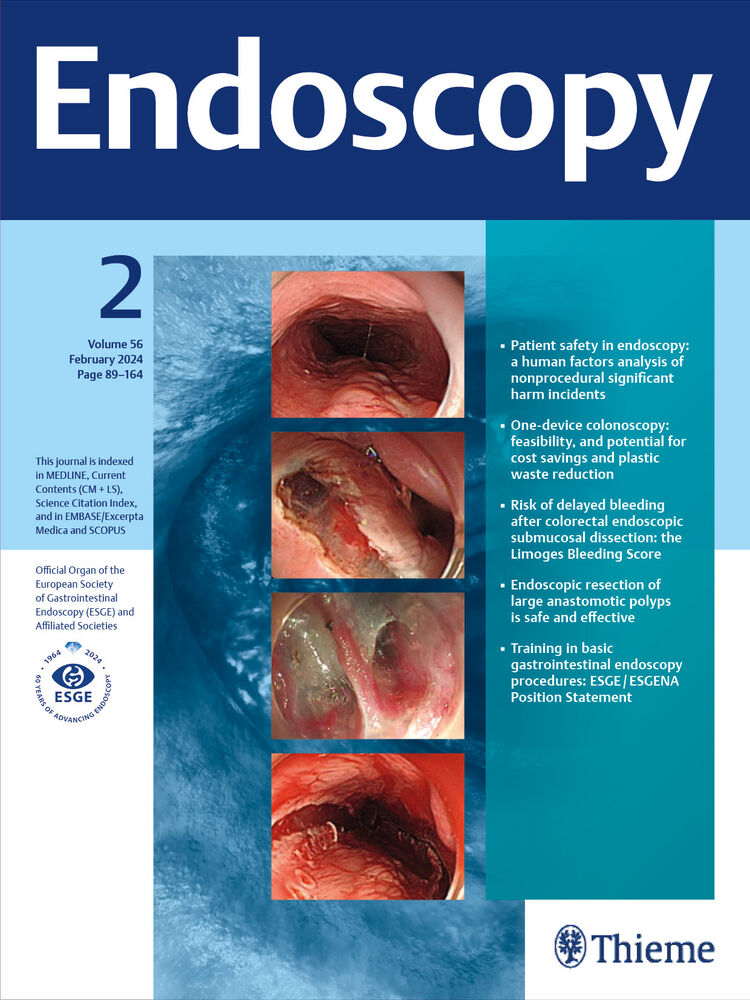
Endoscopy is a leading journal covering the latest technologies and global advancements in gastrointestinal endoscopy. With guidance from an international editorial board, it delivers high-quality content catering to the needs of endoscopists, surgeons, clinicians, and researchers worldwide. Publishing 12 issues each year, Endoscopy offers top-quality review articles, original contributions, prospective studies, surveys of diagnostic and therapeutic advances, and comprehensive coverage of key national and international meetings. Additionally, articles often include supplementary online video content.



 京公网安备 11010802042870号
京ICP备2023020795号-1
京公网安备 11010802042870号
京ICP备2023020795号-1

 分享
分享
 求助内容:
求助内容: 应助结果提醒方式:
 扫码关注我们
