Anna Crepaldi, Giovanni Piva, Nicola Lamberti, Michele Felisatti, Luca Pomidori, Yuri Battaglia, Fabio Manfredini, Alda Storari, Pablo Jesús López-Soto
{"title":"Supervised <i>vs</i> home-based exercise program in kidney transplant recipients: A pilot pragmatic non-randomized study.","authors":"Anna Crepaldi, Giovanni Piva, Nicola Lamberti, Michele Felisatti, Luca Pomidori, Yuri Battaglia, Fabio Manfredini, Alda Storari, Pablo Jesús López-Soto","doi":"10.5500/wjt.v14.i4.96244","DOIUrl":null,"url":null,"abstract":"<p><strong>Background: </strong>Although the benefits of exercise for kidney transplant recipients (KTRs) have been widely demonstrated, these patients experience several barriers in undertaking a structured exercise program in hospital and non-hospital facilities.</p><p><strong>Aim: </strong>To compare the effects of a supervised moderate-intensity gym-based intervention with a home-based low-intensity walking program on exercise capacity in KTRs.</p><p><strong>Methods: </strong>KTRs were asked to choose between two six-month programs. The first group performed a low-intensity interval walking intervention at home-based exercise intervention (HBex). The second group performed a supervised training program at an adapted physical activity gym (Sgym), including aerobic and resistance training. The outcomes, collected at baseline and at the end of the programs, included the 6-minute walking test, the peak oxygen consumption (VO2peak) during a treadmill test, the 5-time sit-to-stand test, and blood pressure.</p><p><strong>Results: </strong>Seventeen patients agreed to participate and self-selected into the HBex (<i>n</i> = 9) and Sgym (<i>n</i> = 8) groups. Two patients in the Sgym group dropped out because of familial problems. At baseline, patients in the HBex group were significantly older and had lower walking distance, VO2peak, and lower limb strength. Primary outcome changes were significantly greater in the HBex group than in the Sgym group (52 ± 23 m <i>vs</i> 8 ± 34; <i>P</i> = 0.005). No other significant differences between groups were observed. Both groups improved most of the outcomes in the within-group comparisons, with significant variations in VO2 peak.</p><p><strong>Conclusion: </strong>Six-month moderate-intensity supervised or low-intensity home-based training programs effectively improved exercise capacity in KTRs. Gym-based programs combine aerobic and resistance training; however, in-home walking may be proposed for frail KTRs.</p>","PeriodicalId":68893,"journal":{"name":"世界移植杂志(英文版)","volume":"14 4","pages":"96244"},"PeriodicalIF":0.0000,"publicationDate":"2024-12-18","publicationTypes":"Journal Article","fieldsOfStudy":null,"isOpenAccess":false,"openAccessPdf":"https://www.ncbi.nlm.nih.gov/pmc/articles/PMC11438937/pdf/","citationCount":"0","resultStr":null,"platform":"Semanticscholar","paperid":null,"PeriodicalName":"世界移植杂志(英文版)","FirstCategoryId":"3","ListUrlMain":"https://doi.org/10.5500/wjt.v14.i4.96244","RegionNum":0,"RegionCategory":null,"ArticlePicture":[],"TitleCN":null,"AbstractTextCN":null,"PMCID":null,"EPubDate":"","PubModel":"","JCR":"","JCRName":"","Score":null,"Total":0}
引用次数: 0
Abstract
Background: Although the benefits of exercise for kidney transplant recipients (KTRs) have been widely demonstrated, these patients experience several barriers in undertaking a structured exercise program in hospital and non-hospital facilities.
Aim: To compare the effects of a supervised moderate-intensity gym-based intervention with a home-based low-intensity walking program on exercise capacity in KTRs.
Methods: KTRs were asked to choose between two six-month programs. The first group performed a low-intensity interval walking intervention at home-based exercise intervention (HBex). The second group performed a supervised training program at an adapted physical activity gym (Sgym), including aerobic and resistance training. The outcomes, collected at baseline and at the end of the programs, included the 6-minute walking test, the peak oxygen consumption (VO2peak) during a treadmill test, the 5-time sit-to-stand test, and blood pressure.
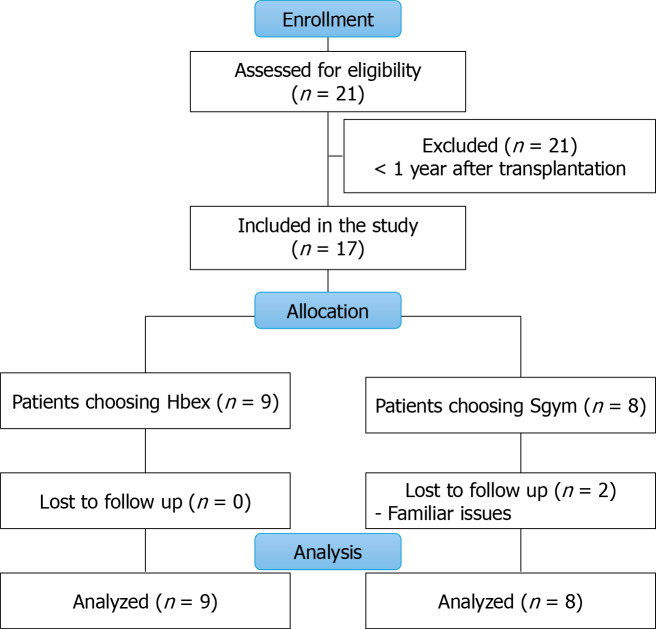
Results: Seventeen patients agreed to participate and self-selected into the HBex (n = 9) and Sgym (n = 8) groups. Two patients in the Sgym group dropped out because of familial problems. At baseline, patients in the HBex group were significantly older and had lower walking distance, VO2peak, and lower limb strength. Primary outcome changes were significantly greater in the HBex group than in the Sgym group (52 ± 23 m vs 8 ± 34; P = 0.005). No other significant differences between groups were observed. Both groups improved most of the outcomes in the within-group comparisons, with significant variations in VO2 peak.
Conclusion: Six-month moderate-intensity supervised or low-intensity home-based training programs effectively improved exercise capacity in KTRs. Gym-based programs combine aerobic and resistance training; however, in-home walking may be proposed for frail KTRs.



 京公网安备 11010802042870号
京ICP备2023020795号-1
京公网安备 11010802042870号
京ICP备2023020795号-1

 分享
分享
 求助内容:
求助内容: 应助结果提醒方式:
 扫码关注我们
