{"title":"NSTEMI and Ischemic Mitral Regurgitation: Incidence and Long-Term Clinical Outcomes with Respect to Management Strategy.","authors":"Pooja Vyas, Radhakishan Dake, Kewal Kanabar, Iva Patel, Ashish Mishra, Vishal Sharma, Tirth Nathwani, Kunal Parwani, Mital Rathod","doi":"10.36660/abc.20240064","DOIUrl":null,"url":null,"abstract":"<p><strong>Background: </strong>The optimal treatment for ischemic mitral regurgitation (IMR) in patients of non-ST elevation myocardial infarction (NSTEMI) is a debated topic.</p><p><strong>Objective: </strong>To evaluate the long term outcome on patients with NSTEMI and IMR, particularly emphasizing the comparison of treatments in those with moderate to severe MR.</p><p><strong>Methods: </strong>We enrolled patients with NSTEMI and classified non/trivial to mild regurgitation as insignificant IMR and moderate to severe regurgitation as significant IMR. Furthermore, patients with substantial IMR were assessed for long-term clinical outcomes with respect to different management strategies. A test was considered statistically significant based on the probability value p<0.05.</p><p><strong>Results: </strong>From a total of 4,189 patients of NSTEMI, significant IMR was found in 7.21% of patients. A significantly higher number of patients with death (1.21% vs. 13.24%, p<0.0001), cardiogenic shock (0.46% vs. 13.24%, p<0.0001) and heart failure (1.03% vs. 11.59%, p<0.0001) were found during hospitalization in patients with significant IMR. At a 2-year follow-up, a higher event rate was observed in the significant IMR group. Patients with significant IMR re-vascularized either by percutaneous coronary intervention (PCI), coronary artery bypass grafting (CABG), or CABG+ mitral valve (MV) surgery showed substantial improvement in MR grade ( 32.65% vs. 6% vs. 16.98%, p<0.0001) and LVEF (27.55% vs. 1% vs. 1.89%, p<0.0001) at 1 year follow up and significantly improved outcomes were identified compared to refused revascularization and medical management group with (-5.10% vs. 15% vs. 13.21%, p=0.04) mortality, (-33.67% vs. 61% vs. 73.58%, p<0.0001) readmission, and (-15.31% vs. 27% vs. 33.96%, p=0.01) heart failure at 2 years follow up.</p><p><strong>Conclusion: </strong>Higher mortality and admission rates were observed in patients with significant IMR compared to those with in-significant IMR. Notably, significant IMR patients who underwent PCI, CABG, or CABG+MV surgery showed improved outcomes compared to non-revascularized counterparts.</p>","PeriodicalId":93887,"journal":{"name":"Arquivos brasileiros de cardiologia","volume":"121 12","pages":"e20240064"},"PeriodicalIF":1.9000,"publicationDate":"2024-11-01","publicationTypes":"Journal Article","fieldsOfStudy":null,"isOpenAccess":false,"openAccessPdf":"https://www.ncbi.nlm.nih.gov/pmc/articles/PMC11634318/pdf/","citationCount":"0","resultStr":null,"platform":"Semanticscholar","paperid":null,"PeriodicalName":"Arquivos brasileiros de cardiologia","FirstCategoryId":"1085","ListUrlMain":"https://doi.org/10.36660/abc.20240064","RegionNum":0,"RegionCategory":null,"ArticlePicture":[],"TitleCN":null,"AbstractTextCN":null,"PMCID":null,"EPubDate":"","PubModel":"","JCR":"","JCRName":"","Score":null,"Total":0}
引用次数: 0
Abstract
Background: The optimal treatment for ischemic mitral regurgitation (IMR) in patients of non-ST elevation myocardial infarction (NSTEMI) is a debated topic.
Objective: To evaluate the long term outcome on patients with NSTEMI and IMR, particularly emphasizing the comparison of treatments in those with moderate to severe MR.
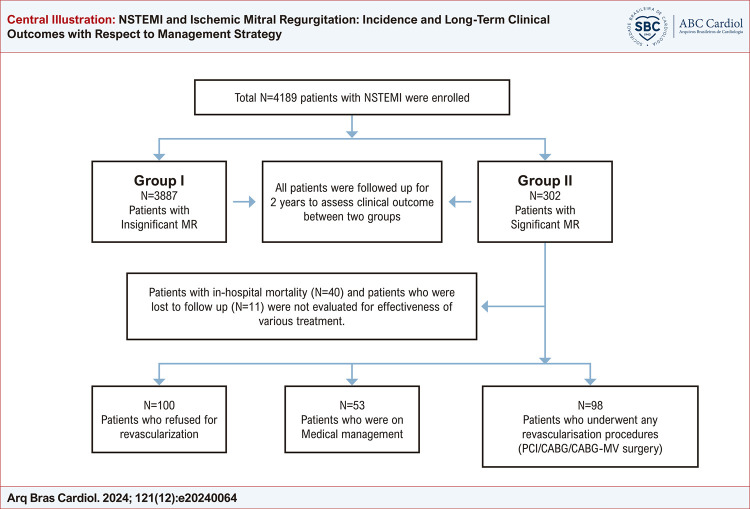
Methods: We enrolled patients with NSTEMI and classified non/trivial to mild regurgitation as insignificant IMR and moderate to severe regurgitation as significant IMR. Furthermore, patients with substantial IMR were assessed for long-term clinical outcomes with respect to different management strategies. A test was considered statistically significant based on the probability value p<0.05.
Results: From a total of 4,189 patients of NSTEMI, significant IMR was found in 7.21% of patients. A significantly higher number of patients with death (1.21% vs. 13.24%, p<0.0001), cardiogenic shock (0.46% vs. 13.24%, p<0.0001) and heart failure (1.03% vs. 11.59%, p<0.0001) were found during hospitalization in patients with significant IMR. At a 2-year follow-up, a higher event rate was observed in the significant IMR group. Patients with significant IMR re-vascularized either by percutaneous coronary intervention (PCI), coronary artery bypass grafting (CABG), or CABG+ mitral valve (MV) surgery showed substantial improvement in MR grade ( 32.65% vs. 6% vs. 16.98%, p<0.0001) and LVEF (27.55% vs. 1% vs. 1.89%, p<0.0001) at 1 year follow up and significantly improved outcomes were identified compared to refused revascularization and medical management group with (-5.10% vs. 15% vs. 13.21%, p=0.04) mortality, (-33.67% vs. 61% vs. 73.58%, p<0.0001) readmission, and (-15.31% vs. 27% vs. 33.96%, p=0.01) heart failure at 2 years follow up.
Conclusion: Higher mortality and admission rates were observed in patients with significant IMR compared to those with in-significant IMR. Notably, significant IMR patients who underwent PCI, CABG, or CABG+MV surgery showed improved outcomes compared to non-revascularized counterparts.
背景:非st段抬高型心肌梗死(NSTEMI)患者缺血性二尖瓣反流(IMR)的最佳治疗是一个有争议的话题。目的:评估NSTEMI和IMR患者的长期预后,特别强调中重度mr患者的治疗比较。方法:我们招募了NSTEMI患者,将非/轻微至轻度反流分类为不显著IMR,将中度至重度反流分类为显著IMR。此外,对重度IMR患者在不同治疗策略下的长期临床结果进行了评估。基于概率值的检验被认为具有统计学意义。结果:在总共4189例NSTEMI患者中,7.21%的患者发现显著的IMR。结论:显著IMR患者的死亡率和住院率高于非显著IMR患者(1.21% vs. 13.24%)。值得注意的是,接受PCI、CABG或CABG+MV手术的显著IMR患者与未行血运重建的患者相比,结果有所改善。



 京公网安备 11010802042870号
京ICP备2023020795号-1
京公网安备 11010802042870号
京ICP备2023020795号-1

 分享
分享

 求助内容:
求助内容: 应助结果提醒方式:
 扫码关注我们
