Guibson da Silva Litaiff, Ricardo Barbosa Lima, Aluísio Eustáquio de Freitas Miranda-Filho, Paulo Nelson-Filho, Raquel Assed Bezerra da Silva, Léa Assed Bezerra da Silva
{"title":"Non-surgical endodontic retreatments in Brazil's public dental services: a 15-year nationwide register-based study.","authors":"Guibson da Silva Litaiff, Ricardo Barbosa Lima, Aluísio Eustáquio de Freitas Miranda-Filho, Paulo Nelson-Filho, Raquel Assed Bezerra da Silva, Léa Assed Bezerra da Silva","doi":"10.1590/0103-644020246004","DOIUrl":null,"url":null,"abstract":"<p><p>The objective of this study was to analyze the provision of non-surgical endodontic retreatments in Brazil's public dental services from 2008 to 2022. A time series was outlined for this purpose. The annual numbers of non-surgical endodontic retreatments were retrieved from the Brazilian National Outpatient Information System and adjusted per 100,000 inhabitants to obtain the incidence between 2008 and 2022. Comparison of the incidence between types of teeth, temporal trend estimation, and evaluation of the COVID-19 pandemic-related impacts were conducted with a significance level of 5%. In this timeframe, 1,270,182 non-surgical endodontic retreatments were carried out. A higher incidence was observed among single-rooted teeth (328/100,000) when compared to double-rooted (183/100,000) and multi-rooted teeth (112/100,000) (p <0.05). The annual incidences showed a significantly decreasing trend over the last 15 years for all types of teeth (p <0.05), as well as demonstrated a highly correlated pattern of temporal variation (p <0.05). In addition, there was no influence on this outcome when removing the period between 2020 and 2022 (all temporal trends remained decreasing). However, the monthly incidence was significantly lower in the first, second, and third years after the COVID-19 pandemic onset (p <0.05). The provision of non-surgical endodontic retreatments in Brazil's public dental services has experienced a dramatic decline over the past 15 years, including after the COVID-19 pandemic.</p>","PeriodicalId":101363,"journal":{"name":"Brazilian dental journal","volume":"35 ","pages":"e246004"},"PeriodicalIF":0.0000,"publicationDate":"2024-12-16","publicationTypes":"Journal Article","fieldsOfStudy":null,"isOpenAccess":false,"openAccessPdf":"https://www.ncbi.nlm.nih.gov/pmc/articles/PMC11653991/pdf/","citationCount":"0","resultStr":null,"platform":"Semanticscholar","paperid":null,"PeriodicalName":"Brazilian dental journal","FirstCategoryId":"1085","ListUrlMain":"https://doi.org/10.1590/0103-644020246004","RegionNum":0,"RegionCategory":null,"ArticlePicture":[],"TitleCN":null,"AbstractTextCN":null,"PMCID":null,"EPubDate":"2024/1/1 0:00:00","PubModel":"eCollection","JCR":"","JCRName":"","Score":null,"Total":0}
引用次数: 0
Abstract
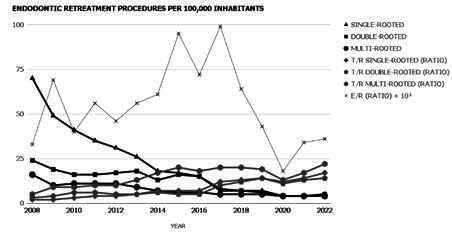
The objective of this study was to analyze the provision of non-surgical endodontic retreatments in Brazil's public dental services from 2008 to 2022. A time series was outlined for this purpose. The annual numbers of non-surgical endodontic retreatments were retrieved from the Brazilian National Outpatient Information System and adjusted per 100,000 inhabitants to obtain the incidence between 2008 and 2022. Comparison of the incidence between types of teeth, temporal trend estimation, and evaluation of the COVID-19 pandemic-related impacts were conducted with a significance level of 5%. In this timeframe, 1,270,182 non-surgical endodontic retreatments were carried out. A higher incidence was observed among single-rooted teeth (328/100,000) when compared to double-rooted (183/100,000) and multi-rooted teeth (112/100,000) (p <0.05). The annual incidences showed a significantly decreasing trend over the last 15 years for all types of teeth (p <0.05), as well as demonstrated a highly correlated pattern of temporal variation (p <0.05). In addition, there was no influence on this outcome when removing the period between 2020 and 2022 (all temporal trends remained decreasing). However, the monthly incidence was significantly lower in the first, second, and third years after the COVID-19 pandemic onset (p <0.05). The provision of non-surgical endodontic retreatments in Brazil's public dental services has experienced a dramatic decline over the past 15 years, including after the COVID-19 pandemic.



 京公网安备 11010802042870号
京ICP备2023020795号-1
京公网安备 11010802042870号
京ICP备2023020795号-1

 分享
分享

 求助内容:
求助内容: 应助结果提醒方式:
 扫码关注我们
