Anna Marseglia, Caroline Dartora, Jessica Samuelsson, Konstantinos Poulakis, Rosaleena Mohanty, Sara Shams, Olof Lindberg, Lina Rydén, Therese Rydberg Sterner, Johan Skoog, Anna Zettergren, Silke Kern, Ingmar Skoog, Eric Westman
{"title":"Biological brain age and resilience in cognitively unimpaired 70-year-old individuals","authors":"Anna Marseglia, Caroline Dartora, Jessica Samuelsson, Konstantinos Poulakis, Rosaleena Mohanty, Sara Shams, Olof Lindberg, Lina Rydén, Therese Rydberg Sterner, Johan Skoog, Anna Zettergren, Silke Kern, Ingmar Skoog, Eric Westman","doi":"10.1002/alz.14435","DOIUrl":null,"url":null,"abstract":"<div>\n \n \n <section>\n \n <h3> INTRODUCTION</h3>\n \n <p>This study investigated the associations of brain age gap (BAG)—a biological marker of brain resilience—with life exposures, neuroimaging measures, biological processes, and cognitive function.</p>\n </section>\n \n <section>\n \n <h3> METHODS</h3>\n \n <p>We derived BAG by subtracting predicted brain age from chronological age in 739 septuagenarians without dementia or neurological disorders. Robust linear regression models assessed BAG associations with life exposures, plasma inflammatory and metabolic biomarkers, magnetic resonance imaging, and cerebrospinal fluid biomarkers of neurodegeneration and vascular brain injury, and cognitive performance.</p>\n </section>\n \n <section>\n \n <h3> RESULTS</h3>\n \n <p>Greater BAG (older-looking brains) was associated with physical inactivity, diabetes, and stroke, while prediabetes was related to lower BAG, that is, younger-looking brains. Physical activity mitigated the link between obesity and BAG. Greater BAG was associated with greater small vessel disease burden, white-matter alterations, inflammation, high glucose, poorer vascular-related cognitive domains. Sex-specific associations were identified.</p>\n </section>\n \n <section>\n \n <h3> DISCUSSION</h3>\n \n <p>Vascular-related lifestyles and health shape brain appearance. Inflammation and insulin-related processes may be keys to understanding vascular cognitive disorders.</p>\n </section>\n \n <section>\n \n <h3> Highlights</h3>\n \n <div>\n <ul>\n \n <li>BAG, reflecting deviations from CA, can indicate resilience.</li>\n \n <li>Diabetes, stroke, and low physical activity link to “older” brains (greater BAG).</li>\n \n <li>Physical activity yielded to “younger” brains in septuagenarians with obesity.</li>\n \n <li>High cerebrovascular burden, inflammation, and glucose associate with “older” brains.</li>\n \n <li>Sex differences were detected in all BAG-associated factors.</li>\n </ul>\n </div>\n </section>\n </div>","PeriodicalId":7471,"journal":{"name":"Alzheimer's & Dementia","volume":"21 2","pages":""},"PeriodicalIF":11.1000,"publicationDate":"2024-12-20","publicationTypes":"Journal Article","fieldsOfStudy":null,"isOpenAccess":false,"openAccessPdf":"https://onlinelibrary.wiley.com/doi/epdf/10.1002/alz.14435","citationCount":"0","resultStr":null,"platform":"Semanticscholar","paperid":null,"PeriodicalName":"Alzheimer's & Dementia","FirstCategoryId":"3","ListUrlMain":"https://alz-journals.onlinelibrary.wiley.com/doi/10.1002/alz.14435","RegionNum":1,"RegionCategory":"医学","ArticlePicture":[],"TitleCN":null,"AbstractTextCN":null,"PMCID":null,"EPubDate":"","PubModel":"","JCR":"Q1","JCRName":"CLINICAL NEUROLOGY","Score":null,"Total":0}
引用次数: 0
Abstract
INTRODUCTION
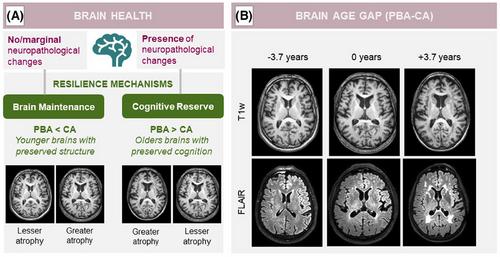
This study investigated the associations of brain age gap (BAG)—a biological marker of brain resilience—with life exposures, neuroimaging measures, biological processes, and cognitive function.
METHODS
We derived BAG by subtracting predicted brain age from chronological age in 739 septuagenarians without dementia or neurological disorders. Robust linear regression models assessed BAG associations with life exposures, plasma inflammatory and metabolic biomarkers, magnetic resonance imaging, and cerebrospinal fluid biomarkers of neurodegeneration and vascular brain injury, and cognitive performance.
RESULTS
Greater BAG (older-looking brains) was associated with physical inactivity, diabetes, and stroke, while prediabetes was related to lower BAG, that is, younger-looking brains. Physical activity mitigated the link between obesity and BAG. Greater BAG was associated with greater small vessel disease burden, white-matter alterations, inflammation, high glucose, poorer vascular-related cognitive domains. Sex-specific associations were identified.
DISCUSSION
Vascular-related lifestyles and health shape brain appearance. Inflammation and insulin-related processes may be keys to understanding vascular cognitive disorders.
Highlights
BAG, reflecting deviations from CA, can indicate resilience.
Diabetes, stroke, and low physical activity link to “older” brains (greater BAG).
Physical activity yielded to “younger” brains in septuagenarians with obesity.
High cerebrovascular burden, inflammation, and glucose associate with “older” brains.
Sex differences were detected in all BAG-associated factors.
期刊介绍:
Alzheimer's & Dementia is a peer-reviewed journal that aims to bridge knowledge gaps in dementia research by covering the entire spectrum, from basic science to clinical trials to social and behavioral investigations. It provides a platform for rapid communication of new findings and ideas, optimal translation of research into practical applications, increasing knowledge across diverse disciplines for early detection, diagnosis, and intervention, and identifying promising new research directions. In July 2008, Alzheimer's & Dementia was accepted for indexing by MEDLINE, recognizing its scientific merit and contribution to Alzheimer's research.






 京公网安备 11010802042870号
京ICP备2023020795号-1
京公网安备 11010802042870号
京ICP备2023020795号-1

 分享
分享
 求助内容:
求助内容: 应助结果提醒方式:
 扫码关注我们
