Mikhail D. Magnitov, Michela Maresca, Noemí Alonso Saiz, Hans Teunissen, Jinhong Dong, Kizhakke M. Sathyan, Luca Braccioli, Michael J. Guertin, Elzo de Wit
{"title":"ZNF143 is a transcriptional regulator of nuclear-encoded mitochondrial genes that acts independently of looping and CTCF","authors":"Mikhail D. Magnitov, Michela Maresca, Noemí Alonso Saiz, Hans Teunissen, Jinhong Dong, Kizhakke M. Sathyan, Luca Braccioli, Michael J. Guertin, Elzo de Wit","doi":"10.1016/j.molcel.2024.11.031","DOIUrl":null,"url":null,"abstract":"Gene expression is orchestrated by transcription factors, which function within the context of a three-dimensional genome. Zinc-finger protein 143 (ZNF143/ZFP143) is a transcription factor that has been implicated in both gene activation and chromatin looping. To study the direct consequences of ZNF143/ZFP143 loss, we generated a ZNF143/ZFP143 depletion system in mouse embryonic stem cells. Our results show that ZNF143/ZFP143 degradation has no effect on chromatin looping. Systematic analysis of ZNF143/ZFP143 occupancy data revealed that a commonly used antibody cross-reacts with CTCF, leading to its incorrect association with chromatin loops. Nevertheless, ZNF143/ZFP143 specifically activates nuclear-encoded mitochondrial genes, and its loss leads to severe mitochondrial dysfunction. Using an <em>in vitro</em> embryo model, we find that ZNF143/ZFP143 is an essential regulator of organismal development. Our results establish ZNF143/ZFP143 as a conserved transcriptional regulator of cell proliferation and differentiation by safeguarding mitochondrial activity.","PeriodicalId":18950,"journal":{"name":"Molecular Cell","volume":"113 1","pages":""},"PeriodicalIF":16.6000,"publicationDate":"2024-12-20","publicationTypes":"Journal Article","fieldsOfStudy":null,"isOpenAccess":false,"openAccessPdf":"","citationCount":"0","resultStr":null,"platform":"Semanticscholar","paperid":null,"PeriodicalName":"Molecular Cell","FirstCategoryId":"99","ListUrlMain":"https://doi.org/10.1016/j.molcel.2024.11.031","RegionNum":1,"RegionCategory":"生物学","ArticlePicture":[],"TitleCN":null,"AbstractTextCN":null,"PMCID":null,"EPubDate":"","PubModel":"","JCR":"Q1","JCRName":"BIOCHEMISTRY & MOLECULAR BIOLOGY","Score":null,"Total":0}
引用次数: 0
Abstract
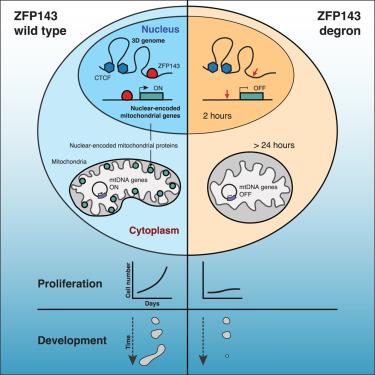
Gene expression is orchestrated by transcription factors, which function within the context of a three-dimensional genome. Zinc-finger protein 143 (ZNF143/ZFP143) is a transcription factor that has been implicated in both gene activation and chromatin looping. To study the direct consequences of ZNF143/ZFP143 loss, we generated a ZNF143/ZFP143 depletion system in mouse embryonic stem cells. Our results show that ZNF143/ZFP143 degradation has no effect on chromatin looping. Systematic analysis of ZNF143/ZFP143 occupancy data revealed that a commonly used antibody cross-reacts with CTCF, leading to its incorrect association with chromatin loops. Nevertheless, ZNF143/ZFP143 specifically activates nuclear-encoded mitochondrial genes, and its loss leads to severe mitochondrial dysfunction. Using an in vitro embryo model, we find that ZNF143/ZFP143 is an essential regulator of organismal development. Our results establish ZNF143/ZFP143 as a conserved transcriptional regulator of cell proliferation and differentiation by safeguarding mitochondrial activity.
期刊介绍:
Molecular Cell is a companion to Cell, the leading journal of biology and the highest-impact journal in the world. Launched in December 1997 and published monthly. Molecular Cell is dedicated to publishing cutting-edge research in molecular biology, focusing on fundamental cellular processes. The journal encompasses a wide range of topics, including DNA replication, recombination, and repair; Chromatin biology and genome organization; Transcription; RNA processing and decay; Non-coding RNA function; Translation; Protein folding, modification, and quality control; Signal transduction pathways; Cell cycle and checkpoints; Cell death; Autophagy; Metabolism.



 京公网安备 11010802042870号
京ICP备2023020795号-1
京公网安备 11010802042870号
京ICP备2023020795号-1

 分享
分享
 求助内容:
求助内容: 应助结果提醒方式:
 扫码关注我们
