Maja Žutić, Marijana Matijaš, Jasminka Štefulj, Maja Brekalo, Sandra Nakić Radoš
{"title":"Gestational diabetes mellitus and peripartum depression: a longitudinal study of a bidirectional relationship.","authors":"Maja Žutić, Marijana Matijaš, Jasminka Štefulj, Maja Brekalo, Sandra Nakić Radoš","doi":"10.1186/s12884-024-07046-1","DOIUrl":null,"url":null,"abstract":"<p><strong>Background: </strong>Gestational diabetes mellitus (GDM) and peripartum depression (PPD) are increasing global health issues with potentially long-lasting adverse outcomes. While limited studies suggest a bidirectional relationship between GDM and PPD, most research has been cross-sectional and focused on one direction of the relationship, primarily if GDM predicts postpartum depression. The interplay between antenatal depression and GDM is less explored, with a critical lack of prospective bidirectional studies. This longitudinal study aimed to investigate the bidirectional relationship between GDM and PPD in a total sample and according to different pre-pregnancy body mass index (BMI) categories. Specifically, we examined whether antenatal depression symptoms predict a subsequent GDM diagnosis and whether GDM predicts subsequent postpartum depression symptoms.</p><p><strong>Methods: </strong>A three-wave online longitudinal study included 360 women who were followed from the second trimester (20-28 weeks, T1) through the third trimester (32-42 weeks, T2), and into the postpartum period (6-20 weeks after birth, T3). Participants completed the General Data Questionnaire, one item about the diagnosis of GDM, and the Edinburgh Postnatal Depression Scale (EPDS). The sample was stratified according to pre-pregnancy BMI into normal-weight (N = 247) and overweight/obese (N = 113) subgroups. Women with type I and II diabetes, GDM at T1, and underweight BMI were excluded.</p><p><strong>Results: </strong>In the total sample, antenatal depression symptoms predicted GDM, whereas GDM did not predict postpartum depression symptoms. A bidirectional relationship was observed in normal-weight women, where antenatal depression symptoms predicted subsequent GDM diagnosis, and GDM diagnosis predicted postpartum depression symptoms. In contrast, no associations were found in either direction in the overweight/obese subgroup.</p><p><strong>Conclusions: </strong>This study provides evidence of a bidirectional relationship between GDM and PPD only in women with normal body weight before pregnancy. The results highlight the complexity of the relationship between peripartum mental and metabolic health, that is dependent on pre-pregnancy BMI. Clinicians should be aware that normal-weight women may have a unique sensitivity to the bidirectional interplay between GDM and PPD. Pregnant women should be closely monitored for both mental and metabolic health issues and targeted for prevention programs to reduce the risks and burdens associated with both conditions.</p>","PeriodicalId":9033,"journal":{"name":"BMC Pregnancy and Childbirth","volume":"24 1","pages":"821"},"PeriodicalIF":2.7000,"publicationDate":"2024-12-19","publicationTypes":"Journal Article","fieldsOfStudy":null,"isOpenAccess":false,"openAccessPdf":"https://www.ncbi.nlm.nih.gov/pmc/articles/PMC11660631/pdf/","citationCount":"0","resultStr":null,"platform":"Semanticscholar","paperid":null,"PeriodicalName":"BMC Pregnancy and Childbirth","FirstCategoryId":"3","ListUrlMain":"https://doi.org/10.1186/s12884-024-07046-1","RegionNum":2,"RegionCategory":"医学","ArticlePicture":[],"TitleCN":null,"AbstractTextCN":null,"PMCID":null,"EPubDate":"","PubModel":"","JCR":"Q1","JCRName":"OBSTETRICS & GYNECOLOGY","Score":null,"Total":0}
引用次数: 0
Abstract
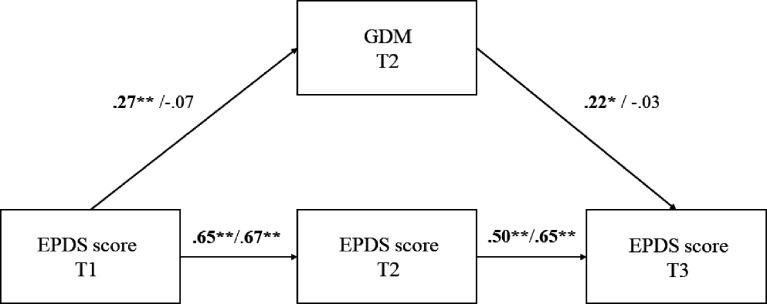
Background: Gestational diabetes mellitus (GDM) and peripartum depression (PPD) are increasing global health issues with potentially long-lasting adverse outcomes. While limited studies suggest a bidirectional relationship between GDM and PPD, most research has been cross-sectional and focused on one direction of the relationship, primarily if GDM predicts postpartum depression. The interplay between antenatal depression and GDM is less explored, with a critical lack of prospective bidirectional studies. This longitudinal study aimed to investigate the bidirectional relationship between GDM and PPD in a total sample and according to different pre-pregnancy body mass index (BMI) categories. Specifically, we examined whether antenatal depression symptoms predict a subsequent GDM diagnosis and whether GDM predicts subsequent postpartum depression symptoms.
Methods: A three-wave online longitudinal study included 360 women who were followed from the second trimester (20-28 weeks, T1) through the third trimester (32-42 weeks, T2), and into the postpartum period (6-20 weeks after birth, T3). Participants completed the General Data Questionnaire, one item about the diagnosis of GDM, and the Edinburgh Postnatal Depression Scale (EPDS). The sample was stratified according to pre-pregnancy BMI into normal-weight (N = 247) and overweight/obese (N = 113) subgroups. Women with type I and II diabetes, GDM at T1, and underweight BMI were excluded.
Results: In the total sample, antenatal depression symptoms predicted GDM, whereas GDM did not predict postpartum depression symptoms. A bidirectional relationship was observed in normal-weight women, where antenatal depression symptoms predicted subsequent GDM diagnosis, and GDM diagnosis predicted postpartum depression symptoms. In contrast, no associations were found in either direction in the overweight/obese subgroup.
Conclusions: This study provides evidence of a bidirectional relationship between GDM and PPD only in women with normal body weight before pregnancy. The results highlight the complexity of the relationship between peripartum mental and metabolic health, that is dependent on pre-pregnancy BMI. Clinicians should be aware that normal-weight women may have a unique sensitivity to the bidirectional interplay between GDM and PPD. Pregnant women should be closely monitored for both mental and metabolic health issues and targeted for prevention programs to reduce the risks and burdens associated with both conditions.
期刊介绍:
BMC Pregnancy & Childbirth is an open access, peer-reviewed journal that considers articles on all aspects of pregnancy and childbirth. The journal welcomes submissions on the biomedical aspects of pregnancy, breastfeeding, labor, maternal health, maternity care, trends and sociological aspects of pregnancy and childbirth.



 京公网安备 11010802042870号
京ICP备2023020795号-1
京公网安备 11010802042870号
京ICP备2023020795号-1

 分享
分享
 求助内容:
求助内容: 应助结果提醒方式:
 扫码关注我们
