Jesus Lopez-Alcalde, L Susan Wieland, Yuqian Yan, Jürgen Barth, Mohammad Reza Khami, Siddharudha Shivalli, Cynthia Lokker, Harleen Kaur Rai, Paul Macharia, Sergi Yun, Elvira Lang, Agnes Bwanika Naggirinya, Concepción Campos-Asensio, Leila Ahmadian, Claudia M Witt
{"title":"Methodological Challenges in Randomized Controlled Trials of mHealth Interventions: Cross-Sectional Survey Study and Consensus-Based Recommendations.","authors":"Jesus Lopez-Alcalde, L Susan Wieland, Yuqian Yan, Jürgen Barth, Mohammad Reza Khami, Siddharudha Shivalli, Cynthia Lokker, Harleen Kaur Rai, Paul Macharia, Sergi Yun, Elvira Lang, Agnes Bwanika Naggirinya, Concepción Campos-Asensio, Leila Ahmadian, Claudia M Witt","doi":"10.2196/53187","DOIUrl":null,"url":null,"abstract":"<p><strong>Background: </strong>Mobile health (mHealth) refers to using mobile communication devices such as smartphones to support health, health care, and public health. mHealth interventions have their own nature and characteristics that distinguish them from traditional health care interventions, including drug interventions. Thus, randomized controlled trials (RCTs) of mHealth interventions present specific methodological challenges. Identifying and overcoming those challenges is essential to determine whether mHealth interventions improve health outcomes.</p><p><strong>Objective: </strong>We aimed to identify specific methodological challenges in RCTs testing mHealth interventions' effects and develop consensus-based recommendations to address selected challenges.</p><p><strong>Methods: </strong>A 2-phase participatory research project was conducted. First, we sent a web-based survey to authors of mHealth RCTs. Survey respondents rated on a 5-point scale how challenging they found 21 methodological aspects in mHealth RCTs compared to non-mHealth RCTs. Nonsystematic searches until June 2022 informed the selection of the methodological challenges listed in the survey. Second, a subset of survey respondents participated in an online workshop to discuss recommendations to address selected methodological aspects identified in the survey. Finally, consensus-based recommendations were developed based on the workshop discussion and email interaction.</p><p><strong>Results: </strong>We contacted 1535 authors of mHealth intervention RCTs, of whom 80 (5.21%) completed the survey. Most respondents (74/80, 92%) identified at least one methodological aspect as more or much more challenging in mHealth RCTs. The aspects most frequently reported as more or much more challenging were those related to mHealth intervention integrity, that is, the degree to which the study intervention was implemented as intended, in particular managing low adherence to the mHealth intervention (43/77, 56%), defining adherence (39/79, 49%), measuring adherence (33/78, 42%), and determining which mHealth intervention components are used or received by the participant (31/75, 41%). Other challenges were also frequent, such as analyzing passive data (eg, data collected from smartphone sensors; 24/58, 41%) and verifying the participants' identity during recruitment (28/68, 41%). In total, 11 survey respondents participated in the subsequent workshop (n=8, 73% had been involved in at least 2 mHealth RCTs). We developed 17 consensus-based recommendations related to the following four categories: (1) how to measure adherence to the mHealth intervention (7 recommendations), (2) defining adequate adherence (2 recommendations), (3) dealing with low adherence rates (3 recommendations), and (4) addressing mHealth intervention components (5 recommendations).</p><p><strong>Conclusions: </strong>RCTs of mHealth interventions have specific methodological challenges compared to those of non-mHealth interventions, particularly those related to intervention integrity. Following our recommendations for addressing these challenges can lead to more reliable assessments of the effects of mHealth interventions on health outcomes.</p>","PeriodicalId":16337,"journal":{"name":"Journal of Medical Internet Research","volume":"26 ","pages":"e53187"},"PeriodicalIF":6.0000,"publicationDate":"2024-12-19","publicationTypes":"Journal Article","fieldsOfStudy":null,"isOpenAccess":false,"openAccessPdf":"https://www.ncbi.nlm.nih.gov/pmc/articles/PMC11695959/pdf/","citationCount":"0","resultStr":null,"platform":"Semanticscholar","paperid":null,"PeriodicalName":"Journal of Medical Internet Research","FirstCategoryId":"3","ListUrlMain":"https://doi.org/10.2196/53187","RegionNum":2,"RegionCategory":"医学","ArticlePicture":[],"TitleCN":null,"AbstractTextCN":null,"PMCID":null,"EPubDate":"","PubModel":"","JCR":"Q1","JCRName":"HEALTH CARE SCIENCES & SERVICES","Score":null,"Total":0}
引用次数: 0
Abstract
Background: Mobile health (mHealth) refers to using mobile communication devices such as smartphones to support health, health care, and public health. mHealth interventions have their own nature and characteristics that distinguish them from traditional health care interventions, including drug interventions. Thus, randomized controlled trials (RCTs) of mHealth interventions present specific methodological challenges. Identifying and overcoming those challenges is essential to determine whether mHealth interventions improve health outcomes.
Objective: We aimed to identify specific methodological challenges in RCTs testing mHealth interventions' effects and develop consensus-based recommendations to address selected challenges.
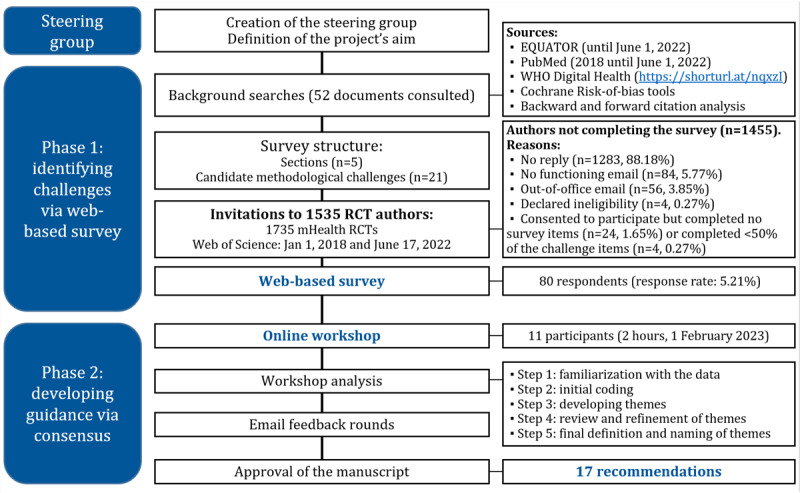
Methods: A 2-phase participatory research project was conducted. First, we sent a web-based survey to authors of mHealth RCTs. Survey respondents rated on a 5-point scale how challenging they found 21 methodological aspects in mHealth RCTs compared to non-mHealth RCTs. Nonsystematic searches until June 2022 informed the selection of the methodological challenges listed in the survey. Second, a subset of survey respondents participated in an online workshop to discuss recommendations to address selected methodological aspects identified in the survey. Finally, consensus-based recommendations were developed based on the workshop discussion and email interaction.
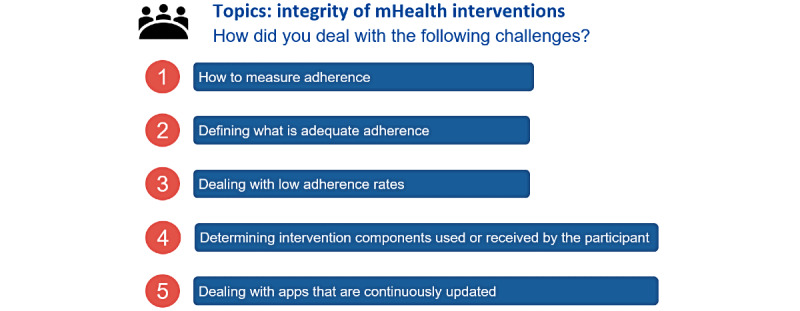
Results: We contacted 1535 authors of mHealth intervention RCTs, of whom 80 (5.21%) completed the survey. Most respondents (74/80, 92%) identified at least one methodological aspect as more or much more challenging in mHealth RCTs. The aspects most frequently reported as more or much more challenging were those related to mHealth intervention integrity, that is, the degree to which the study intervention was implemented as intended, in particular managing low adherence to the mHealth intervention (43/77, 56%), defining adherence (39/79, 49%), measuring adherence (33/78, 42%), and determining which mHealth intervention components are used or received by the participant (31/75, 41%). Other challenges were also frequent, such as analyzing passive data (eg, data collected from smartphone sensors; 24/58, 41%) and verifying the participants' identity during recruitment (28/68, 41%). In total, 11 survey respondents participated in the subsequent workshop (n=8, 73% had been involved in at least 2 mHealth RCTs). We developed 17 consensus-based recommendations related to the following four categories: (1) how to measure adherence to the mHealth intervention (7 recommendations), (2) defining adequate adherence (2 recommendations), (3) dealing with low adherence rates (3 recommendations), and (4) addressing mHealth intervention components (5 recommendations).
Conclusions: RCTs of mHealth interventions have specific methodological challenges compared to those of non-mHealth interventions, particularly those related to intervention integrity. Following our recommendations for addressing these challenges can lead to more reliable assessments of the effects of mHealth interventions on health outcomes.
期刊介绍:
The Journal of Medical Internet Research (JMIR) is a highly respected publication in the field of health informatics and health services. With a founding date in 1999, JMIR has been a pioneer in the field for over two decades.
As a leader in the industry, the journal focuses on digital health, data science, health informatics, and emerging technologies for health, medicine, and biomedical research. It is recognized as a top publication in these disciplines, ranking in the first quartile (Q1) by Impact Factor.
Notably, JMIR holds the prestigious position of being ranked #1 on Google Scholar within the "Medical Informatics" discipline.



 京公网安备 11010802042870号
京ICP备2023020795号-1
京公网安备 11010802042870号
京ICP备2023020795号-1

 分享
分享

 求助内容:
求助内容: 应助结果提醒方式:
 扫码关注我们
