Pia Lundgren, Aldina Pivodic, Anders K. Nilsson, Gunnel Hellgren, Hanna Danielsson, Dirk Wackernagel, Ingrid Hansen Pupp, David Ley, Karin Sävman, Mattias Uhlén, Lois E. H. Smith, Ann Hellström
{"title":"Platelet characteristics in extremely preterm infants after fatty acid supplementation: a randomized controlled trial","authors":"Pia Lundgren, Aldina Pivodic, Anders K. Nilsson, Gunnel Hellgren, Hanna Danielsson, Dirk Wackernagel, Ingrid Hansen Pupp, David Ley, Karin Sävman, Mattias Uhlén, Lois E. H. Smith, Ann Hellström","doi":"10.1038/s41390-024-03775-3","DOIUrl":null,"url":null,"abstract":"Two risk factors for severe retinopathy of prematurity (ROP) in extremely preterm infants are thrombocytopenia and low levels of arachidonic acid (AA) and docosahexaenoic acid (DHA). To date, these risk factors have not been linked. Infants born < 28 weeks gestational age (GA) from 2016 to 2019 were randomized to postnatal enteral AA/DHA supplementation or standard care (controls). Levels of AA and DHA, platelet counts ( < 100 × 109/L defined as thrombocytopenia) and platelet-related proteins in the infants’ first four weeks of life were evaluated for their association with severe ROP. The mean birthweight of 178 included infants was 806 ± 200 grams, and the mean GA was 25.6 ± 1.4 weeks. During the first four postnatal weeks, 20.2% of AA/DHA-supplemented infants had thrombocytopenia versus 27.7% of controls (p = 0.29). In infants with thrombocytopenia, fewer AA/DHA-supplemented infants developed severe ROP than non-supplemented controls, 29.4% (5/17) versus 65.4% (17/26) (p = 0.031). Thrombocytopenia and serum levels of AA and DHA correlated with several platelet-related proteins involved in angiogenesis and ROP, such as platelet-derived growth factor subunits A and B and vascular endothelial growth factor. AA and DHA supplementation is associated with less severe ROP in thrombocytopenic infants, possibly by modulating platelet activation and function.","PeriodicalId":19829,"journal":{"name":"Pediatric Research","volume":"98 2","pages":"680-689"},"PeriodicalIF":3.1000,"publicationDate":"2024-12-19","publicationTypes":"Journal Article","fieldsOfStudy":null,"isOpenAccess":false,"openAccessPdf":"https://www.nature.comhttps://www.nature.com/articles/s41390-024-03775-3.pdf","citationCount":"0","resultStr":null,"platform":"Semanticscholar","paperid":null,"PeriodicalName":"Pediatric Research","FirstCategoryId":"3","ListUrlMain":"https://www.nature.com/articles/s41390-024-03775-3","RegionNum":3,"RegionCategory":"医学","ArticlePicture":[],"TitleCN":null,"AbstractTextCN":null,"PMCID":null,"EPubDate":"","PubModel":"","JCR":"Q1","JCRName":"PEDIATRICS","Score":null,"Total":0}
引用次数: 0
Abstract
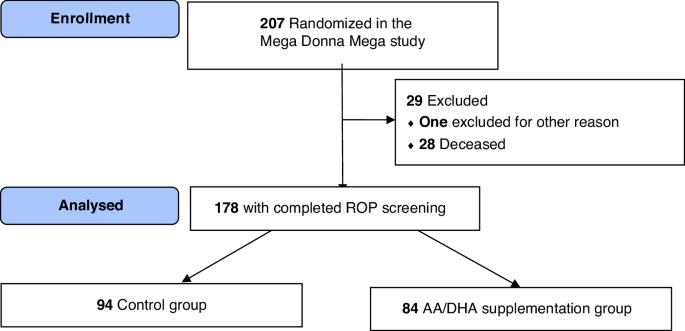
Two risk factors for severe retinopathy of prematurity (ROP) in extremely preterm infants are thrombocytopenia and low levels of arachidonic acid (AA) and docosahexaenoic acid (DHA). To date, these risk factors have not been linked. Infants born < 28 weeks gestational age (GA) from 2016 to 2019 were randomized to postnatal enteral AA/DHA supplementation or standard care (controls). Levels of AA and DHA, platelet counts ( < 100 × 109/L defined as thrombocytopenia) and platelet-related proteins in the infants’ first four weeks of life were evaluated for their association with severe ROP. The mean birthweight of 178 included infants was 806 ± 200 grams, and the mean GA was 25.6 ± 1.4 weeks. During the first four postnatal weeks, 20.2% of AA/DHA-supplemented infants had thrombocytopenia versus 27.7% of controls (p = 0.29). In infants with thrombocytopenia, fewer AA/DHA-supplemented infants developed severe ROP than non-supplemented controls, 29.4% (5/17) versus 65.4% (17/26) (p = 0.031). Thrombocytopenia and serum levels of AA and DHA correlated with several platelet-related proteins involved in angiogenesis and ROP, such as platelet-derived growth factor subunits A and B and vascular endothelial growth factor. AA and DHA supplementation is associated with less severe ROP in thrombocytopenic infants, possibly by modulating platelet activation and function.
期刊介绍:
Pediatric Research publishes original papers, invited reviews, and commentaries on the etiologies of children''s diseases and
disorders of development, extending from molecular biology to epidemiology. Use of model organisms and in vitro techniques
relevant to developmental biology and medicine are acceptable, as are translational human studies



 京公网安备 11010802042870号
京ICP备2023020795号-1
京公网安备 11010802042870号
京ICP备2023020795号-1

 分享
分享
 求助内容:
求助内容: 应助结果提醒方式:
 扫码关注我们
