Guangyao Zhai, Guanglei Wang, Qinghua Shang, Yan Li, Hongrui Wang
{"title":"DMA-Net: A dual branch encoder and multi-scale cross attention fusion network for skin lesion segmentation","authors":"Guangyao Zhai, Guanglei Wang, Qinghua Shang, Yan Li, Hongrui Wang","doi":"10.1049/ipr2.13265","DOIUrl":null,"url":null,"abstract":"<p>Automatic segmentation of skin lesion is an important step in computer-aided diagnosis. However, due to the significant variations in the size and shape of the lesion areas, as well as the low contrast with normal skin tissue, the boundaries are not clearly distinguishable, leading to a high possibility of incorrect segmentation. Therefore, this task is highly challenging. To overcome these difficulties, this paper proposes a medical image segmentation architecture named dual branch encoder and multi-scale cross attention fusion network, which includes a dual-branch encoder based on convolutional neural network and an improved channel-enhanced Mamba to comprehensively extract local and global information from dermoscopy images. Additionally, to enhance the feature interaction and fusion of local and global information, a multi-scale cross attention fusion module is adopted to cross-merge features in different directions and at different scales, maximizing the advantages of the dual-branch encoder and achieving precise segmentation of skin lesions. Extensive experiments are conducted on three public skin lesion datasets: ISIC-2018, ISIC-2017, and ISIC-2016, to verify the effectiveness and superiority of the proposed method. The dice similarity coefficient scores on the three datasets reached 81.77%, 81.68% and 85.60%, respectively, surpassing most state-of-the-art methods.</p>","PeriodicalId":56303,"journal":{"name":"IET Image Processing","volume":"18 14","pages":"4531-4541"},"PeriodicalIF":2.2000,"publicationDate":"2024-10-27","publicationTypes":"Journal Article","fieldsOfStudy":null,"isOpenAccess":false,"openAccessPdf":"https://onlinelibrary.wiley.com/doi/epdf/10.1049/ipr2.13265","citationCount":"0","resultStr":null,"platform":"Semanticscholar","paperid":null,"PeriodicalName":"IET Image Processing","FirstCategoryId":"94","ListUrlMain":"https://ietresearch.onlinelibrary.wiley.com/doi/10.1049/ipr2.13265","RegionNum":4,"RegionCategory":"计算机科学","ArticlePicture":[],"TitleCN":null,"AbstractTextCN":null,"PMCID":null,"EPubDate":"","PubModel":"","JCR":"Q3","JCRName":"COMPUTER SCIENCE, ARTIFICIAL INTELLIGENCE","Score":null,"Total":0}
引用次数: 0
Abstract
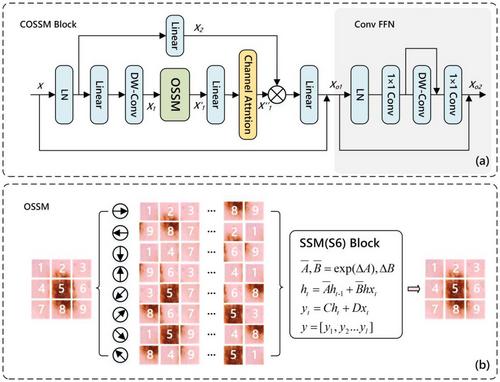
Automatic segmentation of skin lesion is an important step in computer-aided diagnosis. However, due to the significant variations in the size and shape of the lesion areas, as well as the low contrast with normal skin tissue, the boundaries are not clearly distinguishable, leading to a high possibility of incorrect segmentation. Therefore, this task is highly challenging. To overcome these difficulties, this paper proposes a medical image segmentation architecture named dual branch encoder and multi-scale cross attention fusion network, which includes a dual-branch encoder based on convolutional neural network and an improved channel-enhanced Mamba to comprehensively extract local and global information from dermoscopy images. Additionally, to enhance the feature interaction and fusion of local and global information, a multi-scale cross attention fusion module is adopted to cross-merge features in different directions and at different scales, maximizing the advantages of the dual-branch encoder and achieving precise segmentation of skin lesions. Extensive experiments are conducted on three public skin lesion datasets: ISIC-2018, ISIC-2017, and ISIC-2016, to verify the effectiveness and superiority of the proposed method. The dice similarity coefficient scores on the three datasets reached 81.77%, 81.68% and 85.60%, respectively, surpassing most state-of-the-art methods.
期刊介绍:
The IET Image Processing journal encompasses research areas related to the generation, processing and communication of visual information. The focus of the journal is the coverage of the latest research results in image and video processing, including image generation and display, enhancement and restoration, segmentation, colour and texture analysis, coding and communication, implementations and architectures as well as innovative applications.
Principal topics include:
Generation and Display - Imaging sensors and acquisition systems, illumination, sampling and scanning, quantization, colour reproduction, image rendering, display and printing systems, evaluation of image quality.
Processing and Analysis - Image enhancement, restoration, segmentation, registration, multispectral, colour and texture processing, multiresolution processing and wavelets, morphological operations, stereoscopic and 3-D processing, motion detection and estimation, video and image sequence processing.
Implementations and Architectures - Image and video processing hardware and software, design and construction, architectures and software, neural, adaptive, and fuzzy processing.
Coding and Transmission - Image and video compression and coding, compression standards, noise modelling, visual information networks, streamed video.
Retrieval and Multimedia - Storage of images and video, database design, image retrieval, video annotation and editing, mixed media incorporating visual information, multimedia systems and applications, image and video watermarking, steganography.
Applications - Innovative application of image and video processing technologies to any field, including life sciences, earth sciences, astronomy, document processing and security.
Current Special Issue Call for Papers:
Evolutionary Computation for Image Processing - https://digital-library.theiet.org/files/IET_IPR_CFP_EC.pdf
AI-Powered 3D Vision - https://digital-library.theiet.org/files/IET_IPR_CFP_AIPV.pdf
Multidisciplinary advancement of Imaging Technologies: From Medical Diagnostics and Genomics to Cognitive Machine Vision, and Artificial Intelligence - https://digital-library.theiet.org/files/IET_IPR_CFP_IST.pdf
Deep Learning for 3D Reconstruction - https://digital-library.theiet.org/files/IET_IPR_CFP_DLR.pdf




 京公网安备 11010802042870号
京ICP备2023020795号-1
京公网安备 11010802042870号
京ICP备2023020795号-1

 分享
分享
 求助内容:
求助内容: 应助结果提醒方式:
 扫码关注我们
