Brie Tripp, Akshaya Ravi, Ethan Pang, Robert E Furrow
{"title":"Undergraduate STEM Students' Perceptions of Grading Practices Reveal that Quiz Retakes Positively Impact Drivers of Self-determination.","authors":"Brie Tripp, Akshaya Ravi, Ethan Pang, Robert E Furrow","doi":"10.1187/cbe.24-06-0167","DOIUrl":null,"url":null,"abstract":"<p><p>Grades are a staple of education and a gateway to future career opportunities. Yet, grading practices can (re)produce inequities and cause students to feel inadequate and unmotivated. Alternative grading practices may address these problems, but these strategies are often time intensive and impractical in larger classroom settings. In this study, we explore an easy-to-implement grading practice, in-class quiz retakes, to conceptualize how grades motivate learning and impact well-being for undergraduate students in science, technology, engineering, and mathematics (STEM). Through the lens of self-determination theory, we conducted semistructured interviews with undergraduates who experienced quiz retakes in two STEM courses. Our results revealed that retakes largely improved students' perceptions of their competence in the subject matter, autonomy in grade outcomes, feelings of relatedness to the instructors, and overall motivation to learn. The majority of students also expressed how traditional grading practices negatively impacted their motivation and well-being. In addition, a quantitative analysis revealed that quiz retakes particularly benefitted students who scored lower on their initial quizzes. We aspire for this study to prompt educators to reconsider traditional grading practices by opting for more equitable and just alternative grading approaches that motivate student learning and mitigate systemic barriers in education.</p>","PeriodicalId":56321,"journal":{"name":"Cbe-Life Sciences Education","volume":"24 1","pages":"ar4"},"PeriodicalIF":4.1000,"publicationDate":"2025-03-01","publicationTypes":"Journal Article","fieldsOfStudy":null,"isOpenAccess":false,"openAccessPdf":"https://www.ncbi.nlm.nih.gov/pmc/articles/PMC11974534/pdf/","citationCount":"0","resultStr":null,"platform":"Semanticscholar","paperid":null,"PeriodicalName":"Cbe-Life Sciences Education","FirstCategoryId":"95","ListUrlMain":"https://doi.org/10.1187/cbe.24-06-0167","RegionNum":2,"RegionCategory":"教育学","ArticlePicture":[],"TitleCN":null,"AbstractTextCN":null,"PMCID":null,"EPubDate":"","PubModel":"","JCR":"Q1","JCRName":"EDUCATION, SCIENTIFIC DISCIPLINES","Score":null,"Total":0}
引用次数: 0
Abstract
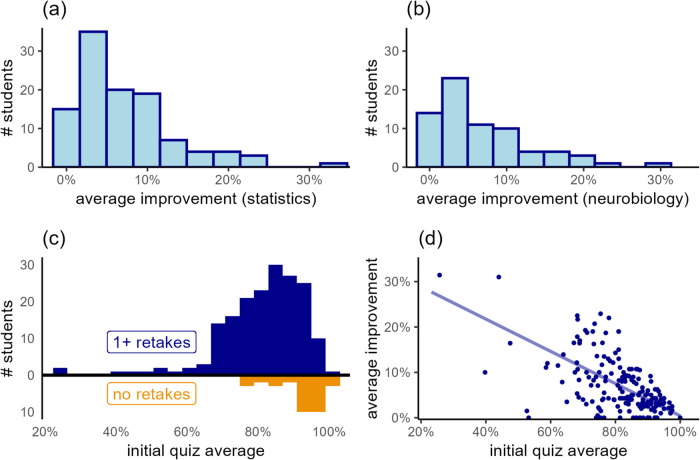
Grades are a staple of education and a gateway to future career opportunities. Yet, grading practices can (re)produce inequities and cause students to feel inadequate and unmotivated. Alternative grading practices may address these problems, but these strategies are often time intensive and impractical in larger classroom settings. In this study, we explore an easy-to-implement grading practice, in-class quiz retakes, to conceptualize how grades motivate learning and impact well-being for undergraduate students in science, technology, engineering, and mathematics (STEM). Through the lens of self-determination theory, we conducted semistructured interviews with undergraduates who experienced quiz retakes in two STEM courses. Our results revealed that retakes largely improved students' perceptions of their competence in the subject matter, autonomy in grade outcomes, feelings of relatedness to the instructors, and overall motivation to learn. The majority of students also expressed how traditional grading practices negatively impacted their motivation and well-being. In addition, a quantitative analysis revealed that quiz retakes particularly benefitted students who scored lower on their initial quizzes. We aspire for this study to prompt educators to reconsider traditional grading practices by opting for more equitable and just alternative grading approaches that motivate student learning and mitigate systemic barriers in education.
期刊介绍:
CBE—Life Sciences Education (LSE), a free, online quarterly journal, is published by the American Society for Cell Biology (ASCB). The journal was launched in spring 2002 as Cell Biology Education—A Journal of Life Science Education. The ASCB changed the name of the journal in spring 2006 to better reflect the breadth of its readership and the scope of its submissions.
LSE publishes peer-reviewed articles on life science education at the K–12, undergraduate, and graduate levels. The ASCB believes that learning in biology encompasses diverse fields, including math, chemistry, physics, engineering, computer science, and the interdisciplinary intersections of biology with these fields. Within biology, LSE focuses on how students are introduced to the study of life sciences, as well as approaches in cell biology, developmental biology, neuroscience, biochemistry, molecular biology, genetics, genomics, bioinformatics, and proteomics.



 京公网安备 11010802042870号
京ICP备2023020795号-1
京公网安备 11010802042870号
京ICP备2023020795号-1

 分享
分享
 求助内容:
求助内容: 应助结果提醒方式:
 扫码关注我们
