Mara Brouwers, Elleke Gm Landeweer, Bram de Boer, Wim G Groen, Miranda C Schreuder, Hilde Verbeek, Relocare Consortium
{"title":"Experiences and needs of residents with dementia in relocating to an innovative living arrangement within long-term care: A qualitative study.","authors":"Mara Brouwers, Elleke Gm Landeweer, Bram de Boer, Wim G Groen, Miranda C Schreuder, Hilde Verbeek, Relocare Consortium","doi":"10.1177/14713012241311433","DOIUrl":null,"url":null,"abstract":"<p><p>During the last decade, an increasing number of care organizations have chosen to rebuild or build a new care facility to provide better person-environments for residents with dementia. This has inevitably led to an increase in relocations. This study investigated how residents with dementia experienced a relocation from a regular nursing home to an innovative living arrangement. A qualitative study was performed, using semi-structured interviews and observations. Two nursing homes offering 24 h care to residents with psychogeriatric symptoms that planned a relocation to an innovative living arrangement were selected. Sixteen residents were included. Five themes from the data described what was of importance to residents when moving, including (1) the physical environment of the new location, (2) the belongings of residents, (3) feeling at home, (4) the importance of social contact when relocating, and (5) the need to be engaged in daily life. This study found that the residents were not actively involved in the relocation process, despite the clear desire they expressed to be involved and of importance. As the residents with dementia were able to express what was important to them in this study, relocation processes should focus more on involving such residents and incorporating them within relocation processes.</p>","PeriodicalId":72778,"journal":{"name":"Dementia (London, England)","volume":" ","pages":"1225-1240"},"PeriodicalIF":2.2000,"publicationDate":"2025-10-01","publicationTypes":"Journal Article","fieldsOfStudy":null,"isOpenAccess":false,"openAccessPdf":"https://www.ncbi.nlm.nih.gov/pmc/articles/PMC12408925/pdf/","citationCount":"0","resultStr":null,"platform":"Semanticscholar","paperid":null,"PeriodicalName":"Dementia (London, England)","FirstCategoryId":"1085","ListUrlMain":"https://doi.org/10.1177/14713012241311433","RegionNum":0,"RegionCategory":null,"ArticlePicture":[],"TitleCN":null,"AbstractTextCN":null,"PMCID":null,"EPubDate":"2024/12/21 0:00:00","PubModel":"Epub","JCR":"","JCRName":"","Score":null,"Total":0}
引用次数: 0
Abstract
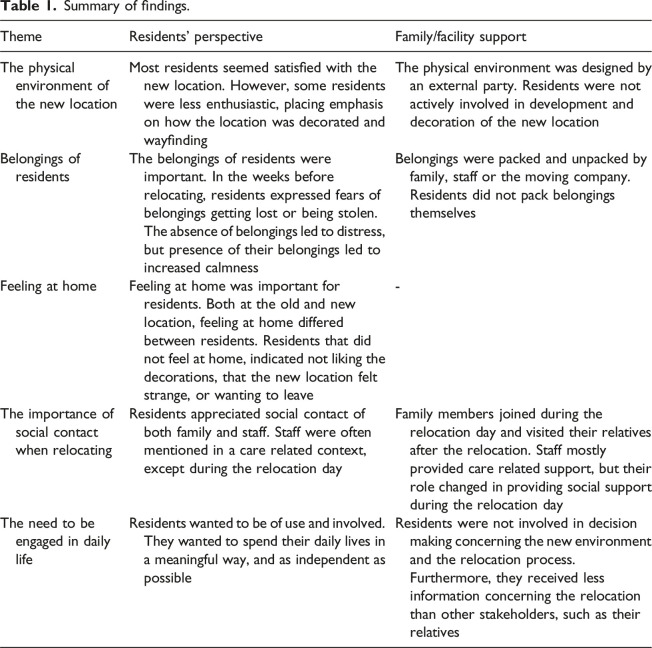
During the last decade, an increasing number of care organizations have chosen to rebuild or build a new care facility to provide better person-environments for residents with dementia. This has inevitably led to an increase in relocations. This study investigated how residents with dementia experienced a relocation from a regular nursing home to an innovative living arrangement. A qualitative study was performed, using semi-structured interviews and observations. Two nursing homes offering 24 h care to residents with psychogeriatric symptoms that planned a relocation to an innovative living arrangement were selected. Sixteen residents were included. Five themes from the data described what was of importance to residents when moving, including (1) the physical environment of the new location, (2) the belongings of residents, (3) feeling at home, (4) the importance of social contact when relocating, and (5) the need to be engaged in daily life. This study found that the residents were not actively involved in the relocation process, despite the clear desire they expressed to be involved and of importance. As the residents with dementia were able to express what was important to them in this study, relocation processes should focus more on involving such residents and incorporating them within relocation processes.



 京公网安备 11010802042870号
京ICP备2023020795号-1
京公网安备 11010802042870号
京ICP备2023020795号-1

 分享
分享

 求助内容:
求助内容: 应助结果提醒方式:
 扫码关注我们
