Miika Martikainen, Roberta Lugano, Ilkka Pietilä, Sofie Brosch, Camille Cabrolier, Aishwarya Sivaramakrishnan, Mohanraj Ramachandran, Di Yu, Anna Dimberg, Magnus Essand
{"title":"VLDLR mediates Semliki Forest virus neuroinvasion through the blood-cerebrospinal fluid barrier","authors":"Miika Martikainen, Roberta Lugano, Ilkka Pietilä, Sofie Brosch, Camille Cabrolier, Aishwarya Sivaramakrishnan, Mohanraj Ramachandran, Di Yu, Anna Dimberg, Magnus Essand","doi":"10.1038/s41467-024-55493-3","DOIUrl":null,"url":null,"abstract":"<p>Semliki Forest virus (SFV) is a neuropathogenic alphavirus which is of interest both as a model neurotropic alphavirus and as an oncolytic virus with proven potency in preclinical cancer models. In laboratory mice, peripherally administered SFV infiltrates the central nervous system (CNS) and causes encephalitis of varying severity. The route of SFV CNS entrance is poorly understood but has been considered to occur through the blood-brain barrier. Here we show that neuroinvasion of intravenously administered SFV is strictly dependent on very-low-density-lipoprotein receptor (VLDLR) which acts as an entry receptor for SFV. Moreover, SFV primarily enters the CNS through the blood-cerebrospinal fluid (B-CSF) barrier via infecting choroid plexus epithelial cells which show distinctly high expression of VLDLR. This is the first indication of neurotropic alphavirus utilizing choroid plexus for CNS entry, and VLDLR playing a specific and crucial role for mediating SFV entry through this pathway.</p>","PeriodicalId":19066,"journal":{"name":"Nature Communications","volume":"6 1","pages":""},"PeriodicalIF":18.1000,"publicationDate":"2024-12-23","publicationTypes":"Journal Article","fieldsOfStudy":null,"isOpenAccess":false,"openAccessPdf":"","citationCount":"0","resultStr":null,"platform":"Semanticscholar","paperid":null,"PeriodicalName":"Nature Communications","FirstCategoryId":"103","ListUrlMain":"https://doi.org/10.1038/s41467-024-55493-3","RegionNum":1,"RegionCategory":"综合性期刊","ArticlePicture":[],"TitleCN":null,"AbstractTextCN":null,"PMCID":null,"EPubDate":"","PubModel":"","JCR":"Q1","JCRName":"MULTIDISCIPLINARY SCIENCES","Score":null,"Total":0}
引用次数: 0
Abstract
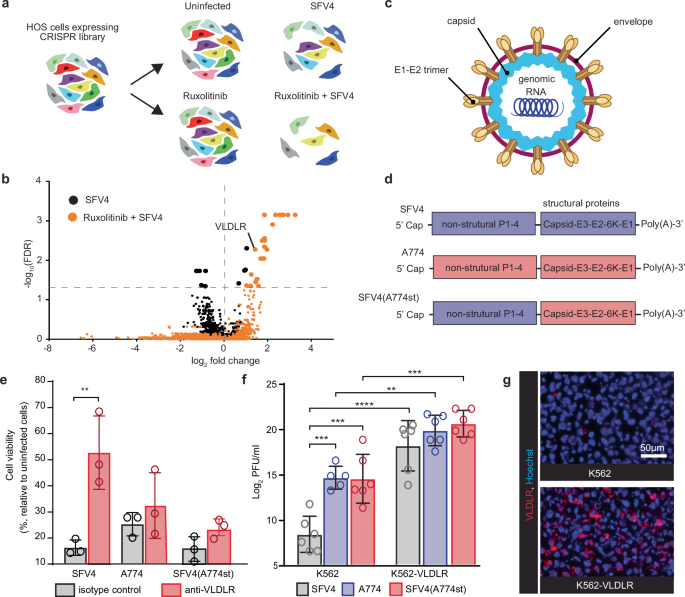
Semliki Forest virus (SFV) is a neuropathogenic alphavirus which is of interest both as a model neurotropic alphavirus and as an oncolytic virus with proven potency in preclinical cancer models. In laboratory mice, peripherally administered SFV infiltrates the central nervous system (CNS) and causes encephalitis of varying severity. The route of SFV CNS entrance is poorly understood but has been considered to occur through the blood-brain barrier. Here we show that neuroinvasion of intravenously administered SFV is strictly dependent on very-low-density-lipoprotein receptor (VLDLR) which acts as an entry receptor for SFV. Moreover, SFV primarily enters the CNS through the blood-cerebrospinal fluid (B-CSF) barrier via infecting choroid plexus epithelial cells which show distinctly high expression of VLDLR. This is the first indication of neurotropic alphavirus utilizing choroid plexus for CNS entry, and VLDLR playing a specific and crucial role for mediating SFV entry through this pathway.
期刊介绍:
Nature Communications, an open-access journal, publishes high-quality research spanning all areas of the natural sciences. Papers featured in the journal showcase significant advances relevant to specialists in each respective field. With a 2-year impact factor of 16.6 (2022) and a median time of 8 days from submission to the first editorial decision, Nature Communications is committed to rapid dissemination of research findings. As a multidisciplinary journal, it welcomes contributions from biological, health, physical, chemical, Earth, social, mathematical, applied, and engineering sciences, aiming to highlight important breakthroughs within each domain.




 京公网安备 11010802042870号
京ICP备2023020795号-1
京公网安备 11010802042870号
京ICP备2023020795号-1

 分享
分享
 求助内容:
求助内容: 应助结果提醒方式:
 扫码关注我们
