Qi Huang, Daniel Bolt, Erin Jonaitis, Bruce Hermann, Rachel Studer, Lianlian Du, Brenda Ryther, Lia Sparks, James E. Galvin, Sterling Johnson, Rebecca Langhough
{"title":"Performance of study partner reports in a non-demented at-risk sample","authors":"Qi Huang, Daniel Bolt, Erin Jonaitis, Bruce Hermann, Rachel Studer, Lianlian Du, Brenda Ryther, Lia Sparks, James E. Galvin, Sterling Johnson, Rebecca Langhough","doi":"10.1002/alz.14470","DOIUrl":null,"url":null,"abstract":"<div>\n \n \n <section>\n \n <h3> INTRODUCTION</h3>\n \n <p>The Clinical Dementia Rating (CDR) Scale is a gold standard for staging impairment in Alzheimer's disease and other dementias (ADRD). The Quick Dementia Rating System (QDRS) offers similar results in 3 to 5 minutes without a trained clinician. This study aimed to (1) investigate concordance between comparably derived QDRS and CDR global scores, (2) examine item-level QDRS/CDR agreement, and (3) compare sample characteristics and cognitive performance across QDRS/CDR global concordant/discordant groups.</p>\n </section>\n \n <section>\n \n <h3> METHODS</h3>\n \n <p>The study included 351 QDRS/CDR pairs from 297 participants in the Wisconsin Registry for Alzheimer's Prevention (WRAP). Analyses included descriptive indices of QDRS/CDR agreement, lasso logistic regression, tetrachoric correlations, and linear mixed models.</p>\n </section>\n \n <section>\n \n <h3> RESULTS</h3>\n \n <p>The QDRS global/CDR global concordance rate is 70.66%. Memory item discrepancies were primarily responsible for QDRS/CDR global rating discordance. Average cognitive scores were highest in concordant-normal QDRS/CDR and lowest in concordant-abnormal QDRS/CDR.</p>\n </section>\n \n <section>\n \n <h3> DISCUSSION</h3>\n \n <p>The QDRS effectively screened for impairment in this sample. Future analyses will investigate QDRS relations to ADRD biomarkers.</p>\n </section>\n \n <section>\n \n <h3> Highlights</h3>\n \n <div>\n <ul>\n \n <li>The Quick Dementia Rating System (QDRS) effectively screened for impairment in Alzheimer's disease and other dementias (ADRD) in a non-demented sample.</li>\n \n <li>Concordance rate between QDRS<sub>CDR</sub> global and Clinical Dementia Rating (CDR) Scale global scores is 70.66%.</li>\n \n <li>Memory item discrepancies primarily cause QDRS/CDR global score discordance.</li>\n \n <li>Cognitive scores are associated with QDRS/CDR concordances/discordances.</li>\n \n <li>Future analyses will explore QDRS relations to ADRD biomarkers.</li>\n </ul>\n </div>\n </section>\n </div>","PeriodicalId":7471,"journal":{"name":"Alzheimer's & Dementia","volume":"21 2","pages":""},"PeriodicalIF":11.1000,"publicationDate":"2024-12-23","publicationTypes":"Journal Article","fieldsOfStudy":null,"isOpenAccess":false,"openAccessPdf":"https://onlinelibrary.wiley.com/doi/epdf/10.1002/alz.14470","citationCount":"0","resultStr":null,"platform":"Semanticscholar","paperid":null,"PeriodicalName":"Alzheimer's & Dementia","FirstCategoryId":"3","ListUrlMain":"https://alz-journals.onlinelibrary.wiley.com/doi/10.1002/alz.14470","RegionNum":1,"RegionCategory":"医学","ArticlePicture":[],"TitleCN":null,"AbstractTextCN":null,"PMCID":null,"EPubDate":"","PubModel":"","JCR":"Q1","JCRName":"CLINICAL NEUROLOGY","Score":null,"Total":0}
引用次数: 0
Abstract
INTRODUCTION
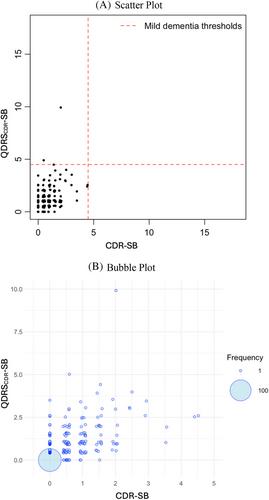
The Clinical Dementia Rating (CDR) Scale is a gold standard for staging impairment in Alzheimer's disease and other dementias (ADRD). The Quick Dementia Rating System (QDRS) offers similar results in 3 to 5 minutes without a trained clinician. This study aimed to (1) investigate concordance between comparably derived QDRS and CDR global scores, (2) examine item-level QDRS/CDR agreement, and (3) compare sample characteristics and cognitive performance across QDRS/CDR global concordant/discordant groups.
METHODS
The study included 351 QDRS/CDR pairs from 297 participants in the Wisconsin Registry for Alzheimer's Prevention (WRAP). Analyses included descriptive indices of QDRS/CDR agreement, lasso logistic regression, tetrachoric correlations, and linear mixed models.
RESULTS
The QDRS global/CDR global concordance rate is 70.66%. Memory item discrepancies were primarily responsible for QDRS/CDR global rating discordance. Average cognitive scores were highest in concordant-normal QDRS/CDR and lowest in concordant-abnormal QDRS/CDR.
DISCUSSION
The QDRS effectively screened for impairment in this sample. Future analyses will investigate QDRS relations to ADRD biomarkers.
Highlights
The Quick Dementia Rating System (QDRS) effectively screened for impairment in Alzheimer's disease and other dementias (ADRD) in a non-demented sample.
Concordance rate between QDRSCDR global and Clinical Dementia Rating (CDR) Scale global scores is 70.66%.
Memory item discrepancies primarily cause QDRS/CDR global score discordance.
Cognitive scores are associated with QDRS/CDR concordances/discordances.
Future analyses will explore QDRS relations to ADRD biomarkers.
期刊介绍:
Alzheimer's & Dementia is a peer-reviewed journal that aims to bridge knowledge gaps in dementia research by covering the entire spectrum, from basic science to clinical trials to social and behavioral investigations. It provides a platform for rapid communication of new findings and ideas, optimal translation of research into practical applications, increasing knowledge across diverse disciplines for early detection, diagnosis, and intervention, and identifying promising new research directions. In July 2008, Alzheimer's & Dementia was accepted for indexing by MEDLINE, recognizing its scientific merit and contribution to Alzheimer's research.





 京公网安备 11010802042870号
京ICP备2023020795号-1
京公网安备 11010802042870号
京ICP备2023020795号-1

 分享
分享
 求助内容:
求助内容: 应助结果提醒方式:
 扫码关注我们
