{"title":"Molecular Hydride Superconductor BiH4 with Tc up to 91 K at 170 GPa","authors":"Pengfei Shan, Liang Ma, Xin Yang, Mei Li, Ziyi Liu, Jun Hou, Sheng Jiang, LiLi Zhang, Lifen Shi, Pengtao Yang, Chuanlong Lin, Bosen Wang, Jianping Sun, Haizhong Guo, Yang Ding, Huiyang Gou, Zhongxian Zhao, Jinguang Cheng","doi":"10.1021/jacs.4c15137","DOIUrl":null,"url":null,"abstract":"In pursuit of high-<i>T</i><sub>c</sub> hydride superconductors, the molecular hydrides have attracted less attention because the hydrogen quasimolecules are usually inactive for superconductivity. Here, we report on the successful synthesis of a novel bismuth hydride superconductor <i>C</i>2/<i>c</i>-BiH<sub>4</sub> at pressures around 170–180 GPa. Its structure comprises bismuth atoms and elongated hydrogen molecules with a H–H bond length of 0.81 Å at 170 GPa, characterizing it as a typical molecular hydride. Transport measurements revealed the occurrence of superconductivity with <i>T</i><sub>c</sub> up to 91 K at 170 GPa, as evidenced by a sharp drop of resistivity to zero and a characteristic downward shift of <i>T</i><sub>c</sub> under magnetic fields. Calculations by density functional theory elucidate that both midfrequency H-derived phonons and low-frequency vibrations from Bi atoms are important for the strong electron–phonon coupling in BiH<sub>4</sub>, differentiating it from most high-<i>T</i><sub>c</sub> superconducting hydrides. Our work not only places <i>C</i>2/<i>c</i>-BiH<sub>4</sub> among the molecular hydride superconductors with the highest <i>T</i><sub>c</sub> but also offers new directions for designing and synthesizing more high-<i>T</i><sub>c</sub> hydride superconductors.","PeriodicalId":49,"journal":{"name":"Journal of the American Chemical Society","volume":"61 1","pages":""},"PeriodicalIF":15.6000,"publicationDate":"2024-12-23","publicationTypes":"Journal Article","fieldsOfStudy":null,"isOpenAccess":false,"openAccessPdf":"","citationCount":"0","resultStr":null,"platform":"Semanticscholar","paperid":null,"PeriodicalName":"Journal of the American Chemical Society","FirstCategoryId":"92","ListUrlMain":"https://doi.org/10.1021/jacs.4c15137","RegionNum":1,"RegionCategory":"化学","ArticlePicture":[],"TitleCN":null,"AbstractTextCN":null,"PMCID":null,"EPubDate":"","PubModel":"","JCR":"Q1","JCRName":"CHEMISTRY, MULTIDISCIPLINARY","Score":null,"Total":0}
引用次数: 0
Abstract
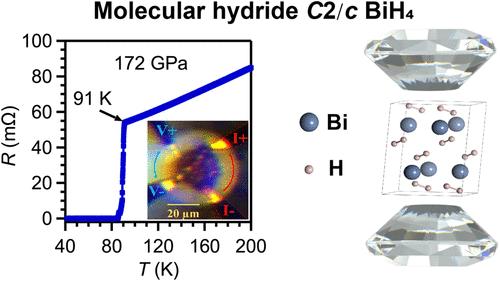
In pursuit of high-Tc hydride superconductors, the molecular hydrides have attracted less attention because the hydrogen quasimolecules are usually inactive for superconductivity. Here, we report on the successful synthesis of a novel bismuth hydride superconductor C2/c-BiH4 at pressures around 170–180 GPa. Its structure comprises bismuth atoms and elongated hydrogen molecules with a H–H bond length of 0.81 Å at 170 GPa, characterizing it as a typical molecular hydride. Transport measurements revealed the occurrence of superconductivity with Tc up to 91 K at 170 GPa, as evidenced by a sharp drop of resistivity to zero and a characteristic downward shift of Tc under magnetic fields. Calculations by density functional theory elucidate that both midfrequency H-derived phonons and low-frequency vibrations from Bi atoms are important for the strong electron–phonon coupling in BiH4, differentiating it from most high-Tc superconducting hydrides. Our work not only places C2/c-BiH4 among the molecular hydride superconductors with the highest Tc but also offers new directions for designing and synthesizing more high-Tc hydride superconductors.
期刊介绍:
The flagship journal of the American Chemical Society, known as the Journal of the American Chemical Society (JACS), has been a prestigious publication since its establishment in 1879. It holds a preeminent position in the field of chemistry and related interdisciplinary sciences. JACS is committed to disseminating cutting-edge research papers, covering a wide range of topics, and encompasses approximately 19,000 pages of Articles, Communications, and Perspectives annually. With a weekly publication frequency, JACS plays a vital role in advancing the field of chemistry by providing essential research.



 京公网安备 11010802042870号
京ICP备2023020795号-1
京公网安备 11010802042870号
京ICP备2023020795号-1

 分享
分享
 求助内容:
求助内容: 应助结果提醒方式:
 扫码关注我们
