Zhi-Ming Su, Jieru Zhu, Darren L. Poole, Mohammad Rafiee, Robert S. Paton, Daniel J. Weix, Shannon S. Stahl
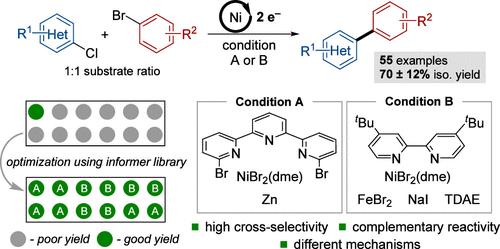
{"title":"Selective Ni-Catalyzed Cross-Electrophile Coupling of Heteroaryl Chlorides and Aryl Bromides at 1:1 Substrate Ratio","authors":"Zhi-Ming Su, Jieru Zhu, Darren L. Poole, Mohammad Rafiee, Robert S. Paton, Daniel J. Weix, Shannon S. Stahl","doi":"10.1021/jacs.4c10776","DOIUrl":null,"url":null,"abstract":"Nickel-catalyzed cross-electrophile coupling (XEC) reactions of (hetero)aryl electrophiles represent appealing alternatives to palladium-catalyzed methods for biaryl synthesis, but they often generate significant quantities of homocoupling and/or proto-dehalogenation side products. In this study, an informer library of heteroaryl chloride and aryl bromide coupling partners is used to identify Ni-catalyzed XEC conditions that access high selectivity for the cross-product when using equimolar quantities of the two substrates. Two different catalyst systems are identified that show complementary scope and broad functional-group tolerance, and time-course data suggest that the two methods follow different mechanisms. A NiBr<sub>2</sub>/terpyridine catalyst system with Zn as the reductant converts the aryl bromide into an arylzinc intermediate that undergoes <i>in situ</i> coupling with 2-chloropyridines, while a NiBr<sub>2</sub>/bipyridine catalyst system with tetrakis(dimethylamino)ethylene as the reductant uses FeBr<sub>2</sub> and NaI as additives to achieve selective cross-coupling.","PeriodicalId":49,"journal":{"name":"Journal of the American Chemical Society","volume":"14 1","pages":""},"PeriodicalIF":15.6000,"publicationDate":"2024-12-23","publicationTypes":"Journal Article","fieldsOfStudy":null,"isOpenAccess":false,"openAccessPdf":"","citationCount":"0","resultStr":null,"platform":"Semanticscholar","paperid":null,"PeriodicalName":"Journal of the American Chemical Society","FirstCategoryId":"92","ListUrlMain":"https://doi.org/10.1021/jacs.4c10776","RegionNum":1,"RegionCategory":"化学","ArticlePicture":[],"TitleCN":null,"AbstractTextCN":null,"PMCID":null,"EPubDate":"","PubModel":"","JCR":"Q1","JCRName":"CHEMISTRY, MULTIDISCIPLINARY","Score":null,"Total":0}
引用次数: 0
Abstract
Nickel-catalyzed cross-electrophile coupling (XEC) reactions of (hetero)aryl electrophiles represent appealing alternatives to palladium-catalyzed methods for biaryl synthesis, but they often generate significant quantities of homocoupling and/or proto-dehalogenation side products. In this study, an informer library of heteroaryl chloride and aryl bromide coupling partners is used to identify Ni-catalyzed XEC conditions that access high selectivity for the cross-product when using equimolar quantities of the two substrates. Two different catalyst systems are identified that show complementary scope and broad functional-group tolerance, and time-course data suggest that the two methods follow different mechanisms. A NiBr2/terpyridine catalyst system with Zn as the reductant converts the aryl bromide into an arylzinc intermediate that undergoes in situ coupling with 2-chloropyridines, while a NiBr2/bipyridine catalyst system with tetrakis(dimethylamino)ethylene as the reductant uses FeBr2 and NaI as additives to achieve selective cross-coupling.
期刊介绍:
The flagship journal of the American Chemical Society, known as the Journal of the American Chemical Society (JACS), has been a prestigious publication since its establishment in 1879. It holds a preeminent position in the field of chemistry and related interdisciplinary sciences. JACS is committed to disseminating cutting-edge research papers, covering a wide range of topics, and encompasses approximately 19,000 pages of Articles, Communications, and Perspectives annually. With a weekly publication frequency, JACS plays a vital role in advancing the field of chemistry by providing essential research.



 京公网安备 11010802042870号
京ICP备2023020795号-1
京公网安备 11010802042870号
京ICP备2023020795号-1

 分享
分享
 求助内容:
求助内容: 应助结果提醒方式:
 扫码关注我们
