Sarah P Sherlock, Allison McCrady, Jeffrey Palmer, Haleh Aghamolaey, André Ahlgren, Per Widholm, Olof Dahlqvist Leinhard, Markus Karlsson
{"title":"Relationship Between Quantitative Magnetic Resonance Imaging Measures and Functional Changes in Patients With Duchenne Muscular Dystrophy.","authors":"Sarah P Sherlock, Allison McCrady, Jeffrey Palmer, Haleh Aghamolaey, André Ahlgren, Per Widholm, Olof Dahlqvist Leinhard, Markus Karlsson","doi":"10.1002/mus.28321","DOIUrl":null,"url":null,"abstract":"<p><strong>Introduction/aims: </strong>Improved methodologies to monitor the progression of Duchenne muscular dystrophy (DMD) are needed, especially in the context of clinical trials. We report changes in muscle magnetic resonance imaging (MRI) parameters in participants with DMD, including changes in lean muscle volume (LMV), muscle fat fraction (MFF), and muscle fat infiltration (MFI) and their relationship to changes in functional parameters.</p><p><strong>Methods: </strong>MRI data were obtained as part of a clinical study (NCT02310763) of domagrozumab, an antibody-targeting myostatin that negatively regulates skeletal muscle mass. This post hoc analysis evaluated participants with Dixon MRI data and corresponding functional data at baseline and weeks 49 and 97. Images were analyzed to evaluate changes in adductors, hamstrings, and quadriceps.</p><p><strong>Results: </strong>There was a positive correlation between increases in LMV and function. LMV changes in adductors (R = 0.51) and quadriceps (R = 0.54) showed a stronger correlation with function than LMV changes in hamstrings (R = 0.30). There was a negative correlation between MFF and MFI, respectively, and function in adductors (R = -0.57, R = -0.42), quadriceps (R = -0.59, R = -0.50), and hamstrings (R = -0.53, R = -048). Participants with preserved North Star Ambulatory Assessment scores had high total LMV (LMV<sub>tot</sub>) and low total MFI (MFI<sub>tot</sub>). Low ratios of LMV<sub>tot</sub> to MFI<sub>tot</sub>, or participants with small LMV<sub>tot</sub> and high MFI<sub>tot</sub>, appeared to have a rapid decline in function and loss of ambulation.</p><p><strong>Discussion: </strong>These findings support the use of MRI biomarkers as potential surrogate endpoints in clinical trials of patients with DMD.</p><p><strong>Trial registration: </strong>ClinicalTrials.gov identifiers: NCT02310763.</p>","PeriodicalId":18968,"journal":{"name":"Muscle & Nerve","volume":" ","pages":"343-352"},"PeriodicalIF":3.1000,"publicationDate":"2025-03-01","publicationTypes":"Journal Article","fieldsOfStudy":null,"isOpenAccess":false,"openAccessPdf":"https://www.ncbi.nlm.nih.gov/pmc/articles/PMC11799397/pdf/","citationCount":"0","resultStr":null,"platform":"Semanticscholar","paperid":null,"PeriodicalName":"Muscle & Nerve","FirstCategoryId":"3","ListUrlMain":"https://doi.org/10.1002/mus.28321","RegionNum":3,"RegionCategory":"医学","ArticlePicture":[],"TitleCN":null,"AbstractTextCN":null,"PMCID":null,"EPubDate":"2024/12/23 0:00:00","PubModel":"Epub","JCR":"Q2","JCRName":"CLINICAL NEUROLOGY","Score":null,"Total":0}
引用次数: 0
Abstract
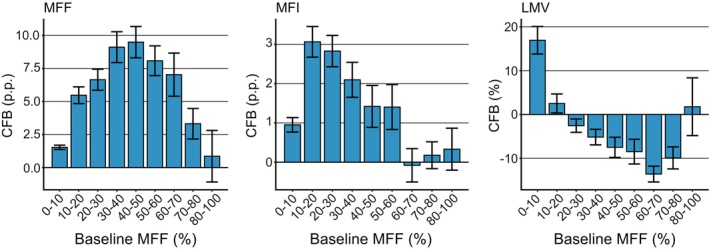
Introduction/aims: Improved methodologies to monitor the progression of Duchenne muscular dystrophy (DMD) are needed, especially in the context of clinical trials. We report changes in muscle magnetic resonance imaging (MRI) parameters in participants with DMD, including changes in lean muscle volume (LMV), muscle fat fraction (MFF), and muscle fat infiltration (MFI) and their relationship to changes in functional parameters.
Methods: MRI data were obtained as part of a clinical study (NCT02310763) of domagrozumab, an antibody-targeting myostatin that negatively regulates skeletal muscle mass. This post hoc analysis evaluated participants with Dixon MRI data and corresponding functional data at baseline and weeks 49 and 97. Images were analyzed to evaluate changes in adductors, hamstrings, and quadriceps.
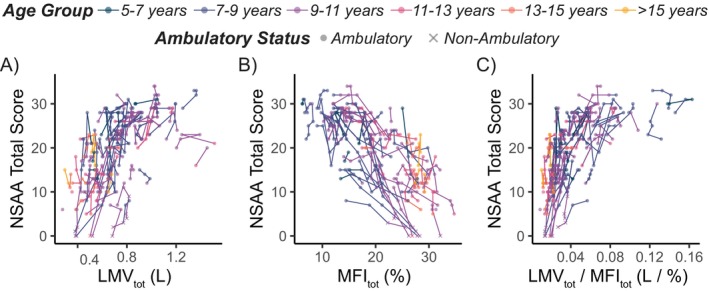
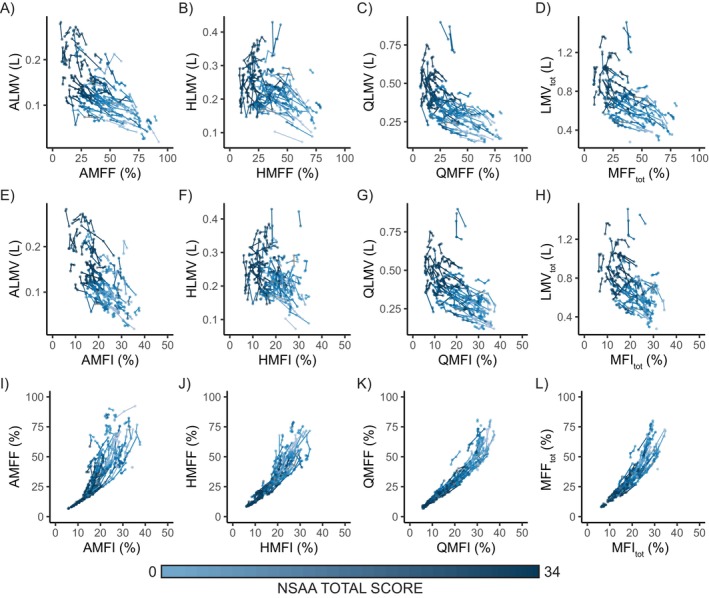
Results: There was a positive correlation between increases in LMV and function. LMV changes in adductors (R = 0.51) and quadriceps (R = 0.54) showed a stronger correlation with function than LMV changes in hamstrings (R = 0.30). There was a negative correlation between MFF and MFI, respectively, and function in adductors (R = -0.57, R = -0.42), quadriceps (R = -0.59, R = -0.50), and hamstrings (R = -0.53, R = -048). Participants with preserved North Star Ambulatory Assessment scores had high total LMV (LMVtot) and low total MFI (MFItot). Low ratios of LMVtot to MFItot, or participants with small LMVtot and high MFItot, appeared to have a rapid decline in function and loss of ambulation.
Discussion: These findings support the use of MRI biomarkers as potential surrogate endpoints in clinical trials of patients with DMD.
期刊介绍:
Muscle & Nerve is an international and interdisciplinary publication of original contributions, in both health and disease, concerning studies of the muscle, the neuromuscular junction, the peripheral motor, sensory and autonomic neurons, and the central nervous system where the behavior of the peripheral nervous system is clarified. Appearing monthly, Muscle & Nerve publishes clinical studies and clinically relevant research reports in the fields of anatomy, biochemistry, cell biology, electrophysiology and electrodiagnosis, epidemiology, genetics, immunology, pathology, pharmacology, physiology, toxicology, and virology. The Journal welcomes articles and reports on basic clinical electrophysiology and electrodiagnosis. We expedite some papers dealing with timely topics to keep up with the fast-moving pace of science, based on the referees'' recommendation.



 京公网安备 11010802042870号
京ICP备2023020795号-1
京公网安备 11010802042870号
京ICP备2023020795号-1

 分享
分享
 求助内容:
求助内容: 应助结果提醒方式:
 扫码关注我们
