Geraldo da Rocha Motta Filho, Marcus Vinicius Galvão Amaral, Luis Gustavo Prata Nascimento, André Couto Godinho, Caio Santos Checchia, Mauricio de Paiva Raffaelli, Rafael Peçanha Pitta, Ana Carolina Leal
{"title":"Assessment of Inter- and Intrasurgeon Variability in Preoperative Planning of Reverse Shoulder Arthroplasty: A Multicenter Evaluation.","authors":"Geraldo da Rocha Motta Filho, Marcus Vinicius Galvão Amaral, Luis Gustavo Prata Nascimento, André Couto Godinho, Caio Santos Checchia, Mauricio de Paiva Raffaelli, Rafael Peçanha Pitta, Ana Carolina Leal","doi":"10.1055/s-0044-1788783","DOIUrl":null,"url":null,"abstract":"<p><p><b>Objective</b> To evaluate the intra and intersurgeon variability regarding the positioning and selection of implants in reverse shoulder arthroplasty. <b>Methods</b> A cross-sectional study assessed computed tomography images of the shoulder joint of patients diagnosed with degenerative joint diseases. The study team included seven specialists in shoulder surgery, representing six different institutions. Surgeons were instructed to plan all cases twice, and then we evaluated inter- and intrasurgeon variability. <b>Results</b> The interclass correlation for version and inclination showed low agreement concerning inclination (0.26), and moderate agreement for version (0.73) and graft selection (0.54). The intrasurgeon evaluation revealed a moderate correlation for version (0.55), inclination (0.58), and implant selection (0.46), while for lateralization the correlation was high (0.77). <b>Conclusion</b> This comparative study of preoperative planning by different surgeons showed the lack of consensus on implant positioning parameters during reverse shoulder arthroplasty planning. However, most surgeons tend to plan for zero degrees of version and inclination.</p>","PeriodicalId":21536,"journal":{"name":"Revista Brasileira de Ortopedia","volume":"59 6","pages":"e950-e957"},"PeriodicalIF":0.0000,"publicationDate":"2024-08-16","publicationTypes":"Journal Article","fieldsOfStudy":null,"isOpenAccess":false,"openAccessPdf":"https://www.ncbi.nlm.nih.gov/pmc/articles/PMC11663061/pdf/","citationCount":"0","resultStr":null,"platform":"Semanticscholar","paperid":null,"PeriodicalName":"Revista Brasileira de Ortopedia","FirstCategoryId":"1085","ListUrlMain":"https://doi.org/10.1055/s-0044-1788783","RegionNum":0,"RegionCategory":null,"ArticlePicture":[],"TitleCN":null,"AbstractTextCN":null,"PMCID":null,"EPubDate":"2024/12/1 0:00:00","PubModel":"eCollection","JCR":"Q3","JCRName":"Medicine","Score":null,"Total":0}
引用次数: 0
Abstract
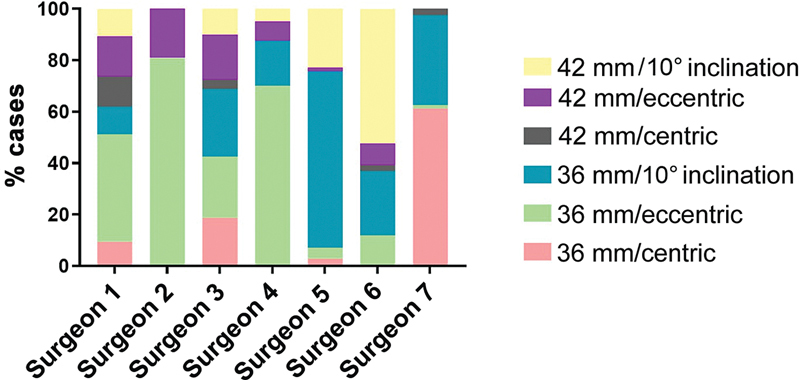
Objective To evaluate the intra and intersurgeon variability regarding the positioning and selection of implants in reverse shoulder arthroplasty. Methods A cross-sectional study assessed computed tomography images of the shoulder joint of patients diagnosed with degenerative joint diseases. The study team included seven specialists in shoulder surgery, representing six different institutions. Surgeons were instructed to plan all cases twice, and then we evaluated inter- and intrasurgeon variability. Results The interclass correlation for version and inclination showed low agreement concerning inclination (0.26), and moderate agreement for version (0.73) and graft selection (0.54). The intrasurgeon evaluation revealed a moderate correlation for version (0.55), inclination (0.58), and implant selection (0.46), while for lateralization the correlation was high (0.77). Conclusion This comparative study of preoperative planning by different surgeons showed the lack of consensus on implant positioning parameters during reverse shoulder arthroplasty planning. However, most surgeons tend to plan for zero degrees of version and inclination.






 京公网安备 11010802042870号
京ICP备2023020795号-1
京公网安备 11010802042870号
京ICP备2023020795号-1

 分享
分享
 求助内容:
求助内容: 应助结果提醒方式:
 扫码关注我们
