Wenting Fang , Yuyan Zhang , Liqun Kang , Serena DeBeer , Walter Leitner , Alexis Bordet , Anders Riisager
{"title":"Molecularly modified aluminum phosphates as support materials for Ru nanoparticles in selective hydrogenation","authors":"Wenting Fang , Yuyan Zhang , Liqun Kang , Serena DeBeer , Walter Leitner , Alexis Bordet , Anders Riisager","doi":"10.1016/j.jcat.2024.115911","DOIUrl":null,"url":null,"abstract":"<div><div>Modified aluminum phosphate (APO-5) proved suitable as zeotype support for the preparation of imidazolium-based supported ionic liquid phase material, i.e. SILP(APO-5). The successful chemisorption of ionic liquid-like modifiers at the APO-5 surface was demonstrated by solid- state <sup>31</sup>P and <sup>13</sup>C nuclear magnetic resonance (NMR) spectroscopy. The immobilization of Ru nanoparticles (NPs) on SILP(APO-5) was achieved following an organometallic approach, producing well-dispersed Ru NPs with a mean average size of 1.4 nm on the support. The resulting Ru@SILP(APO-5) material was thoroughly characterized using multiple techniques, e.g., solid-state NMR, transmission electron microscopy (TEM), infrared (IR) spectroscopy, X-ray absorption spectroscopy (XAS), and applied as a catalyst for the hydrogenation of biomass-derived furfural acetone with molecular hydrogen. The ionic liquid-like layer was found beneficial for the stabilization of the Ru NPs as well as of the APO-5 material. A temperature-controlled selectivity switch between olefinic, carbonyl or furan ring hydrogenation could be achieved with this new material with the APO-5 facilitating activation of the olefinic bond, while the carbonyl bond was remarkably deactivated. The demonstrated suitability of aluminum phosphate materials to produce molecularly modified surfaces offers a new control parameter for the systematic design and optimization of zeotype-based catalysts.</div></div>","PeriodicalId":346,"journal":{"name":"Journal of Catalysis","volume":"442 ","pages":"Article 115911"},"PeriodicalIF":6.5000,"publicationDate":"2025-02-01","publicationTypes":"Journal Article","fieldsOfStudy":null,"isOpenAccess":false,"openAccessPdf":"","citationCount":"0","resultStr":null,"platform":"Semanticscholar","paperid":null,"PeriodicalName":"Journal of Catalysis","FirstCategoryId":"92","ListUrlMain":"https://www.sciencedirect.com/science/article/pii/S0021951724006249","RegionNum":1,"RegionCategory":"化学","ArticlePicture":[],"TitleCN":null,"AbstractTextCN":null,"PMCID":null,"EPubDate":"","PubModel":"","JCR":"Q2","JCRName":"CHEMISTRY, PHYSICAL","Score":null,"Total":0}
引用次数: 0
Abstract
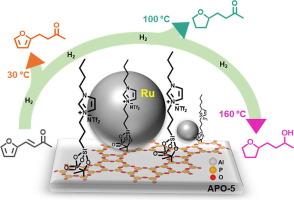
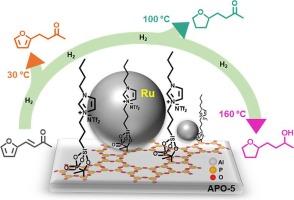
Modified aluminum phosphate (APO-5) proved suitable as zeotype support for the preparation of imidazolium-based supported ionic liquid phase material, i.e. SILP(APO-5). The successful chemisorption of ionic liquid-like modifiers at the APO-5 surface was demonstrated by solid- state 31P and 13C nuclear magnetic resonance (NMR) spectroscopy. The immobilization of Ru nanoparticles (NPs) on SILP(APO-5) was achieved following an organometallic approach, producing well-dispersed Ru NPs with a mean average size of 1.4 nm on the support. The resulting Ru@SILP(APO-5) material was thoroughly characterized using multiple techniques, e.g., solid-state NMR, transmission electron microscopy (TEM), infrared (IR) spectroscopy, X-ray absorption spectroscopy (XAS), and applied as a catalyst for the hydrogenation of biomass-derived furfural acetone with molecular hydrogen. The ionic liquid-like layer was found beneficial for the stabilization of the Ru NPs as well as of the APO-5 material. A temperature-controlled selectivity switch between olefinic, carbonyl or furan ring hydrogenation could be achieved with this new material with the APO-5 facilitating activation of the olefinic bond, while the carbonyl bond was remarkably deactivated. The demonstrated suitability of aluminum phosphate materials to produce molecularly modified surfaces offers a new control parameter for the systematic design and optimization of zeotype-based catalysts.
期刊介绍:
The Journal of Catalysis publishes scholarly articles on both heterogeneous and homogeneous catalysis, covering a wide range of chemical transformations. These include various types of catalysis, such as those mediated by photons, plasmons, and electrons. The focus of the studies is to understand the relationship between catalytic function and the underlying chemical properties of surfaces and metal complexes.
The articles in the journal offer innovative concepts and explore the synthesis and kinetics of inorganic solids and homogeneous complexes. Furthermore, they discuss spectroscopic techniques for characterizing catalysts, investigate the interaction of probes and reacting species with catalysts, and employ theoretical methods.
The research presented in the journal should have direct relevance to the field of catalytic processes, addressing either fundamental aspects or applications of catalysis.



 京公网安备 11010802042870号
京ICP备2023020795号-1
京公网安备 11010802042870号
京ICP备2023020795号-1

 分享
分享
 求助内容:
求助内容: 应助结果提醒方式:
 扫码关注我们
