Weiying Xie;Jitao Ma;Tianen Lu;Yunsong Li;Jie Lei;Leyuan Fang;Qian Du
{"title":"Distributed Deep Learning With Gradient Compression for Big Remote Sensing Image Interpretation","authors":"Weiying Xie;Jitao Ma;Tianen Lu;Yunsong Li;Jie Lei;Leyuan Fang;Qian Du","doi":"10.1109/TNNLS.2024.3517535","DOIUrl":null,"url":null,"abstract":"Fast and reliable interpretation of high-dimensional hyperspectral images (HSIs) can provide great support to remote sensing-based Earth observations. Targets of interest in HSI can be detected using deep neural networks (DNNs) for background learning on an acquired image where the occurrence probability of background samples is much greater than that of targets, accounting for more than 95% of the whole scene. However, there is an increasing gap between theory and feasible application, because of the contradiction between massive hyperspectral data and resource-limited Internet of Things (IoT)/edge device hardware like satellite. To facilitate the deployment of hyperspectral target detection (HTD) in an edge computing environment, we introduce distributed background learning—a decentralized deep learning approach to meet the computing requirements of exploding high-dimensional data and larger DNNs. To address the communication bottleneck caused by gradient exchange during distributed learning, the proposed gradient compression solution, named gradient compression via centroid (GCC), uniquely compresses the most replaceable gradients with redundant information, thereby reducing communication overhead while maintaining accuracy. To illustrate the feasibility of the proposed method, we test it over two very large hyperspectral datasets with a total size of about 3.2 gigabytes (GBs) on a distributed system based on Ring All-reduce. We show that HTD based on distributed background learning outperforms those developed on a single node in terms of speed. Besides, the GCC compresses 50% gradients with only 0.01% loss of target detection accuracy to greatly reduce the communication overhead, surpassing existing gradient compression methods. It is expected that this framework will accelerate the introduction of distributed training on IoT/edge devices.","PeriodicalId":13303,"journal":{"name":"IEEE transactions on neural networks and learning systems","volume":"36 8","pages":"14328-14342"},"PeriodicalIF":8.9000,"publicationDate":"2024-12-23","publicationTypes":"Journal Article","fieldsOfStudy":null,"isOpenAccess":false,"openAccessPdf":"","citationCount":"0","resultStr":null,"platform":"Semanticscholar","paperid":null,"PeriodicalName":"IEEE transactions on neural networks and learning systems","FirstCategoryId":"94","ListUrlMain":"https://ieeexplore.ieee.org/document/10812017/","RegionNum":1,"RegionCategory":"计算机科学","ArticlePicture":[],"TitleCN":null,"AbstractTextCN":null,"PMCID":null,"EPubDate":"","PubModel":"","JCR":"Q1","JCRName":"COMPUTER SCIENCE, ARTIFICIAL INTELLIGENCE","Score":null,"Total":0}
引用次数: 0
Abstract
Fast and reliable interpretation of high-dimensional hyperspectral images (HSIs) can provide great support to remote sensing-based Earth observations. Targets of interest in HSI can be detected using deep neural networks (DNNs) for background learning on an acquired image where the occurrence probability of background samples is much greater than that of targets, accounting for more than 95% of the whole scene. However, there is an increasing gap between theory and feasible application, because of the contradiction between massive hyperspectral data and resource-limited Internet of Things (IoT)/edge device hardware like satellite. To facilitate the deployment of hyperspectral target detection (HTD) in an edge computing environment, we introduce distributed background learning—a decentralized deep learning approach to meet the computing requirements of exploding high-dimensional data and larger DNNs. To address the communication bottleneck caused by gradient exchange during distributed learning, the proposed gradient compression solution, named gradient compression via centroid (GCC), uniquely compresses the most replaceable gradients with redundant information, thereby reducing communication overhead while maintaining accuracy. To illustrate the feasibility of the proposed method, we test it over two very large hyperspectral datasets with a total size of about 3.2 gigabytes (GBs) on a distributed system based on Ring All-reduce. We show that HTD based on distributed background learning outperforms those developed on a single node in terms of speed. Besides, the GCC compresses 50% gradients with only 0.01% loss of target detection accuracy to greatly reduce the communication overhead, surpassing existing gradient compression methods. It is expected that this framework will accelerate the introduction of distributed training on IoT/edge devices.
期刊介绍:
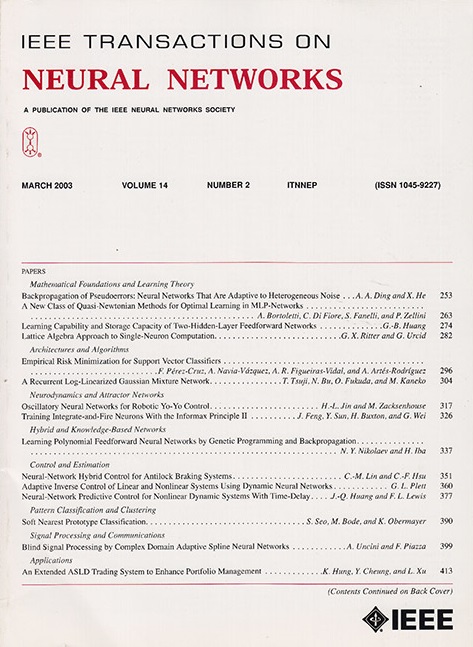
The focus of IEEE Transactions on Neural Networks and Learning Systems is to present scholarly articles discussing the theory, design, and applications of neural networks as well as other learning systems. The journal primarily highlights technical and scientific research in this domain.



 京公网安备 11010802042870号
京ICP备2023020795号-1
京公网安备 11010802042870号
京ICP备2023020795号-1

 分享
分享
 求助内容:
求助内容: 应助结果提醒方式:
 扫码关注我们
