Wei Yang, Zhenyan Zhao, Prof. Dr. Yu Lan, Zhou Dong, Ruiying Chang, Yihang Bai, Dr. Shihan Liu, Dr. Shi-Jun Li, Dr. Linbin Niu
{"title":"Heterocoupling Two Similar Benzyl Radicals by Dual Photoredox/Cobalt Catalysis","authors":"Wei Yang, Zhenyan Zhao, Prof. Dr. Yu Lan, Zhou Dong, Ruiying Chang, Yihang Bai, Dr. Shihan Liu, Dr. Shi-Jun Li, Dr. Linbin Niu","doi":"10.1002/anie.202421256","DOIUrl":null,"url":null,"abstract":"<p>Transition-metal-regulated radical cross coupling enables the selective bonding of two distinct transient radicals, whereas the catalytic method for sorting two almost identical transient radicals, especially similar benzyl radicals, is still rare. Herein, we show that leveraging dual photoredox/cobalt catalysis can selectively couple two similar benzyl radicals. Using easily accessible methylarenes and phenylacetates (benzyl <i>N</i>-hydroxyphthalimide (NHPI) esters) as benzyl radical sources, a range of unsymmetrical 1,2-diarylethane classes via the 1°–1°, 1°–2°, 1°–3°, 2°–2°, 2°–3° and 3°–3° couplings were obtained with broad functional group tolerance. Besides the photochemical continuous flow synthesis, the one-pot procedure that directly uses phenylacetic acids and NHPI as the starting materials to avoid the pre-preparation of benzyl NHPI esters for the gram-scale synthesis is also feasible and affords good yields, showcasing the synthetic utility of our protocol.</p>","PeriodicalId":125,"journal":{"name":"Angewandte Chemie International Edition","volume":"64 10","pages":""},"PeriodicalIF":16.9000,"publicationDate":"2024-12-24","publicationTypes":"Journal Article","fieldsOfStudy":null,"isOpenAccess":false,"openAccessPdf":"","citationCount":"0","resultStr":null,"platform":"Semanticscholar","paperid":null,"PeriodicalName":"Angewandte Chemie International Edition","FirstCategoryId":"92","ListUrlMain":"https://onlinelibrary.wiley.com/doi/10.1002/anie.202421256","RegionNum":1,"RegionCategory":"化学","ArticlePicture":[],"TitleCN":null,"AbstractTextCN":null,"PMCID":null,"EPubDate":"","PubModel":"","JCR":"Q1","JCRName":"CHEMISTRY, MULTIDISCIPLINARY","Score":null,"Total":0}
引用次数: 0
Abstract
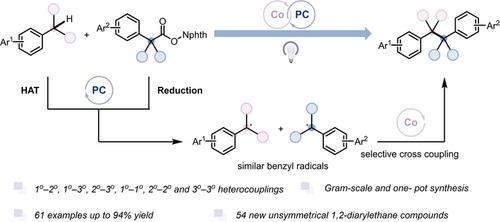
Transition-metal-regulated radical cross coupling enables the selective bonding of two distinct transient radicals, whereas the catalytic method for sorting two almost identical transient radicals, especially similar benzyl radicals, is still rare. Herein, we show that leveraging dual photoredox/cobalt catalysis can selectively couple two similar benzyl radicals. Using easily accessible methylarenes and phenylacetates (benzyl N-hydroxyphthalimide (NHPI) esters) as benzyl radical sources, a range of unsymmetrical 1,2-diarylethane classes via the 1°–1°, 1°–2°, 1°–3°, 2°–2°, 2°–3° and 3°–3° couplings were obtained with broad functional group tolerance. Besides the photochemical continuous flow synthesis, the one-pot procedure that directly uses phenylacetic acids and NHPI as the starting materials to avoid the pre-preparation of benzyl NHPI esters for the gram-scale synthesis is also feasible and affords good yields, showcasing the synthetic utility of our protocol.
期刊介绍:
Angewandte Chemie, a journal of the German Chemical Society (GDCh), maintains a leading position among scholarly journals in general chemistry with an impressive Impact Factor of 16.6 (2022 Journal Citation Reports, Clarivate, 2023). Published weekly in a reader-friendly format, it features new articles almost every day. Established in 1887, Angewandte Chemie is a prominent chemistry journal, offering a dynamic blend of Review-type articles, Highlights, Communications, and Research Articles on a weekly basis, making it unique in the field.



 京公网安备 11010802042870号
京ICP备2023020795号-1
京公网安备 11010802042870号
京ICP备2023020795号-1

 分享
分享
 求助内容:
求助内容: 应助结果提醒方式:
 扫码关注我们
