Ye Eun Kim, Pilseon Im, Seung Woo Choi, Jaeyun Kim
{"title":"Autocatalytic Ceria Nanoparticle-Embedded Tilapia Collagen Hydrogels as Enhanced Antioxidative and Long-Lasting Dermal Fillers for Photoaged Skin","authors":"Ye Eun Kim, Pilseon Im, Seung Woo Choi, Jaeyun Kim","doi":"10.1021/acs.nanolett.4c04797","DOIUrl":null,"url":null,"abstract":"Excessive reactive oxygen species (ROS) generated by ultraviolet (UV) irradiation significantly contribute to photoaging by increasing the level of matrix metalloproteinases (MMPs), accelerating collagen degradation. Commercial dermal fillers offer temporary wrinkle reduction via volume enhancement. In this study, we propose tilapia-derived collagen hydrogels embedded with ceria nanoparticles (Ce@Col gels) as long-lasting dermal fillers for UVB-induced photoaging. Ceria nanoparticles (CeNPs) significantly enhance the stability of the collagen matrix against enzymatic degradation. These gels exhibit mechanical stability and injectability comparable to those of commercial alternatives. Additionally, CeNPs effectively eliminate ROS to suppress MMP production, curbing both collagen degradation and inflammatory responses. In a UVB-induced photoaging mouse model, the Ce@Col gels significantly reduced the level of oxidative stress in the skin, decreased the number of wrinkles, reduced epidermal thickness, and decreased levels of aging-related biomarkers while increasing the level of collagen deposition. These antiaging effects persisted for seven months post-injection, highlighting Ce@Col gels as a promising approach for prolonged collagen regeneration and sustained anti-inflammatory benefits in photoaged skin.","PeriodicalId":53,"journal":{"name":"Nano Letters","volume":"25 1","pages":""},"PeriodicalIF":9.1000,"publicationDate":"2024-12-24","publicationTypes":"Journal Article","fieldsOfStudy":null,"isOpenAccess":false,"openAccessPdf":"","citationCount":"0","resultStr":null,"platform":"Semanticscholar","paperid":null,"PeriodicalName":"Nano Letters","FirstCategoryId":"88","ListUrlMain":"https://doi.org/10.1021/acs.nanolett.4c04797","RegionNum":1,"RegionCategory":"材料科学","ArticlePicture":[],"TitleCN":null,"AbstractTextCN":null,"PMCID":null,"EPubDate":"","PubModel":"","JCR":"Q1","JCRName":"CHEMISTRY, MULTIDISCIPLINARY","Score":null,"Total":0}
引用次数: 0
Abstract
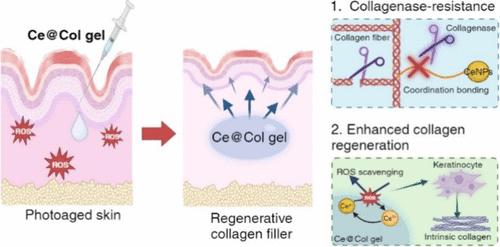
Excessive reactive oxygen species (ROS) generated by ultraviolet (UV) irradiation significantly contribute to photoaging by increasing the level of matrix metalloproteinases (MMPs), accelerating collagen degradation. Commercial dermal fillers offer temporary wrinkle reduction via volume enhancement. In this study, we propose tilapia-derived collagen hydrogels embedded with ceria nanoparticles (Ce@Col gels) as long-lasting dermal fillers for UVB-induced photoaging. Ceria nanoparticles (CeNPs) significantly enhance the stability of the collagen matrix against enzymatic degradation. These gels exhibit mechanical stability and injectability comparable to those of commercial alternatives. Additionally, CeNPs effectively eliminate ROS to suppress MMP production, curbing both collagen degradation and inflammatory responses. In a UVB-induced photoaging mouse model, the Ce@Col gels significantly reduced the level of oxidative stress in the skin, decreased the number of wrinkles, reduced epidermal thickness, and decreased levels of aging-related biomarkers while increasing the level of collagen deposition. These antiaging effects persisted for seven months post-injection, highlighting Ce@Col gels as a promising approach for prolonged collagen regeneration and sustained anti-inflammatory benefits in photoaged skin.
期刊介绍:
Nano Letters serves as a dynamic platform for promptly disseminating original results in fundamental, applied, and emerging research across all facets of nanoscience and nanotechnology. A pivotal criterion for inclusion within Nano Letters is the convergence of at least two different areas or disciplines, ensuring a rich interdisciplinary scope. The journal is dedicated to fostering exploration in diverse areas, including:
- Experimental and theoretical findings on physical, chemical, and biological phenomena at the nanoscale
- Synthesis, characterization, and processing of organic, inorganic, polymer, and hybrid nanomaterials through physical, chemical, and biological methodologies
- Modeling and simulation of synthetic, assembly, and interaction processes
- Realization of integrated nanostructures and nano-engineered devices exhibiting advanced performance
- Applications of nanoscale materials in living and environmental systems
Nano Letters is committed to advancing and showcasing groundbreaking research that intersects various domains, fostering innovation and collaboration in the ever-evolving field of nanoscience and nanotechnology.



 京公网安备 11010802042870号
京ICP备2023020795号-1
京公网安备 11010802042870号
京ICP备2023020795号-1

 分享
分享
 求助内容:
求助内容: 应助结果提醒方式:
 扫码关注我们
