{"title":"Reverse Electron Transfer-Induced SnS2 Phase Transition for Efficient Photocatalytic CO2–C2H6 Conversion","authors":"Qifan Wu, Yaqi Liu, Yichen Liu, Zuozheng Xu, Guicheng Luo, Guangqing Liu, Yun Shan, Shuyi Wu, Lizhe Liu, Zhimin Liu","doi":"10.1021/acssuschemeng.4c06819","DOIUrl":null,"url":null,"abstract":"Two-dimensional metal sulfides such as SnS<sub>2</sub> play a pivotal role in the field of environmental energy due to their suitable optical bandgap and high specific surface area. However, the steady-state 2H-phase SnS<sub>2</sub> suffers from rapid charge recombination and low CO<sub>2</sub> catalytic activity, limiting its practical application in photocatalytic CO<sub>2</sub> reduction. In this work, we designed a CuPd/SnS<sub>2</sub> heterojunction system by loading CuPd nanoparticles onto SnS<sub>2</sub> nanosheets (NSs). Under illumination, the hot electrons excited in CuPd nanoparticles induce a 2H-1T-phase transition of SnS<sub>2</sub>, effectively improving the photogenerated carrier dynamics of the material. Additionally, the post-transition energy level structure facilitates more efficient injection of photogenerated electrons into highly catalytic CuPd particles, achieving the goal of photocatalytic reduction of CO<sub>2</sub> to C<sub>2</sub>H<sub>6</sub>. Resultingly, the CuPd/SnS<sub>2</sub> photocatalytic system achieves a C<sub>2</sub>H<sub>6</sub> production rate of 255.6 μmol g<sup>–1</sup> h<sup>–1</sup>, which is approximately 24.4 times and 3.9 times higher than that of Cu/SnS<sub>2</sub> and Pd/SnS<sub>2</sub>, respectively. Moreover, it boasts a remarkable product selectivity of up to 90.4% for C<sub>2</sub>H<sub>6</sub>. This study provides a valuable approach for modulating photogenerated carrier dynamics and enhancing catalytic activity in two-dimensional metal sulfides.","PeriodicalId":25,"journal":{"name":"ACS Sustainable Chemistry & Engineering","volume":"31 1","pages":""},"PeriodicalIF":7.3000,"publicationDate":"2024-12-23","publicationTypes":"Journal Article","fieldsOfStudy":null,"isOpenAccess":false,"openAccessPdf":"","citationCount":"0","resultStr":null,"platform":"Semanticscholar","paperid":null,"PeriodicalName":"ACS Sustainable Chemistry & Engineering","FirstCategoryId":"92","ListUrlMain":"https://doi.org/10.1021/acssuschemeng.4c06819","RegionNum":1,"RegionCategory":"化学","ArticlePicture":[],"TitleCN":null,"AbstractTextCN":null,"PMCID":null,"EPubDate":"","PubModel":"","JCR":"Q1","JCRName":"CHEMISTRY, MULTIDISCIPLINARY","Score":null,"Total":0}
引用次数: 0
Abstract
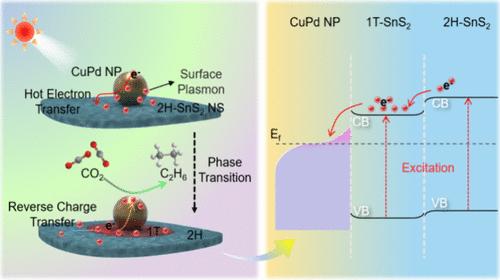
Two-dimensional metal sulfides such as SnS2 play a pivotal role in the field of environmental energy due to their suitable optical bandgap and high specific surface area. However, the steady-state 2H-phase SnS2 suffers from rapid charge recombination and low CO2 catalytic activity, limiting its practical application in photocatalytic CO2 reduction. In this work, we designed a CuPd/SnS2 heterojunction system by loading CuPd nanoparticles onto SnS2 nanosheets (NSs). Under illumination, the hot electrons excited in CuPd nanoparticles induce a 2H-1T-phase transition of SnS2, effectively improving the photogenerated carrier dynamics of the material. Additionally, the post-transition energy level structure facilitates more efficient injection of photogenerated electrons into highly catalytic CuPd particles, achieving the goal of photocatalytic reduction of CO2 to C2H6. Resultingly, the CuPd/SnS2 photocatalytic system achieves a C2H6 production rate of 255.6 μmol g–1 h–1, which is approximately 24.4 times and 3.9 times higher than that of Cu/SnS2 and Pd/SnS2, respectively. Moreover, it boasts a remarkable product selectivity of up to 90.4% for C2H6. This study provides a valuable approach for modulating photogenerated carrier dynamics and enhancing catalytic activity in two-dimensional metal sulfides.
期刊介绍:
ACS Sustainable Chemistry & Engineering is a prestigious weekly peer-reviewed scientific journal published by the American Chemical Society. Dedicated to advancing the principles of green chemistry and green engineering, it covers a wide array of research topics including green chemistry, green engineering, biomass, alternative energy, and life cycle assessment.
The journal welcomes submissions in various formats, including Letters, Articles, Features, and Perspectives (Reviews), that address the challenges of sustainability in the chemical enterprise and contribute to the advancement of sustainable practices. Join us in shaping the future of sustainable chemistry and engineering.



 京公网安备 11010802042870号
京ICP备2023020795号-1
京公网安备 11010802042870号
京ICP备2023020795号-1

 分享
分享
 求助内容:
求助内容: 应助结果提醒方式:
 扫码关注我们
