Marco Pinna, Javier Diaz, Christopher Denison, Andrei Zvelindovsky and Ignacio Pagonabarraga
{"title":"Mechanisms of alignment of lamellar-forming block copolymer under shear flow†","authors":"Marco Pinna, Javier Diaz, Christopher Denison, Andrei Zvelindovsky and Ignacio Pagonabarraga","doi":"10.1039/D4SM01241K","DOIUrl":null,"url":null,"abstract":"<p >The potential applications of block copolymer thin films, utilising their self-assembly capabilities, are enhanced when achieving long-range ordering. In this study we explain the experimental alignment of lamellae under shear flow findings [S. Pujari <em>et al. Soft Matter</em>, 2012, <strong>8</strong>, 5258] and classify the alignment mechanisms based on shear rate and segregation, uncovering similarities to the systems subjected to electric fields, suggesting a common pathway of lamellae orientations. However, the presence of thin films surfaces introduces distinct features in the lamellae orientation under shear compared to electric fields. Notably, we observe the emergence of a three-dimensional rotation alongside the conventional two-dimensional rotation. Furthermore, a transient regime has been identified within the melting mechanism, which confirms the existence of the checkboard pattern proposed by Schneider <em>et al.</em> [<em>Macromolecules</em>, 2018, <strong>51</strong>, 4642]. These findings significantly enhance our understanding of block copolymer alignments and shed light on the intricate interplay between external fields and the lamellar structure.</p>","PeriodicalId":103,"journal":{"name":"Soft Matter","volume":" 3","pages":" 476-487"},"PeriodicalIF":2.8000,"publicationDate":"2024-12-16","publicationTypes":"Journal Article","fieldsOfStudy":null,"isOpenAccess":false,"openAccessPdf":"https://www.ncbi.nlm.nih.gov/pmc/articles/PMC11667677/pdf/","citationCount":"0","resultStr":null,"platform":"Semanticscholar","paperid":null,"PeriodicalName":"Soft Matter","FirstCategoryId":"92","ListUrlMain":"https://pubs.rsc.org/en/content/articlelanding/2025/sm/d4sm01241k","RegionNum":3,"RegionCategory":"化学","ArticlePicture":[],"TitleCN":null,"AbstractTextCN":null,"PMCID":null,"EPubDate":"","PubModel":"","JCR":"Q3","JCRName":"CHEMISTRY, PHYSICAL","Score":null,"Total":0}
引用次数: 0
Abstract
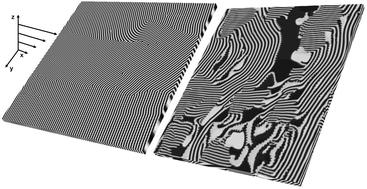
The potential applications of block copolymer thin films, utilising their self-assembly capabilities, are enhanced when achieving long-range ordering. In this study we explain the experimental alignment of lamellae under shear flow findings [S. Pujari et al. Soft Matter, 2012, 8, 5258] and classify the alignment mechanisms based on shear rate and segregation, uncovering similarities to the systems subjected to electric fields, suggesting a common pathway of lamellae orientations. However, the presence of thin films surfaces introduces distinct features in the lamellae orientation under shear compared to electric fields. Notably, we observe the emergence of a three-dimensional rotation alongside the conventional two-dimensional rotation. Furthermore, a transient regime has been identified within the melting mechanism, which confirms the existence of the checkboard pattern proposed by Schneider et al. [Macromolecules, 2018, 51, 4642]. These findings significantly enhance our understanding of block copolymer alignments and shed light on the intricate interplay between external fields and the lamellar structure.
期刊介绍:
Soft Matter is an international journal published by the Royal Society of Chemistry using Engineering-Materials Science: A Synthesis as its research focus. It publishes original research articles, review articles, and synthesis articles related to this field, reporting the latest discoveries in the relevant theoretical, practical, and applied disciplines in a timely manner, and aims to promote the rapid exchange of scientific information in this subject area. The journal is an open access journal. The journal is an open access journal and has not been placed on the alert list in the last three years.



 京公网安备 11010802042870号
京ICP备2023020795号-1
京公网安备 11010802042870号
京ICP备2023020795号-1

 分享
分享
 求助内容:
求助内容: 应助结果提醒方式:
 扫码关注我们
