Magda Kopczyńska, Upasana Saha, Anastasiia Romanenko, Takayuki Nojima, Michał R Gdula, Kinga Kamieniarz-Gdula
{"title":"Defining gene ends: RNA polymerase II CTD threonine 4 phosphorylation marks transcription termination regions genome-wide","authors":"Magda Kopczyńska, Upasana Saha, Anastasiia Romanenko, Takayuki Nojima, Michał R Gdula, Kinga Kamieniarz-Gdula","doi":"10.1093/nar/gkae1240","DOIUrl":null,"url":null,"abstract":"Defining the beginning of a eukaryotic protein-coding gene is relatively simple. It corresponds to the first ribonucleotide incorporated by RNA polymerase II (Pol II) into the nascent RNA molecule. This nucleotide is protected by capping and maintained in the mature messenger RNA (mRNA). However, in higher eukaryotes, the end of mRNA is separated from the sites of transcription termination by hundreds to thousands of base pairs. Currently used genomic annotations only take account of the end of the mature transcript – the sites where pre-mRNA cleavage occurs, while the regions in which transcription terminates are unannotated. Here, we describe the evidence for a marker of transcription termination, which could be widely applicable in genomic studies. Pol II termination regions can be determined genome-wide by detecting Pol II phosphorylated on threonine 4 of its C-terminal domain (Pol II CTD-T4ph). Pol II in this state pauses before leaving the DNA template. Up to date this potent mark has been underused because the evidence for its place and role in termination is scattered across multiple publications. We summarize the observations regarding Pol II CTD-T4ph in termination regions and present bioinformatic analyses that further support Pol II CTD-T4ph as a global termination mark in animals.","PeriodicalId":19471,"journal":{"name":"Nucleic Acids Research","volume":"59 1","pages":""},"PeriodicalIF":13.1000,"publicationDate":"2024-12-24","publicationTypes":"Journal Article","fieldsOfStudy":null,"isOpenAccess":false,"openAccessPdf":"","citationCount":"0","resultStr":null,"platform":"Semanticscholar","paperid":null,"PeriodicalName":"Nucleic Acids Research","FirstCategoryId":"99","ListUrlMain":"https://doi.org/10.1093/nar/gkae1240","RegionNum":2,"RegionCategory":"生物学","ArticlePicture":[],"TitleCN":null,"AbstractTextCN":null,"PMCID":null,"EPubDate":"","PubModel":"","JCR":"Q1","JCRName":"BIOCHEMISTRY & MOLECULAR BIOLOGY","Score":null,"Total":0}
引用次数: 0
Abstract
Defining the beginning of a eukaryotic protein-coding gene is relatively simple. It corresponds to the first ribonucleotide incorporated by RNA polymerase II (Pol II) into the nascent RNA molecule. This nucleotide is protected by capping and maintained in the mature messenger RNA (mRNA). However, in higher eukaryotes, the end of mRNA is separated from the sites of transcription termination by hundreds to thousands of base pairs. Currently used genomic annotations only take account of the end of the mature transcript – the sites where pre-mRNA cleavage occurs, while the regions in which transcription terminates are unannotated. Here, we describe the evidence for a marker of transcription termination, which could be widely applicable in genomic studies. Pol II termination regions can be determined genome-wide by detecting Pol II phosphorylated on threonine 4 of its C-terminal domain (Pol II CTD-T4ph). Pol II in this state pauses before leaving the DNA template. Up to date this potent mark has been underused because the evidence for its place and role in termination is scattered across multiple publications. We summarize the observations regarding Pol II CTD-T4ph in termination regions and present bioinformatic analyses that further support Pol II CTD-T4ph as a global termination mark in animals.
确定真核生物蛋白质编码基因的起始是相对简单的。它对应于由RNA聚合酶II (Pol II)整合到新生RNA分子中的第一个核糖核苷酸。该核苷酸受到帽盖的保护,并维持在成熟信使RNA (mRNA)中。然而,在高等真核生物中,mRNA的末端与转录终止位点相隔数百到数千个碱基对。目前使用的基因组注释只考虑了成熟转录物的末端- pre-mRNA切割发生的位点,而转录终止的区域没有注释。在这里,我们描述了转录终止标记的证据,这可能在基因组研究中广泛应用。通过检测苏氨酸4上磷酸化的Pol II (Pol II CTD-T4ph),可以在全基因组范围内确定Pol II终止区域。这种状态下的Pol II在离开DNA模板之前会暂停。迄今为止,这一强有力的标志尚未得到充分利用,因为其在终止中的地位和作用的证据分散在多个出版物中。我们总结了Pol II CTD-T4ph在终止区域的观察结果,并提出了生物信息学分析,进一步支持Pol II CTD-T4ph作为动物的全局终止标记。
期刊介绍:
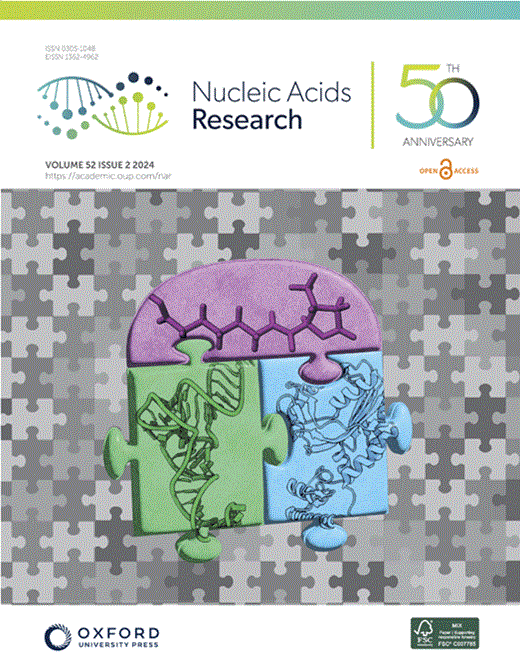
Nucleic Acids Research (NAR) is a scientific journal that publishes research on various aspects of nucleic acids and proteins involved in nucleic acid metabolism and interactions. It covers areas such as chemistry and synthetic biology, computational biology, gene regulation, chromatin and epigenetics, genome integrity, repair and replication, genomics, molecular biology, nucleic acid enzymes, RNA, and structural biology. The journal also includes a Survey and Summary section for brief reviews. Additionally, each year, the first issue is dedicated to biological databases, and an issue in July focuses on web-based software resources for the biological community. Nucleic Acids Research is indexed by several services including Abstracts on Hygiene and Communicable Diseases, Animal Breeding Abstracts, Agricultural Engineering Abstracts, Agbiotech News and Information, BIOSIS Previews, CAB Abstracts, and EMBASE.



 京公网安备 11010802042870号
京ICP备2023020795号-1
京公网安备 11010802042870号
京ICP备2023020795号-1

 分享
分享
 求助内容:
求助内容: 应助结果提醒方式:
 扫码关注我们
