{"title":"RALACs: Action Recognition in Autonomous Vehicles Using Interaction Encoding and Optical Flow","authors":"Eddy Zhou;Owen Leather;Alex Zhuang;Alikasim Budhwani;Rowan Dempster;Quanquan Li;Mohammad Al-Sharman;Derek Rayside;William Melek","doi":"10.1109/TCYB.2024.3515104","DOIUrl":null,"url":null,"abstract":"When applied to autonomous vehicle (AV) settings, action recognition can enhance an environment model’s situational awareness. This is especially prevalent in scenarios where traditional geometric descriptions and heuristics in AVs are insufficient. However, action recognition has traditionally been studied for humans, and its limited adaptability to noisy, un-clipped, un-pampered, raw RGB data has limited its application in other fields. To push for the advancement and adoption of action recognition into AVs, this work proposes a novel two-stage action recognition system, termed RALACs. RALACs formulates the problem of action recognition for road scenes, and bridges the gap between it and the established field of human action recognition. This work shows how attention layers can be useful for encoding the relations across agents, and stresses how such a scheme can be class-agnostic. Furthermore, to address the dynamic nature of agents on the road, RALACs constructs a novel approach to adapting Region of Interest (ROI) alignment to agent tracks for downstream action classification. Finally, our scheme also considers the problem of active agent detection, and utilizes a novel application of fusing optical flow maps to discern relevant agents in a road scene. We show that our proposed scheme can outperform the baseline on the ICCV2021 Road Challenge dataset (Singh et al., 2023) algorithm and by deploying it on a real vehicle platform, we provide preliminary insight to the usefulness of action recognition in decision making. The code is publicly available at <uri>https://github.com/WATonomous/action-classification</uri>.","PeriodicalId":13112,"journal":{"name":"IEEE Transactions on Cybernetics","volume":"55 2","pages":"512-525"},"PeriodicalIF":10.5000,"publicationDate":"2024-12-24","publicationTypes":"Journal Article","fieldsOfStudy":null,"isOpenAccess":false,"openAccessPdf":"","citationCount":"0","resultStr":null,"platform":"Semanticscholar","paperid":null,"PeriodicalName":"IEEE Transactions on Cybernetics","FirstCategoryId":"94","ListUrlMain":"https://ieeexplore.ieee.org/document/10813578/","RegionNum":1,"RegionCategory":"计算机科学","ArticlePicture":[],"TitleCN":null,"AbstractTextCN":null,"PMCID":null,"EPubDate":"","PubModel":"","JCR":"Q1","JCRName":"AUTOMATION & CONTROL SYSTEMS","Score":null,"Total":0}
引用次数: 0
Abstract
When applied to autonomous vehicle (AV) settings, action recognition can enhance an environment model’s situational awareness. This is especially prevalent in scenarios where traditional geometric descriptions and heuristics in AVs are insufficient. However, action recognition has traditionally been studied for humans, and its limited adaptability to noisy, un-clipped, un-pampered, raw RGB data has limited its application in other fields. To push for the advancement and adoption of action recognition into AVs, this work proposes a novel two-stage action recognition system, termed RALACs. RALACs formulates the problem of action recognition for road scenes, and bridges the gap between it and the established field of human action recognition. This work shows how attention layers can be useful for encoding the relations across agents, and stresses how such a scheme can be class-agnostic. Furthermore, to address the dynamic nature of agents on the road, RALACs constructs a novel approach to adapting Region of Interest (ROI) alignment to agent tracks for downstream action classification. Finally, our scheme also considers the problem of active agent detection, and utilizes a novel application of fusing optical flow maps to discern relevant agents in a road scene. We show that our proposed scheme can outperform the baseline on the ICCV2021 Road Challenge dataset (Singh et al., 2023) algorithm and by deploying it on a real vehicle platform, we provide preliminary insight to the usefulness of action recognition in decision making. The code is publicly available at https://github.com/WATonomous/action-classification.
期刊介绍:
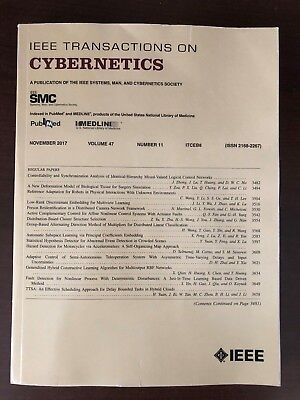
The scope of the IEEE Transactions on Cybernetics includes computational approaches to the field of cybernetics. Specifically, the transactions welcomes papers on communication and control across machines or machine, human, and organizations. The scope includes such areas as computational intelligence, computer vision, neural networks, genetic algorithms, machine learning, fuzzy systems, cognitive systems, decision making, and robotics, to the extent that they contribute to the theme of cybernetics or demonstrate an application of cybernetics principles.



 京公网安备 11010802042870号
京ICP备2023020795号-1
京公网安备 11010802042870号
京ICP备2023020795号-1

 分享
分享
 求助内容:
求助内容: 应助结果提醒方式:
 扫码关注我们
