Eman L Habbak, Mohamed S Abdalzaher, Adel S Othman, H A Mansour
{"title":"Enhancing the classification of seismic events with supervised machine learning and feature importance.","authors":"Eman L Habbak, Mohamed S Abdalzaher, Adel S Othman, H A Mansour","doi":"10.1038/s41598-024-81113-7","DOIUrl":null,"url":null,"abstract":"<p><p>The accurate classification of seismic events into natural earthquakes (EQ) and quarry blasts (QB) is crucial for geological understanding, seismic hazard mitigation, and public safety. This paper proposes a machine-learning approach to discriminate seismic events, particularly differentiating between natural EQs and man-made QBs. The core of this study is to integrate different features into a unified dataset to train some linear and nonlinear supervised machine learning (ML) models. The proposed approach considers a collection of 837 events (EQs and QBs) with local magnitudes of <math><mrow><mn>1.5</mn> <mo>≤</mo> <msub><mi>M</mi> <mi>L</mi></msub> <mo>≤</mo> <mn>3.3</mn></mrow> </math> from the Egyptian National Seismic Network (ENSN) seismic event catalog between 2009 and 2015. This paper's principal contribution is applying feature selection techniques and feature importance analysis to identify the best features leading to the best events' discrimination. In other words, the proposed approach enhances classification accuracy and provides insights into which features are most crucial for distinguishing between EQ and QB events. The results show that with only three features, corner frequency, power of event, and spectral ratio, the best-developed ML model accomplishes a discrimination accuracy of 100% among several benchmarks of linear and non-linear models.</p>","PeriodicalId":21811,"journal":{"name":"Scientific Reports","volume":"14 1","pages":"30638"},"PeriodicalIF":3.9000,"publicationDate":"2024-12-24","publicationTypes":"Journal Article","fieldsOfStudy":null,"isOpenAccess":false,"openAccessPdf":"https://www.ncbi.nlm.nih.gov/pmc/articles/PMC11668824/pdf/","citationCount":"0","resultStr":null,"platform":"Semanticscholar","paperid":null,"PeriodicalName":"Scientific Reports","FirstCategoryId":"103","ListUrlMain":"https://doi.org/10.1038/s41598-024-81113-7","RegionNum":2,"RegionCategory":"综合性期刊","ArticlePicture":[],"TitleCN":null,"AbstractTextCN":null,"PMCID":null,"EPubDate":"","PubModel":"","JCR":"Q1","JCRName":"MULTIDISCIPLINARY SCIENCES","Score":null,"Total":0}
引用次数: 0
Abstract
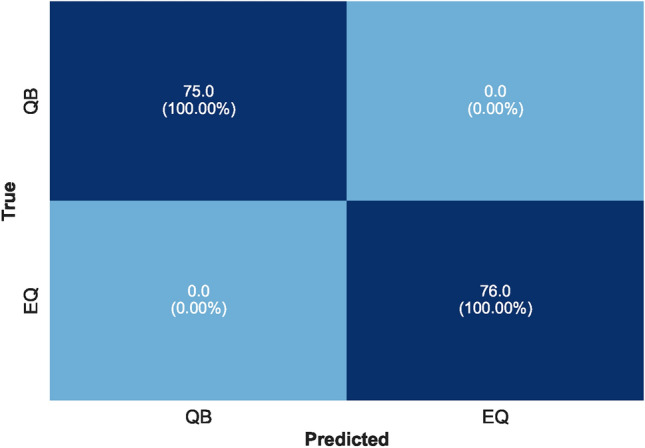
The accurate classification of seismic events into natural earthquakes (EQ) and quarry blasts (QB) is crucial for geological understanding, seismic hazard mitigation, and public safety. This paper proposes a machine-learning approach to discriminate seismic events, particularly differentiating between natural EQs and man-made QBs. The core of this study is to integrate different features into a unified dataset to train some linear and nonlinear supervised machine learning (ML) models. The proposed approach considers a collection of 837 events (EQs and QBs) with local magnitudes of from the Egyptian National Seismic Network (ENSN) seismic event catalog between 2009 and 2015. This paper's principal contribution is applying feature selection techniques and feature importance analysis to identify the best features leading to the best events' discrimination. In other words, the proposed approach enhances classification accuracy and provides insights into which features are most crucial for distinguishing between EQ and QB events. The results show that with only three features, corner frequency, power of event, and spectral ratio, the best-developed ML model accomplishes a discrimination accuracy of 100% among several benchmarks of linear and non-linear models.
期刊介绍:
We publish original research from all areas of the natural sciences, psychology, medicine and engineering. You can learn more about what we publish by browsing our specific scientific subject areas below or explore Scientific Reports by browsing all articles and collections.
Scientific Reports has a 2-year impact factor: 4.380 (2021), and is the 6th most-cited journal in the world, with more than 540,000 citations in 2020 (Clarivate Analytics, 2021).
•Engineering
Engineering covers all aspects of engineering, technology, and applied science. It plays a crucial role in the development of technologies to address some of the world''s biggest challenges, helping to save lives and improve the way we live.
•Physical sciences
Physical sciences are those academic disciplines that aim to uncover the underlying laws of nature — often written in the language of mathematics. It is a collective term for areas of study including astronomy, chemistry, materials science and physics.
•Earth and environmental sciences
Earth and environmental sciences cover all aspects of Earth and planetary science and broadly encompass solid Earth processes, surface and atmospheric dynamics, Earth system history, climate and climate change, marine and freshwater systems, and ecology. It also considers the interactions between humans and these systems.
•Biological sciences
Biological sciences encompass all the divisions of natural sciences examining various aspects of vital processes. The concept includes anatomy, physiology, cell biology, biochemistry and biophysics, and covers all organisms from microorganisms, animals to plants.
•Health sciences
The health sciences study health, disease and healthcare. This field of study aims to develop knowledge, interventions and technology for use in healthcare to improve the treatment of patients.





 京公网安备 11010802042870号
京ICP备2023020795号-1
京公网安备 11010802042870号
京ICP备2023020795号-1

 分享
分享
 求助内容:
求助内容: 应助结果提醒方式:
 扫码关注我们
