{"title":"3D convolutional neural network based on spatial-spectral feature pictures learning for decoding motor imagery EEG signal.","authors":"Xiaoguang Li, Yaqi Chu, Xuejian Wu","doi":"10.3389/fnbot.2024.1485640","DOIUrl":null,"url":null,"abstract":"<p><p>Non-invasive brain-computer interfaces (BCI) hold great promise in the field of neurorehabilitation. They are easy to use and do not require surgery, particularly in the area of motor imagery electroencephalography (EEG). However, motor imagery EEG signals often have a low signal-to-noise ratio and limited spatial and temporal resolution. Traditional deep neural networks typically only focus on the spatial and temporal features of EEG, resulting in relatively low decoding and accuracy rates for motor imagery tasks. To address these challenges, this paper proposes a 3D Convolutional Neural Network (P-3DCNN) decoding method that jointly learns spatial-frequency feature maps from the frequency and spatial domains of the EEG signals. First, the Welch method is used to calculate the frequency band power spectrum of the EEG, and a 2D matrix representing the spatial topology distribution of the electrodes is constructed. These spatial-frequency representations are then generated through cubic interpolation of the temporal EEG data. Next, the paper designs a 3DCNN network with 1D and 2D convolutional layers in series to optimize the convolutional kernel parameters and effectively learn the spatial-frequency features of the EEG. Batch normalization and dropout are also applied to improve the training speed and classification performance of the network. Finally, through experiments, the proposed method is compared to various classic machine learning and deep learning techniques. The results show an average decoding accuracy rate of 86.69%, surpassing other advanced networks. This demonstrates the effectiveness of our approach in decoding motor imagery EEG and offers valuable insights for the development of BCI.</p>","PeriodicalId":12628,"journal":{"name":"Frontiers in Neurorobotics","volume":"18 ","pages":"1485640"},"PeriodicalIF":2.8000,"publicationDate":"2024-12-10","publicationTypes":"Journal Article","fieldsOfStudy":null,"isOpenAccess":false,"openAccessPdf":"https://www.ncbi.nlm.nih.gov/pmc/articles/PMC11667157/pdf/","citationCount":"0","resultStr":null,"platform":"Semanticscholar","paperid":null,"PeriodicalName":"Frontiers in Neurorobotics","FirstCategoryId":"94","ListUrlMain":"https://doi.org/10.3389/fnbot.2024.1485640","RegionNum":4,"RegionCategory":"计算机科学","ArticlePicture":[],"TitleCN":null,"AbstractTextCN":null,"PMCID":null,"EPubDate":"2024/1/1 0:00:00","PubModel":"eCollection","JCR":"Q3","JCRName":"COMPUTER SCIENCE, ARTIFICIAL INTELLIGENCE","Score":null,"Total":0}
引用次数: 0
Abstract
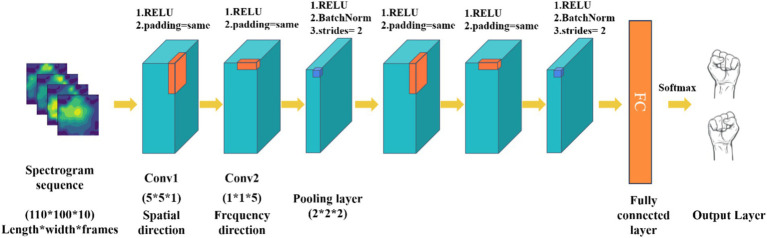
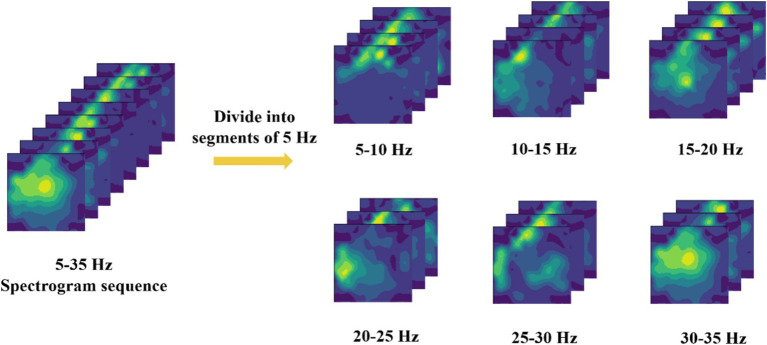
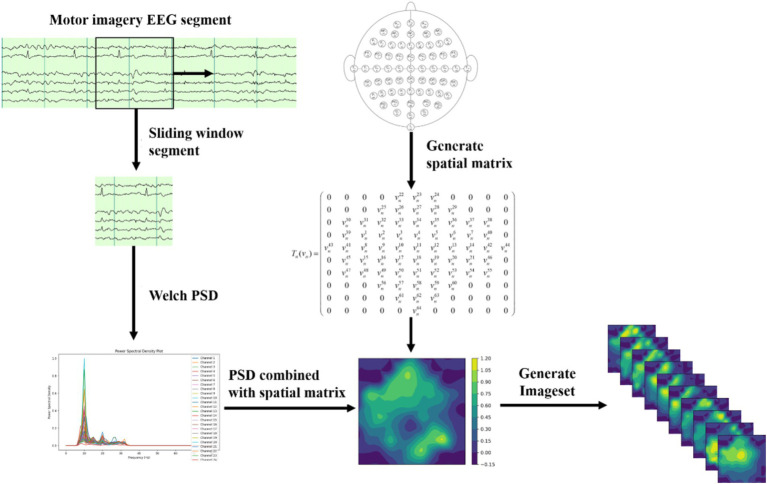
Non-invasive brain-computer interfaces (BCI) hold great promise in the field of neurorehabilitation. They are easy to use and do not require surgery, particularly in the area of motor imagery electroencephalography (EEG). However, motor imagery EEG signals often have a low signal-to-noise ratio and limited spatial and temporal resolution. Traditional deep neural networks typically only focus on the spatial and temporal features of EEG, resulting in relatively low decoding and accuracy rates for motor imagery tasks. To address these challenges, this paper proposes a 3D Convolutional Neural Network (P-3DCNN) decoding method that jointly learns spatial-frequency feature maps from the frequency and spatial domains of the EEG signals. First, the Welch method is used to calculate the frequency band power spectrum of the EEG, and a 2D matrix representing the spatial topology distribution of the electrodes is constructed. These spatial-frequency representations are then generated through cubic interpolation of the temporal EEG data. Next, the paper designs a 3DCNN network with 1D and 2D convolutional layers in series to optimize the convolutional kernel parameters and effectively learn the spatial-frequency features of the EEG. Batch normalization and dropout are also applied to improve the training speed and classification performance of the network. Finally, through experiments, the proposed method is compared to various classic machine learning and deep learning techniques. The results show an average decoding accuracy rate of 86.69%, surpassing other advanced networks. This demonstrates the effectiveness of our approach in decoding motor imagery EEG and offers valuable insights for the development of BCI.
期刊介绍:
Frontiers in Neurorobotics publishes rigorously peer-reviewed research in the science and technology of embodied autonomous neural systems. Specialty Chief Editors Alois C. Knoll and Florian Röhrbein at the Technische Universität München are supported by an outstanding Editorial Board of international experts. This multidisciplinary open-access journal is at the forefront of disseminating and communicating scientific knowledge and impactful discoveries to researchers, academics and the public worldwide.
Neural systems include brain-inspired algorithms (e.g. connectionist networks), computational models of biological neural networks (e.g. artificial spiking neural nets, large-scale simulations of neural microcircuits) and actual biological systems (e.g. in vivo and in vitro neural nets). The focus of the journal is the embodiment of such neural systems in artificial software and hardware devices, machines, robots or any other form of physical actuation. This also includes prosthetic devices, brain machine interfaces, wearable systems, micro-machines, furniture, home appliances, as well as systems for managing micro and macro infrastructures. Frontiers in Neurorobotics also aims to publish radically new tools and methods to study plasticity and development of autonomous self-learning systems that are capable of acquiring knowledge in an open-ended manner. Models complemented with experimental studies revealing self-organizing principles of embodied neural systems are welcome. Our journal also publishes on the micro and macro engineering and mechatronics of robotic devices driven by neural systems, as well as studies on the impact that such systems will have on our daily life.



 京公网安备 11010802042870号
京ICP备2023020795号-1
京公网安备 11010802042870号
京ICP备2023020795号-1

 分享
分享
 求助内容:
求助内容: 应助结果提醒方式:
 扫码关注我们
