Pengfei Xing, Junsong Qu, Shuaijing Feng, Jiarong Guo, Tao Huang
{"title":"Comparison of the efficacy of robot-assisted total knee arthroplasty in patients with knee osteoarthritis with varying severity deformity.","authors":"Pengfei Xing, Junsong Qu, Shuaijing Feng, Jiarong Guo, Tao Huang","doi":"10.1186/s13018-024-05372-w","DOIUrl":null,"url":null,"abstract":"<p><strong>Aim: </strong>To evaluate the clinical efficacy and imaging outcomes of a domestically produced orthopedic surgical robot for total knee arthroplasty and to explore its applicability in patients with varying degrees of deformity.</p><p><strong>Methods: </strong>This study retrospectively included 120 patients who underwent TKA at our hospital between February 2023 and June 2024. The patients were divided into a control group (conventional TKA surgery) and an observation group (robot-assisted TKA surgery), with 60 patients in each group. Based on different lower extremity alignment angles, each group was further subdivided into mild deformities (Hip knee ankle angle (HKA angle)deviation < 10°) and significant deformities (HKA angle deviation ≥ 10°). Preoperative and postoperative HKA angles, range of motion (ROM), visual analog scale (VAS) pain scores, and Knee Society (AKS) scores were recorded for both groups. Postoperative measurements included the posterior tibial slope angle (PSA), femoral coronal component angle (FFC), tibial coronal component angle (FTC), and femoral sagittal component angle (LFC), as well as the incidence of abnormal values for each angle, which were analyzed statistically.</p><p><strong>Results: </strong>The operation time in the observation group was longer than that in the control group, but intraoperative blood loss was significantly lower in the observation group (P < 0.05). Postoperatively, the differences in the HKA and PSA angles and the incidence of abnormal values were significantly better in the robot-assisted group than in the control group (P < 0.05). The other indicators did not significantly differ between the two groups. (P > 0.05). For patients with mild preoperative deformities, those in the robot-assisted group had significantly better postoperative HKA angle deviations and rates of postoperative HKA angle outliers than those in the conventional group. For patients with significant deformities, the robot-assisted group presented greater postoperative HKA and PSA angle deviations than the control group; the postoperative HKA and PSA angle outlier rates were significantly lower in the robot-assisted group (P < 0.05).</p><p><strong>Conclusion: </strong>The TINAVI robotic system demonstrated superior safety and efficacy in TKA surgery. Compared with conventional TKA, the robot-assisted system achieved significantly better outcomes regarding prosthesis implantation accuracy and lower extremity alignment, with a particular advantage in patients with severe limb alignment deformities.</p>","PeriodicalId":16629,"journal":{"name":"Journal of Orthopaedic Surgery and Research","volume":"19 1","pages":"872"},"PeriodicalIF":2.8000,"publicationDate":"2024-12-24","publicationTypes":"Journal Article","fieldsOfStudy":null,"isOpenAccess":false,"openAccessPdf":"https://www.ncbi.nlm.nih.gov/pmc/articles/PMC11668079/pdf/","citationCount":"0","resultStr":null,"platform":"Semanticscholar","paperid":null,"PeriodicalName":"Journal of Orthopaedic Surgery and Research","FirstCategoryId":"3","ListUrlMain":"https://doi.org/10.1186/s13018-024-05372-w","RegionNum":3,"RegionCategory":"医学","ArticlePicture":[],"TitleCN":null,"AbstractTextCN":null,"PMCID":null,"EPubDate":"","PubModel":"","JCR":"Q1","JCRName":"ORTHOPEDICS","Score":null,"Total":0}
引用次数: 0
Abstract
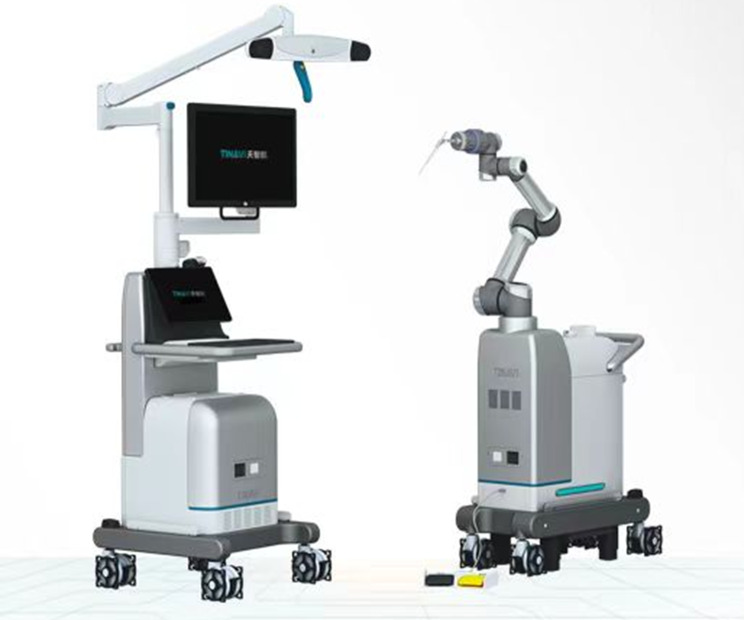
Aim: To evaluate the clinical efficacy and imaging outcomes of a domestically produced orthopedic surgical robot for total knee arthroplasty and to explore its applicability in patients with varying degrees of deformity.
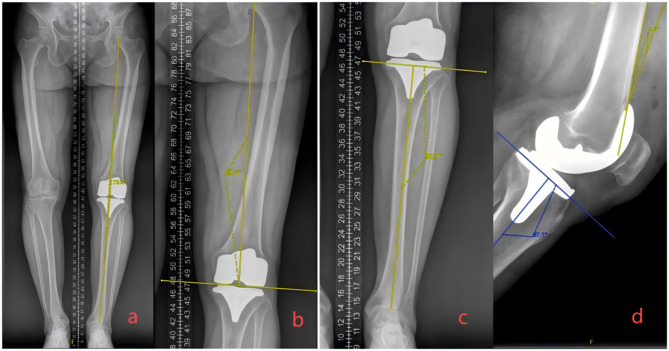
Methods: This study retrospectively included 120 patients who underwent TKA at our hospital between February 2023 and June 2024. The patients were divided into a control group (conventional TKA surgery) and an observation group (robot-assisted TKA surgery), with 60 patients in each group. Based on different lower extremity alignment angles, each group was further subdivided into mild deformities (Hip knee ankle angle (HKA angle)deviation < 10°) and significant deformities (HKA angle deviation ≥ 10°). Preoperative and postoperative HKA angles, range of motion (ROM), visual analog scale (VAS) pain scores, and Knee Society (AKS) scores were recorded for both groups. Postoperative measurements included the posterior tibial slope angle (PSA), femoral coronal component angle (FFC), tibial coronal component angle (FTC), and femoral sagittal component angle (LFC), as well as the incidence of abnormal values for each angle, which were analyzed statistically.
Results: The operation time in the observation group was longer than that in the control group, but intraoperative blood loss was significantly lower in the observation group (P < 0.05). Postoperatively, the differences in the HKA and PSA angles and the incidence of abnormal values were significantly better in the robot-assisted group than in the control group (P < 0.05). The other indicators did not significantly differ between the two groups. (P > 0.05). For patients with mild preoperative deformities, those in the robot-assisted group had significantly better postoperative HKA angle deviations and rates of postoperative HKA angle outliers than those in the conventional group. For patients with significant deformities, the robot-assisted group presented greater postoperative HKA and PSA angle deviations than the control group; the postoperative HKA and PSA angle outlier rates were significantly lower in the robot-assisted group (P < 0.05).
Conclusion: The TINAVI robotic system demonstrated superior safety and efficacy in TKA surgery. Compared with conventional TKA, the robot-assisted system achieved significantly better outcomes regarding prosthesis implantation accuracy and lower extremity alignment, with a particular advantage in patients with severe limb alignment deformities.
期刊介绍:
Journal of Orthopaedic Surgery and Research is an open access journal that encompasses all aspects of clinical and basic research studies related to musculoskeletal issues.
Orthopaedic research is conducted at clinical and basic science levels. With the advancement of new technologies and the increasing expectation and demand from doctors and patients, we are witnessing an enormous growth in clinical orthopaedic research, particularly in the fields of traumatology, spinal surgery, joint replacement, sports medicine, musculoskeletal tumour management, hand microsurgery, foot and ankle surgery, paediatric orthopaedic, and orthopaedic rehabilitation. The involvement of basic science ranges from molecular, cellular, structural and functional perspectives to tissue engineering, gait analysis, automation and robotic surgery. Implant and biomaterial designs are new disciplines that complement clinical applications.
JOSR encourages the publication of multidisciplinary research with collaboration amongst clinicians and scientists from different disciplines, which will be the trend in the coming decades.



 京公网安备 11010802042870号
京ICP备2023020795号-1
京公网安备 11010802042870号
京ICP备2023020795号-1

 分享
分享
 求助内容:
求助内容: 应助结果提醒方式:
 扫码关注我们
