{"title":"Risk and protective factors for coronavirus disease 2019 (COVID-19) in allergic rhinitis patients: a national survey in China.","authors":"Xiaozhe Yang, Yutong Sima, Jinming Zhao, Jing Zhang, Xiangdong Wang, Luo Zhang","doi":"10.3389/falgy.2024.1479493","DOIUrl":null,"url":null,"abstract":"<p><strong>Background: </strong>Several epidemiological studies have shown that allergic rhinitis (AR) patients are more susceptible to coronavirus disease 2019 (COVID-19).</p><p><strong>Objective: </strong>We aim to investigate the risk factors for COVID-19 in AR patients.</p><p><strong>Methods: </strong>A retrospective nationwide cohort study was conducted based on a questionnaire survey in China. The baseline characteristics, region of residence, smoking and drinking status, comorbidities, vaccination status and previous infection information were obtained. Allergen test results, the SARS-CoV-2 nucleic acid test, and antigen detection results were collected. Information on AR and comorbid medication use pre-SARS-CoV-2 infection was also collected. Binary logistic regression and analysis of covariance (different adjusted models) were conducted.</p><p><strong>Results: </strong>In all, 830 AR patients were included; 627 patients (75.54%) were infected with SARS-CoV-2. AR comorbid with allergic conjunctivitis (AC) was a protective factor [OR: 0.525 (95% CI = 0.296-0.929), <i>P</i> = 0.027] against SARS-CoV-2 infection, while AR comorbid with food allergy was a risk factor [OR: 6.404 (95% CI = 1.349-30.402), <i>P</i> = 0.0195]. Although fewer patients received four doses of the vaccine, the results showed a significant protective effect against SARS-CoV-2 infection in AR patients [OR: 0.093 (95% CI = 0.025-0.348), <i>P</i> = 0.0004]. Underweight was a protective factor against COVID-19 [OR: 0.287 (95% CI = 0.147-0.562), <i>P</i> = 0.0003] after full multivariable adjustment. Overweight was associated with a 2.071-fold higher risk for COVID-19 compared with normal weight [(95% CI = 1.045-4.105), <i>P</i> = 0.0370]. Additionally, house dust mite (HDM)-specific allergies were also protective against COVID-19 [OR: 0.537 (95% CI = 0.290-0.996), <i>P</i> = 0.0484].</p><p><strong>Conclusions: </strong>This study revealed underlying protective and risk factors, which might be used to improve the management of AR and COVID-19.</p>","PeriodicalId":73062,"journal":{"name":"Frontiers in allergy","volume":"5 ","pages":"1479493"},"PeriodicalIF":3.1000,"publicationDate":"2024-12-10","publicationTypes":"Journal Article","fieldsOfStudy":null,"isOpenAccess":false,"openAccessPdf":"https://www.ncbi.nlm.nih.gov/pmc/articles/PMC11666529/pdf/","citationCount":"0","resultStr":null,"platform":"Semanticscholar","paperid":null,"PeriodicalName":"Frontiers in allergy","FirstCategoryId":"1085","ListUrlMain":"https://doi.org/10.3389/falgy.2024.1479493","RegionNum":0,"RegionCategory":null,"ArticlePicture":[],"TitleCN":null,"AbstractTextCN":null,"PMCID":null,"EPubDate":"2024/1/1 0:00:00","PubModel":"eCollection","JCR":"Q2","JCRName":"ALLERGY","Score":null,"Total":0}
引用次数: 0
Abstract
Background: Several epidemiological studies have shown that allergic rhinitis (AR) patients are more susceptible to coronavirus disease 2019 (COVID-19).
Objective: We aim to investigate the risk factors for COVID-19 in AR patients.
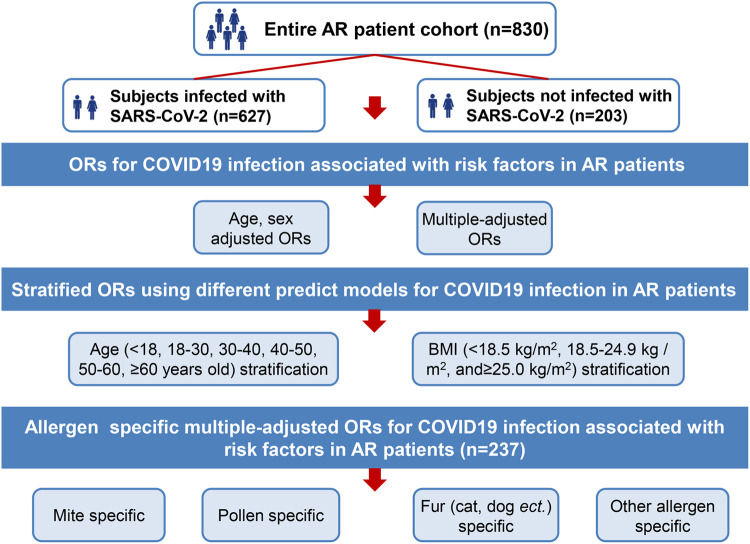
Methods: A retrospective nationwide cohort study was conducted based on a questionnaire survey in China. The baseline characteristics, region of residence, smoking and drinking status, comorbidities, vaccination status and previous infection information were obtained. Allergen test results, the SARS-CoV-2 nucleic acid test, and antigen detection results were collected. Information on AR and comorbid medication use pre-SARS-CoV-2 infection was also collected. Binary logistic regression and analysis of covariance (different adjusted models) were conducted.
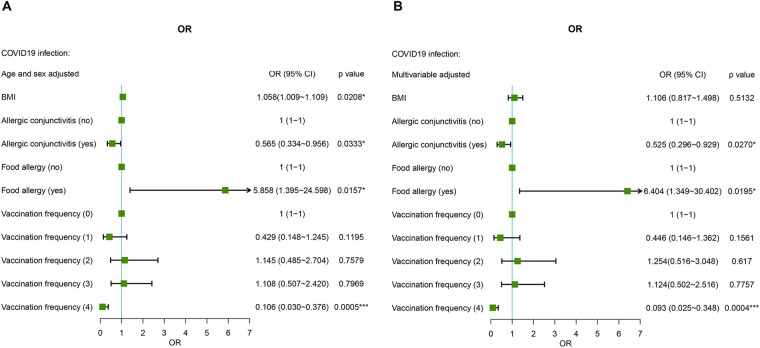
Results: In all, 830 AR patients were included; 627 patients (75.54%) were infected with SARS-CoV-2. AR comorbid with allergic conjunctivitis (AC) was a protective factor [OR: 0.525 (95% CI = 0.296-0.929), P = 0.027] against SARS-CoV-2 infection, while AR comorbid with food allergy was a risk factor [OR: 6.404 (95% CI = 1.349-30.402), P = 0.0195]. Although fewer patients received four doses of the vaccine, the results showed a significant protective effect against SARS-CoV-2 infection in AR patients [OR: 0.093 (95% CI = 0.025-0.348), P = 0.0004]. Underweight was a protective factor against COVID-19 [OR: 0.287 (95% CI = 0.147-0.562), P = 0.0003] after full multivariable adjustment. Overweight was associated with a 2.071-fold higher risk for COVID-19 compared with normal weight [(95% CI = 1.045-4.105), P = 0.0370]. Additionally, house dust mite (HDM)-specific allergies were also protective against COVID-19 [OR: 0.537 (95% CI = 0.290-0.996), P = 0.0484].
Conclusions: This study revealed underlying protective and risk factors, which might be used to improve the management of AR and COVID-19.
背景:多项流行病学研究表明,变应性鼻炎(AR)患者更容易感染2019冠状病毒病(COVID-19)。目的:探讨AR患者感染COVID-19的危险因素。方法:以问卷调查为基础,在全国范围内进行回顾性队列研究。获得基线特征、居住地区、吸烟和饮酒状况、合并症、疫苗接种状况和既往感染信息。收集过敏原检测结果、SARS-CoV-2核酸检测结果和抗原检测结果。还收集了sars - cov -2感染前的AR和合并症药物使用信息。进行了二元逻辑回归和协方差分析(不同调整模型)。结果:共纳入830例AR患者;627例(75.54%)感染SARS-CoV-2。AR合并变应性结膜炎(AC)是预防SARS-CoV-2感染的保护因素[OR: 0.525 (95% CI = 0.296 ~ 0.929), P = 0.027], AR合并食物过敏是危险因素[OR: 6.404 (95% CI = 1.349 ~ 30.402), P = 0.0195]。虽然接种四剂疫苗的患者较少,但结果显示AR患者对SARS-CoV-2感染有显著的保护作用[OR: 0.093 (95% CI = 0.025-0.348), P = 0.0004]。在完全多变量调整后,体重不足是预防COVID-19的保护因素[OR: 0.287 (95% CI = 0.147-0.562), P = 0.0003]。与正常体重相比,超重与COVID-19的风险增加2.071倍相关[95% CI = 1.045-4.105]。此外,屋尘螨(HDM)特异性过敏也对COVID-19具有保护作用[OR: 0.537 (95% CI = 0.290-0.996), P = 0.0484]。结论:本研究揭示了潜在的保护和危险因素,可能用于改善AR和COVID-19的管理。



 京公网安备 11010802042870号
京ICP备2023020795号-1
京公网安备 11010802042870号
京ICP备2023020795号-1

 分享
分享

 求助内容:
求助内容: 应助结果提醒方式:
 扫码关注我们
