{"title":"Potential impact of obstetric history on postmenopausal fragility fracture risk: A reassessment of the Fracture Risk Assessment Tool.","authors":"Aydan Sezgin, Huriye Güvenç Saçıntı, Elşad Osmanlı, Kübra Mangır, Koray Görkem Saçıntı, Erdem Aras Sezgin","doi":"10.52312/jdrs.2025.1995","DOIUrl":null,"url":null,"abstract":"<p><strong>Objectives: </strong>This study aimed to evaluate the impact of integrating obstetric parameters into the Fracture Risk Assessment Tool (FRAX) on the precision of risk assessment.</p><p><strong>Patients and methods: </strong>In this retrospective study, patients who experienced postmenopausal fragility fractures of the distal radius, proximal femur, or lumbar vertebrae between January 1, 2021, and December 31, 2023, were included. Obstetric histories, along with standard FRAX parameters, were obtained by phone interviews. Based on the FRAX major osteoporotic fracture risk score calculated without bone mineral density, patients were classified into high-, intermediate-, and low-risk group categories. Differences in age at menarche, age at menopause, lactation duration, gravidity, and parity were analyzed across risk categories.</p><p><strong>Results: </strong>A total of 328 patients (mean age: 64.5±5.8 years; range, 55 to 75 years) were included. The mean FRAX score was 16±8.8 (range, 3 to 58), and 85, 191, and 52 patients were classified as high-, intermediate-, and low-risk, respectively. A positive correlation was observed between FRAX scores and both later age at menarche and earlier menopause (p<0.001 and p=0.008, respectively). The mean age at menopause was significantly different between the high- and low-risk groups (46.4 vs. 49.3 years, p=0.016). The intermediate-risk group was also evaluated, showing no significant differences in obstetric parameters compared to the low-risk group (p>0.05).</p><p><strong>Conclusion: </strong>Although late menarche is not explicitly included in FRAX, its association with higher fracture risk was evident. The established influence of early menopause on FRAX scores supports its role in fracture risk estimation. However, the inclusion of additional obstetric parameters did not enhance the predictive accuracy of FRAX in this cohort.</p>","PeriodicalId":73560,"journal":{"name":"Joint diseases and related surgery","volume":"36 1","pages":"142-147"},"PeriodicalIF":1.9000,"publicationDate":"2025-01-02","publicationTypes":"Journal Article","fieldsOfStudy":null,"isOpenAccess":false,"openAccessPdf":"https://www.ncbi.nlm.nih.gov/pmc/articles/PMC11734845/pdf/","citationCount":"0","resultStr":null,"platform":"Semanticscholar","paperid":null,"PeriodicalName":"Joint diseases and related surgery","FirstCategoryId":"1085","ListUrlMain":"https://doi.org/10.52312/jdrs.2025.1995","RegionNum":0,"RegionCategory":null,"ArticlePicture":[],"TitleCN":null,"AbstractTextCN":null,"PMCID":null,"EPubDate":"2024/12/9 0:00:00","PubModel":"Epub","JCR":"Q2","JCRName":"ORTHOPEDICS","Score":null,"Total":0}
引用次数: 0
Abstract
Objectives: This study aimed to evaluate the impact of integrating obstetric parameters into the Fracture Risk Assessment Tool (FRAX) on the precision of risk assessment.
Patients and methods: In this retrospective study, patients who experienced postmenopausal fragility fractures of the distal radius, proximal femur, or lumbar vertebrae between January 1, 2021, and December 31, 2023, were included. Obstetric histories, along with standard FRAX parameters, were obtained by phone interviews. Based on the FRAX major osteoporotic fracture risk score calculated without bone mineral density, patients were classified into high-, intermediate-, and low-risk group categories. Differences in age at menarche, age at menopause, lactation duration, gravidity, and parity were analyzed across risk categories.
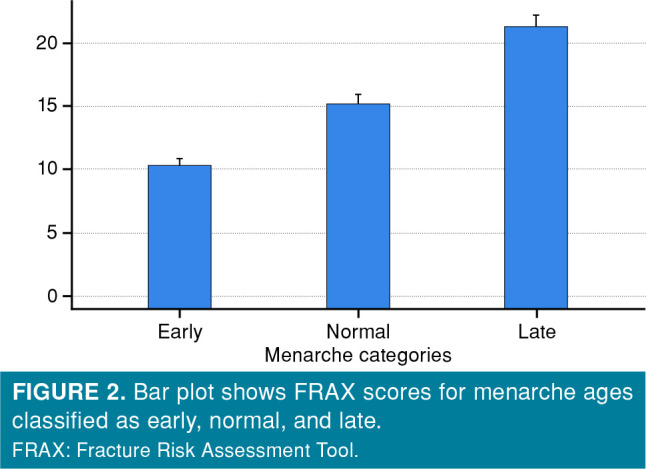
Results: A total of 328 patients (mean age: 64.5±5.8 years; range, 55 to 75 years) were included. The mean FRAX score was 16±8.8 (range, 3 to 58), and 85, 191, and 52 patients were classified as high-, intermediate-, and low-risk, respectively. A positive correlation was observed between FRAX scores and both later age at menarche and earlier menopause (p<0.001 and p=0.008, respectively). The mean age at menopause was significantly different between the high- and low-risk groups (46.4 vs. 49.3 years, p=0.016). The intermediate-risk group was also evaluated, showing no significant differences in obstetric parameters compared to the low-risk group (p>0.05).
Conclusion: Although late menarche is not explicitly included in FRAX, its association with higher fracture risk was evident. The established influence of early menopause on FRAX scores supports its role in fracture risk estimation. However, the inclusion of additional obstetric parameters did not enhance the predictive accuracy of FRAX in this cohort.





 京公网安备 11010802042870号
京ICP备2023020795号-1
京公网安备 11010802042870号
京ICP备2023020795号-1

 分享
分享

 求助内容:
求助内容: 应助结果提醒方式:
 扫码关注我们
